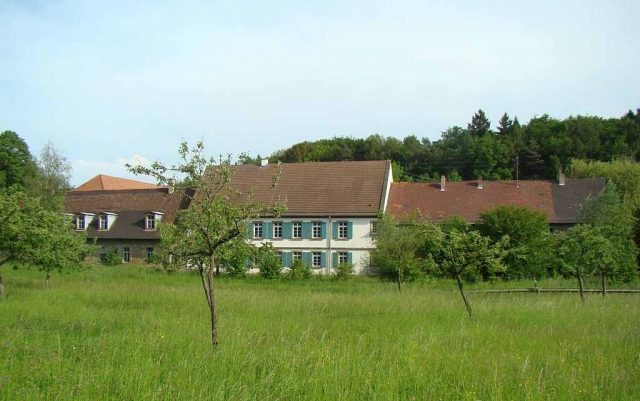
Farm
Odenheim Manor

The Knightly Collegiate Foundation of Odenheim was founded in 1122 near Odenheim as a Benedictine monastery, converted into a secular collegiate foundation in 1494, and relocated to Bruchsal in 1507. In Odenheim, meanwhile, there were still collegiate farms; the old monastery complex was destroyed in the German Peasants' War in 1525 and subsequently used as a quarry for construction projects in the village. The last structural remnants were incorporated into a dairy farm in the 17th century, which, after the destruction of Bruchsal in 1676, again housed the canons and also included two churches. The foundation was dissolved in the course of the Reichsdeputationshauptschluss. Depending on which phase of its existence is meant, the names Odenheim Monastery, Odenheim Collegiate Foundation, Knightly Collegiate Foundation in Bruchsal, or Knightly Collegiate Foundation of Odenheim in Bruchsal are also common.
Founding Years
In 1122, the year of the Concordat of Worms, which was favorable for monastery foundations, Bishop Bruno of Trier and his brother Poppo III of Lauffen founded a Benedictine monastery on the family estates of the Counts of Lauffen, at the foot of the Eichelberg near Odenheim, then still called Wigoldesberg. They endowed it with large possessions, including in Odenheim, Tiefenbach, Aglasterhausen, Großgartach, including the associated churches, waters, mills, serfs, etc. Count Poppo of Lauffen also seems to have donated half of the church in Odenheim (or the right to collect tithes from it). In the very year of its foundation, the rights and possessions of the monastery on the Wigoldesberg were confirmed by Emperor Henry V. Thereafter, the monastery had the right to freely elect its abbot and Vogt.
The original monastery complex, consisting of a monastery church, residential and economic buildings, was built by the same Hirsau workshop that had previously built the Paulinzella Monastery, which is why the complexes in Odenheim and Paulinzella were structurally similar.
In 1161, Emperor Frederick I (Barbarossa) confirmed the extensive possessions of the monastery, especially in the Zabergäu and on the Neckar, but also in Elsenz, Ubstadt, Hambrücken, Bruchsal, Forst, Rettigheim, and Östringen. Many of the possessions are mentioned for the first time in this document, but were probably already part of the founding endowment, but had only been cultivated for the first time since the monastery's foundation (or again after long fallow periods since the Hungarian invasions in 954).
Golden Age around 1200
In 1184, Pope Lucius III allowed the Benedictine abbey to have the pastoral care in the parish church of Odenheim provided by monks. The church, its goods, and its tithe rights were thus incorporated into the monastery. In 1191, Pope Celestine III took the monastery under his protection and made it independent of the mother monastery of the Benedictine order and the Bishop of Speyer. A short time later, the monastery in Kirchheim am Neckar was founded from Odenheim, which was endowed with Odenheim's goods, including the village of Häfnerhaslach.
Around 1200, the monastery experienced its golden age and brought about an economic boom for the entire village of Odenheim. After the extinction of the Kraichgau Counts of Lauffen in the male line in 1219, the Vogtship over Odenheim Monastery passed to the Staufer kings, attested by a document from Emperor Frederick II, and thus became an Imperial Vogtship. However, the document also forbade the construction of castles, fortifications, and the founding of free cities in the monastery's territory, which would later have an unfavorable effect on Odenheim's development, as the village was never fortified or expanded into a city.
From 1225, the (re-)founding of the village of Eichelberg took place from the monastery, where initially there had only been vineyards, but from that year on, these were no longer cultivated by the monastery, but by farmers under hereditary lease. In 1237, Frederick II confirmed further monastic possessions in Waldangelloch, Michelfeld, and Zeutern.
After seemingly continuous growth, the monastery experienced economic problems for the first time in the mid-13th century. Between 1249 and 1261, several sales of goods and rights took place. In 1273, Odenheim received market rights, making the village an important trading center also for livestock and agricultural products from the monastery's operations.
In the early 14th century, the monastery handed over numerous formerly self-managed estates under hereditary lease. Many estates in the immediate vicinity were assigned as agricultural land to several newly built farm buildings in Odenheim. Through the allocation of these farms to serfs or tenants, agriculture flourished. In addition to the old monastery mill (the later Upper Mill), two more mills were built near Odenheim.
Pledging of the Imperial Vogtship to the Prince-Bishopric of Speyer 1330
In 1330, the rulers of the Holy Roman Empire pledged their Vogtship rights over the monastery to Albrecht Hofwart von Kirchheim, who also owned property in Münzesheim. In 1338, the then Bishop of Speyer, Gerhard von Ehrenberg, acquired the protective Vogtship over the monastery and the income from the Kastenvogtei Odenheim for the Prince-Bishopric of Speyer. In 1349, the pledge on Odenheim was linked to the pledges of Landau in the Palatinate and Waibstadt, which were also in Speyer's possession, so that in the future only a joint redemption or re-pledging would be possible. In 1350, the Emperor allowed a partial re-pledging, which the Speyer bishops soon made use of to cover their war costs in those years. Within the fragmented pledge, the former in-kind payments were now financially regulated.
Defensive Expansion of the Monastery Complex from 1377
The political instability and insecurity led to the defensive expansion of the monastery complex under Abbot Dieter von Helmstatt from 1377. Under him, who also acquired the castle and town of Rohrbach am Gießhübel from the Lords of Sickingen, the core complex of the monastery was surrounded by a moat modeled on Rohrbach Castle, and the monastery church received a fortified forebuilding. His successor Dietrich III von Venningen finally had the economic buildings around the monastery walled and the still preserved defensive towers erected around 1400.
Abbot Dietrich II von Angelach acquired the village of Landshausen for the monastery in 1427 from the Lords of Mentzingen, but had to pledge part of the monastery's estates due to the debts accumulated by his predecessors. The following places belonged to the monastery between 1430 and 1440: Odenheim with Tiefenbach and Eichelberg, Rohrbach am Gießhübel, Rettigheim, Landshausen, 9/10 of Großgartach, half of Waldangelloch, and Häfnerhaslach including Kirchheim. Furthermore, the monastery at that time had goods and serfs in various other places, including Östringen, Michelfeld, Eichtersheim, Cleebronn, Elsenz, and Massenbachhausen.
Dietrich II also continued to advance the expansion of the monastery in Odenheim under the influence of the Hussite Wars. He had the monastery's fortifications supplemented with additional gate towers. The expansion was so costly that Dietrich, to cover the costs, sold the monastery in Kirchheim, which had meanwhile degenerated into the abbot's summer residence, to the monastery in Frauenzimmern.
The subsequent abbot, Eberhard II von Flehingen, also had further defensive structures built. In 1461, the fortified complex withstood an attack by Martin Werner von Haberschlöcht.
Conversion to a Knightly Collegiate Foundation in 1494 and Relocation to Bruchsal in 1507
In the last third of the 15th century, with increasing material prosperity, the morals of the monastery monks declined. Several attempts were made by the ecclesiastical authorities to carry out a reform to eliminate the abuses. The first attempt was made in 1468 by the Bishop of Speyer, Matthias von Rammung, and his successor Ludwig von Helmstatt made the second in 1472. All efforts to restore a monastic-ascetic way of life failed. In 1472, Abbot Johann Schenk von Winterstetten, who also failed in this endeavor, resigned his office. His successor Ulrich von Finsterlohe, who had moved from Sinsheim Abbey to Odenheim, succeeded within 14 years in at least reorganizing the hereditary lease relationships of the Odenheim estates. For the large number of documents that were prepared for this purpose, he had an archive building erected in the monastery in 1486. Nevertheless, the monastery had almost no monks left. Under Abbot Ulrich, their number increased from initially two to seven, but monastic life was no longer attractive to later-born nobles. When the few older monks remaining in Odenheim were to be admitted to the Bursfelde Congregation in 1491, four excused themselves due to infirmity, so that ultimately only two monks remained, while the remaining brothers were excluded. The Odenheim convent was reoccupied with monks from the monasteries of Gottesau, Sponheim, and Hirsau.
At the urging of the noble monks and corresponding requests from the Roman-German King and later Emperor Maximilian I, Pope Alexander VI converted Odenheim Monastery in 1494 into a free noble collegiate chapter, retaining all freedoms, possessions, rights, and income. The Knightly Collegiate Foundation consisted of five dignitaries (Provost, Dean, Scholaster, Cantor, Custos) and twelve canons (ten nobles and two doctors or licentiates) as well as seven, later ten, vicars. The name Knightly Collegiate Foundation is due to the fact that most of the canons had to be at least knights.
The monks excluded in 1491 returned to Odenheim, while the newly admitted monks were sent back to their mother monasteries. The last abbot Christoph von Angelach (in office since 1486) thus became the collegiate provost, and the prior became the dean. Christoph von Angelach's successor as provost was Melchior von Nieppenberg, who had been among the monks excluded in 1491. In the Upper Rhenish Imperial Circle founded in 1500, the provost had a seat and vote.
After peasant unrest in the area and legal disputes between Odenheim and the noble Knightly Collegiate Foundation, the latter was relocated to Bruchsal in 1507 at the urging of the canons and by order of the Bishop of Speyer Philipp I von Rosenberg, retaining the name Odenheim and the freedoms, possessions, rights, and income of the foundation. As its seat, he transferred the city church in Bruchsal to the foundation "freely and fully," which received the rank of a Knightly Collegiate Church. This relocation also entailed the loss of Odenheim's market rights. In the Latin school, also relocated from Odenheim to Bruchsal in 1507, the altar servers were trained for choir service.
Thanks to the reorganization of economic conditions carried out only in 1486 under Abbot Ulrich, the relocation of the foundation and the regulation of its relations with the city of Bruchsal proceeded exceptionally quickly.
In 1517, Emperor Maximilian I redeemed the pledged Landau again, while the Odenheim and Waibstadt foundations remained pledged to the Prince-Bishopric of Speyer.
Destruction of the Monastery in Odenheim 1525
During the Peasants' War in 1525, there were also unrest within the territory belonging to the Prince-Bishopric of Speyer. In Odenheim, the old Schultheiß and peasant leader Marx Hovwarth remembered that it had been decided during the relocation of the Knightly Collegiate Foundation to Bruchsal in 1507 to demolish the walls of the old monastery. He therefore directed the peasants following him to the old monastery buildings, which then fell victim to the flames. While part of the buildings would have been demolished anyway, the total loss of the archive, which had only been established in 1486, is particularly regrettable in the destruction of the complex. The peasants primarily wanted to destroy the rent books and tax registers there. However, these were already in Bruchsal, while the old monastery library with countless old books and manuscripts, including probably a copy of the Nibelungenlied and the monastery chronicle, burned with the archive.
In contrast to many other peasant actions in the area, the destruction of the monastery had no legal consequences for the Odenheim peasants. Peasant leader Hovwarth was also pardoned by Bishop Georg von Speyer in 1526.
Subsequently, the ruins of the monastery were used as a quarry for the construction of buildings in Odenheim. Stones from the monastery were used in the church in Odenheim, which was renovated in 1543, as well as in the rectory built shortly thereafter and in the hunter's house. Even entire cellar vaults were dismantled in the monastery and rebuilt in the village.
In 1569, with the completion of the Odenheim administrative building, the administration of the monastery's property and agriculture was moved to the village. For the construction projects in Odenheim, the foundation sold the village of Rettigheim to Bishop Philipp II of Speyer in 1546. The foundation raised further funds from newly created taxes, such as the Umgeld on tavern wine levied in 1588. Due to such taxes, but also due to reformatory activities in Odenheim, unrest occurred around 1600, which led to an occupation of the Odenheim lordship by the Electoral Palatinate from 1609 to 1615.
Construction of the Stifterhof in Odenheim 1671
After the destructions of the Thirty Years' War, Provost Heinrich Hathard von Rollingen († 1719) ordered in 1671 the construction of a dairy farm in the old monastery courtyard of Odenheim. Parts of the defensive walls and storage buildings were still present; a single-nave Peter and Paul Church and residential buildings were added. After the destruction of Bruchsal by the French in 1676, the canons also temporarily returned to Odenheim and had a prelature and a small Marian chapel built in the monastery courtyard. The old archive building was converted into a knight's hall.
Secularization 1802/03
In 1802/03, the possessions of the Knightly Collegiate Foundation fell to Baden in the course of secularization on the Upper Rhine. The church and prelates' chapel were demolished. Today, a manor house and two towers of the medieval complex can still be seen.
Abbots+
- Eberhard (1122–1146?)
- Heinrich (1146–1157?)
- Burkhard (1157–1190?)
- Siegfried (1190–1213)
- Berengar (1213–1224?)
- Deinhard (124–1245?)
- Heinrich II. (1245–1275?)
- Albert von Michelfeld (1275–1313?)
- Morhardt (1313–1325?)
- Burkard Röder (1325–1341?)
- Dietrich (1341–1365?)
- Dietrich II. von Ubstadt (1365–1377?)
- Dieter von Helmstatt (1377–1398)
- Dietrich III. von Venningen (1398–1424)
- Dieter II. von Angelach (1424–1445?)
- Eberhard von Flehingen (1445–1458?)
- Philipp von Flehingen (1458?–1468)
- Johann Schenk von Winterstetten (1468–1472)
- Ulrich von Finsterlohe (1472–1491)
- Christoph von Angelach (1491–1503)
Canons+
- Christoph von Angelach († 1503) last abbot of Odenheim Monastery, who was granted the abbacy in 1486 and who, after the conversion into a free noble Knightly Collegiate Foundation in 1494, presided over it as its first provost until his death in 1503.
- Melchior von Nieppenberg, provost from 1503, under whose leadership the relocation to Bruchsal took place in 1507
- Philipp Christoph von Sötern (1567–1652) was provost of the foundation in 1607, cathedral provost in Trier and cathedral scholaster in Mainz
- Karl Eugen von Zobel von Giebelstadt (* April 26, 1795; † May 7, 1760), sworn in on October 6, 1789, joined the chapter there on May 8, 1793, he came from the Zobel von Giebelstadt family
- Emmerich Carl von Schütz zu Holzhausen († July 9, 1833; age: 67 years)
Bailiffs+
- until 1549 Thomas Schnee
- 1581–1598 Ulrich Ernst Ruff
- 1602–1609 Johann Conrad Vogell
- 1613 Melchior Vögler
- 1614–1619 Adam Hertzog
- 1626–1631 Johann Christoph Brüning
- 1655 Salomon Buchinger
- 1673–1702 Henrich Henrici
- 1702–1725 Johann Gottfried Henrici
- 1731–1755 Anton Philipp Bauer
- 1755–1776 Franz Christoph Fick
- 1776–1803 Theodor von Meßbach
Take Mobile History with you
You are reading this text for free. Premium adds what matters on the road: descriptions read aloud, sites found through your camera, whole regions taken offline.
- Every description, including the ~17,700 Premium sites
- Audio guide: have descriptions read to you on location
- AR finder: see sites through your camera, with distance and bearing
- Unlimited saved sites
14 days free, then from €2.99 a month. Cancel anytime.
Source: Wikipedia · Licence: CC BY-SA 4.0 · Image: http://commons.wikimedia.org/wiki/File:Odenheim-stifterhif-kloster5.jpg
This description draws on the facts documented in the linked Wikipedia article; Wikipedia content is licensed under CC BY-SA 4.0. Wording and editing: Mobile History.
Location: 49.1841, 8.7763