Museum
Olbernhau Manor
The Rittergut+
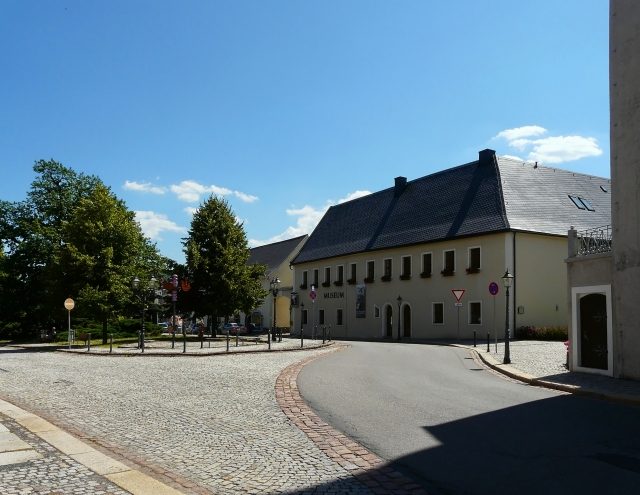
In 1654, Elector Johann Georg II transformed the former feudal estate into the Rittergut. At this time, it was the seat of the Oehmichen family. At the end of the 19th century, it came into the possession of Albert Lange and finally, in 1933, into that of the city of Olbernhau. In 1956, the "Haus der Heimat" (House of the Homeland) was established in the former manor house - renamed "Museum Olbernhau" in 2004.
The Manor House+
The manor house is a two-story building with a hipped roof, built in the Renaissance style. It was extensively renovated in the 18th century, with the addition of baroque elements. The interior features a grand staircase, stucco ceilings, and a historic tiled stove.
The Estate+
The Rittergut complex includes several outbuildings, such as a barn, stables, and a forge. These buildings were used for agricultural purposes and to support the daily operations of the estate. Today, some of these buildings have been converted for modern use, while others are preserved as historical monuments.
History of the Owners+
The Rittergut has a rich history of owners, each leaving their mark on the property. The Oehmichen family, who established the Rittergut, were influential in the region. Later owners, such as Albert Lange, contributed to the estate's development and modernization. The city of Olbernhau's acquisition in 1933 marked a new chapter, leading to its transformation into a cultural institution.
The Oehmichen Family+
The Oehmichen family played a crucial role in the early history of the Rittergut. They were responsible for its transformation from a feudal estate and established its prominence in the area. Their legacy is still visible in some of the architectural features of the manor house.
Albert Lange's Influence+
Albert Lange's ownership at the end of the 19th century brought significant changes to the Rittergut. He invested in modernizing the agricultural operations and made improvements to the manor house. His period of ownership represents a transition towards more contemporary estate management.
The City of Olbernhau+
Since 1933, the city of Olbernhau has been the owner of the Rittergut. This ownership led to its transformation from a private estate into a public cultural and historical center. The establishment of the "Haus der Heimat" and later the "Museum Olbernhau" reflects the city's commitment to preserving and sharing its heritage.
The Museum Olbernhau+
The Museum Olbernhau, formerly known as the "Haus der Heimat," is dedicated to preserving and presenting the history and culture of Olbernhau and the surrounding region. It houses various collections, including local history, traditional crafts, and folk art. The museum serves as an important educational and cultural hub for the community.
Exhibitions+
The museum features permanent and temporary exhibitions that showcase different aspects of local history and culture. These exhibitions cover topics such as mining, woodworking, traditional costumes, and the daily life of the region's inhabitants throughout the centuries.
Collections+
The collections of the Museum Olbernhau include a wide range of artifacts, from historical documents and photographs to tools, furniture, and works of art. These collections provide valuable insights into the social, economic, and cultural development of the region.
Educational Programs+
The museum offers various educational programs for schools and the general public. These programs aim to engage visitors with the region's history and traditions through guided tours, workshops, and interactive activities. The museum plays an active role in promoting cultural education.
Architectural Features+
The Rittergut's architecture is a testament to its long history, blending Renaissance foundations with Baroque additions. The manor house, in particular, showcases these stylistic evolutions, reflecting the tastes and trends of different eras. The preservation of these features is crucial for understanding the building's historical significance.
Renaissance Elements+
The original Renaissance structure of the manor house is evident in its robust construction and certain decorative details. These elements speak to the architectural styles prevalent in the 17th century when the Rittergut was established. The overall layout and some window frames still hint at this early period.
Baroque Additions+
The 18th-century renovations introduced significant Baroque elements, which softened the earlier Renaissance austerity. These additions include more ornate stucco work, a grander staircase, and possibly changes to the roofline and facade. These modifications reflect the changing aesthetic preferences of the time.
Preservation Efforts+
Ongoing preservation efforts aim to maintain the architectural integrity of the Rittergut. These efforts involve careful restoration of historical features, structural maintenance, and adherence to conservation principles. The goal is to ensure that future generations can appreciate the building's unique architectural heritage.
Take Mobile History with you
You are reading this text for free. Premium adds what matters on the road: descriptions read aloud, sites found through your camera, whole regions taken offline.
- Every description, including the ~17,700 Premium sites
- Audio guide: have descriptions read to you on location
- AR finder: see sites through your camera, with distance and bearing
- Unlimited saved sites
14 days free, then from €2.99 a month. Cancel anytime.
Source: Wikipedia · Licence: CC BY-SA 4.0 · Image: Thomas Eichler
This description draws on the facts documented in the linked Wikipedia article; Wikipedia content is licensed under CC BY-SA 4.0. Wording and editing: Mobile History.
Location: 50.6609, 13.3351