Cultural Events
To be privately owned
Sieversdorf Manor

Sieversdorf was owned by the von Strantz family until 1777, when Royal Major Bogislaw Ehrentreich Wilhelm von Strantz, lacking heirs, sold Sieversdorf to Royal Privy Councillor Ludwig von la Motte. He only kept the village for a short time; in 1782, the von Rohr family acquired the property, and after von Rohr's death, it came into the possession of Royal Chief Bailiff Philipp Heinrich Karbe (1743-1799) in 1789, who was the tenant of the Royal domains of Chorin and Gramzow. After the Chief Bailiff's death in 1799, it was administered under guardianship, and in 1809, his son Friedrich Ernst Leopold Karbe became the hereditary lord of Sieversdorf. After his death in 1857, his eldest son Carl Friedrich Ferdinand Leopold Karbe inherited it, and he is presumably responsible for the alterations to the castle and the redesign of the park.
Karl Julius Wilhelm Ewald von Stünzner-Karbe of Sieversdorf (1872–1934) was the manor owner from 1894, as his uncle, Ferdinand Karbe (* February 22, 1825, in Clauswalde; † March 11, 1891, in Berlin), a member of the Prussian Landtag and owner of the manors of Clauswalde and Sieversdorf, died unmarried and childless. The children of his brother-in-law Benno Karl Ewald von Stünzner were appointed as heirs. A further redesign of the garden was planned by his descendants in 1944, and gardener Georg Potente was invited for garden consultation on March 10, 1944. Measurements were taken at the end of November and design drawings were made at the beginning of December 1944, but the execution was prevented by the circumstances of the Second World War and the subsequent expropriation.
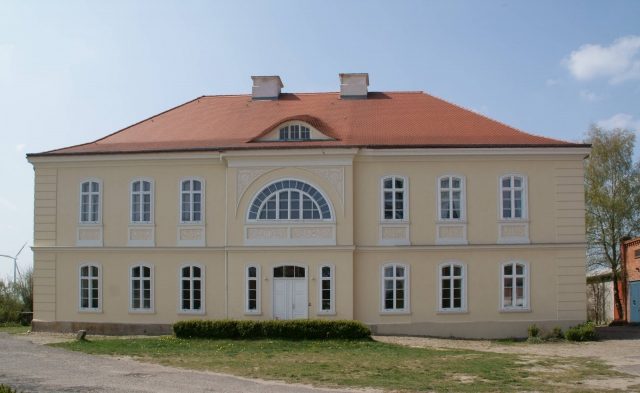
The rectangular, two-story plastered building with a central risalit and nine axes, built in 1689, was the center of the estate for 250 years. Equipped with baroque stucco ceilings, attributed to the Simonetti family, a hall on the first floor, and a baroque fireplace mantel, it was partially rebuilt and extended in the 19th century under Friedrich Ernst Leopold Karbe.
The large half-moon window in the middle of the building is a result of the taste of Gilly, a predecessor of Schinkel.
One wing of the house contained the "Black Kitchen," above which were guest rooms and a retirement residence for the family.
In the course of the land reform, the estate was expropriated in 1945, and half of the manor house was demolished in 1947/1948. In 1993, the von Stünzner-Karbe family was able to reacquire and renovate the property. The three demolished axes were rebuilt, and the roof, baroque hall, and staircase were renovated. Since 1994, regular concerts with renowned artists, organized by the Association for Art and Monument Preservation, have taken place in the baroque hall. In 2006/2007, the old form was restored using EU funding, and it now houses a Bed & Breakfast. The old courtyard complex contains the Scheffler organ workshop and the Golem art and building ceramics, with a small park adjacent.
Take Mobile History with you
You are reading this text for free. Premium adds what matters on the road: descriptions read aloud, sites found through your camera, whole regions taken offline.
- Every description, including the ~17,700 Premium sites
- Audio guide: have descriptions read to you on location
- AR finder: see sites through your camera, with distance and bearing
- Unlimited saved sites
14 days free, then from €2.99 a month. Cancel anytime.
Source: Wikipedia · Licence: CC BY-SA 4.0 · Image: Jörg Dorowski
This description draws on the facts documented in the linked Wikipedia article; Wikipedia content is licensed under CC BY-SA 4.0. Wording and editing: Mobile History.
Location: 52.3785, 14.3710