Cultural facilitie
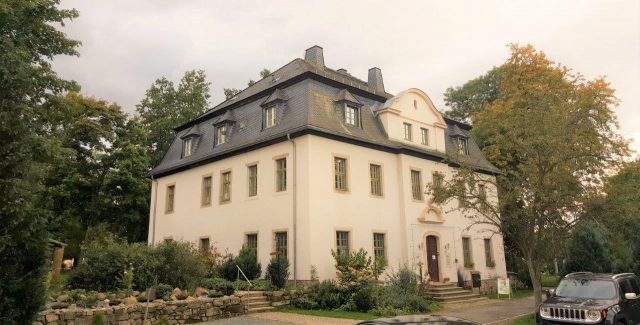
Unterlauterbach Manor

Lauterbach is first mentioned in a document from May 1416. The brothers Hans, Georg, and Heinrich von Machwitz are named as owners. Franconian settlement had already begun in the 12th century and certainly reached Lauterbach before 1400. In the pond system opposite the manor house, the "Bühl" - the protective island - of a ring fort from the initial settlement can still be seen today. Further documentary mentions occurred in 1421 and 1436. On August 23, 1436, Landgrave Friedrich the Younger of Thuringia lent "Nickel von Machwitz and his sons Unterlauterbach, with upper and lower courts as the Molstorffers had previously possessed." Various documents refer to the place as "Lutirbach" until 1436, "Luterbach" in 1470, and "Lauterbach" in 1485. Since 1445, the Unterlauterbach manor has been mentioned as a knight's seat.
In 1537, the manor passed into the possession of Eberhard von Feilitzsch zu Treuen and remained in the possession of this family for a long time. In 1724, the brothers Major Friedrich von Obernitz and Lieutenant Colonel Karl-Heinrich von Obernitz acquired it. By 1744, the manor was run down and came "subhasta," for forced sale.
According to family history, Georg Adler and his cousin Wolf Adam Adler acquired the manor on March 24, 1744. They may have initially been tenants until the official execution of the purchase agreement. The Chemnitz State Archives records the following under 30840 Unterlauterbach: "...after we acquired the noble Obernitz manor Unterlauterbach before the Royal Polish and Electoral Saxon Office in Plauen subhasta, and it was also adjudicated by most gracious command and granted as a fief, done in Unterlauterbach, June 28, 1746."
With this acquisition and the purchase of further manors, the successful 200-year family history of the Adlers in Vogtland began. The Adlers belonged to exiles who, in the course of religious conflicts after the Reformation, were expelled from Habsburg lands and immigrated to the Protestant Vogtland via the Upper Palatinate or the Egerland at the beginning of the 17th century. The families spread from the south across the entire Vogtland. Among them were lawyers, pastors, and farmers. The manor owners were each patrons of St. Bartholomew's Church in Treuen. Christian Gottfried Adler was appointed to the 1st Chamber of the Saxon Landtag in 1787.
Lauterbach was located at an important crossroads. South of the village area, two important transport routes crossed since the late Middle Ages - the "Kärrnerweg" (carter's path), on which "Hällisches Saltz" (salt from Halle) was carted from Halle to Eger and Bohemia, and the west-east settler's road Hof-Plauen-Schneeberg. These road connections not only brought significant economic advantages but also caused severe burdens for the population during armed conflicts, especially due to marauding soldiers and stray gangs. It was the Hussite Wars, the Wars of Religion in the 16th and 17th centuries, Napoleon's Russian campaign, and finally the occupation after World War II, that caused damage and suffering to the population.
In this ambivalent location, the manor and the small village of Unterlauterbach developed. Initially as an outwork of the Treuen manor, along with subjects and cottagers. From a core building of the settlement period, the feudal manor house was erected in 1511 through reconstruction and expansion. A bronze plaque with an inscription from this period indicates the structural expansion. The farmyard was trapezoidal and, together with the manor house, formed a four-sided courtyard. Until the 17th century, the road connection passed through the courtyard via a northern entrance gate with a turret and a southern exit gate. Only a narrow path ran outside the estate directly on the west side.
In 1885, a large part of the farmyard burned down. Most of the livestock could be saved with the help of the population, and the manor house was spared from the fire. Bernhard Adler rebuilt the farmyard by 1890 in the form and size still visible today. The two-story rectangular courtyard with farm, stable, and barn buildings in solid construction - with granite surrounds on the openings - was built approximately one-third larger. At the same time, the manor park was also expanded into its current form in the style of an English landscape park.
The estate always included a series of ponds in the estuary of the Lauterbach into the Trieb, which served the fish industry. By enlarging the pond of the original ring fort, the mill pond was created primarily for operating the water mill. Furthermore, the manor included approximately 200 hectares of mountain forest with the Butterberg (471 m) and the Knock (581 m). In 1861, a burial site was established northeast of the estate. This family burial ground was dismantled for material procurement during the land reform and gradually destroyed. The last remnants were completely removed after the privatization of the forest about 3 years ago. Remains of the grave cover can still be seen in the coach house building of the manor.
Carl Ferdinand Adler, the last owner of the Unterlauterbach manor, had already leased the estate in 1923. He managed and lived in the Straßberg manor. In 1936, he was forced to sell 70 hectares of the Straßberg estate to the German Wehrmacht for the expansion of the Plauen military training area. The remaining areas of the Straßberg estate were acquired by the Saxon Farmers' Settlement Dresden and 4 other smaller farmers. As a result of this development, C. F. Adler then expanded, renovated, and modernized the manor house in Unterlauterbach and moved there embittered in 1939.
On July 20, 1944, C. F. Adler turned 80, and in the same year, according to the family chronicle, the Unterlauterbach manor had been in the possession of the Adlers for 200 years. The mayor and councilors congratulated him on the anniversary and presented a painting of the manor house, painted by the Leipzig artist Walter Hinze. C. F. Adler lived in the manor house from the end of the war until his death in 1948.
Already on April 17, 1945, American combat troops had entered the village. After minor skirmishes in the region, they withdrew from Unterlauterbach and finally occupied it on May 6. Due to the agreements of the Potsdam Agreement, Soviet troops replaced the Americans as the occupying power on July 2, 1945.
The Fate of the Manor Complex from 1945 to the End of the GDR in 1990
Following the example of the Soviet Union, all landholdings over 100 hectares were expropriated without compensation in the Soviet Occupation Zone in 1945. To implement this land reform, a land reform commission was founded in Unterlauterbach on April 1, 1946. The task was to divide the expropriated manor property, including forest, totaling 289 hectares. Six new farmsteads of 10 hectares of agricultural land and 2 hectares of forest each were created. For four new farmsteads, the farmyard was divided according to the intended use.
The enclosed courtyard development was deliberately destroyed by structural boundary distances. It was certainly not an orderly procedure, but rather the rapid creation of new farmsteads, entirely in the spirit of political ideology. For this purpose, stables and barns were built or prepared from the existing buildings through demolition, conversion, etc. The remaining agricultural areas of the manor were distributed to land-poor farmers, other settlers, and the municipality of Unterlauterbach. The largest part of the forest went to the state of Saxony. The manor house with its park was transferred to the municipality of Unterlauterbach on April 30, 1947. Thus, Carl Ferdinand Adler's landholding was divided and expropriated without compensation by letter from the district administrator dated October 1, 1945.
C. F. Adler then wrote to the Land Reform Commission: "...to leave him, his daughter, and granddaughter a farm of about 70 hectares and about 20-30 hectares of forest, as he was an opponent of the Nazis and had already been severely damaged by the forced sale of his Straßberg estate."
He was unsuccessful. Another attempt to keep "...the manor house and garden..." as a substitute, which still housed about 30 refugees, also failed. However, C. F. Adler and his family escaped eviction from the manor house and also forced deportation to Rügen. His granddaughter Edith Bayerlein, née Landmann, and the long-time tenant Oskar Delling were granted a new farmstead on the manor grounds.
A small episode prevented the demolition of the manor house. The manor house, as usual, had house number 1, when the order from the Soviet Military Administration (SMAD) came to demolish building No. 1. Over 30 people, including many refugees, were housed in the manor house. The officials found it irresponsible to carry this out. They tried a trick and swapped house number 1 of the manor house with that of the forester's house. Then, the rather insignificant 1½-story forester's house was dismantled as house number 1 accordingly. The trick was successful. No negative consequences of the trade became known. Respect to those responsible at the time!
The changes brought about by the land reform were followed by the effects of the collectivization of agriculture. This resulted in the spontaneous fragmentation of the manor complex and, due to neglect and lack of interest, a deterioration of the buildings, decay, and finally partial demolition. In 1989, only parts of privately managed buildings and the manor house remained of the manor complex; the rest had collapsed and/or was still being demolished, and sheds and barns from the new farmer era stood in the middle of the former courtyard.
Reconstruction of the Manor Complex through Renovation, Modernization, and New Construction since German Reunification in 1990
In 1990, the municipality of Oberlauterbach owned the manor house and the manor park in the district of Unterlauterbach, as well as the buildings of the new farmer Oskar Delling. Both buildings were inhabited. The manor house also housed the "Heimatstube" (local history room) of the cultural association and an "LPG Consultation Center." After the fall of the Berlin Wall, the municipality sold the former estate manager's house and rented the rooms of the LPG Consultation Center to an architectural firm. In addition, the operators of the firm acquired vacant courtyard buildings of a former new farmstead.
Following a municipal council resolution, the architectural firm was commissioned with the planning survey according to the conditions of the Office for Rural Reorganization (ALN) and the creation of a local development concept. With the local development concept, it was possible to submit funding applications to the ALN for the renovation and modernization of buildings, as well as the partial restoration of historical buildings, within the framework of the village renewal program. The first application for funding from 3 owners of the manor complex was approved by the ALN simultaneously. These first renovation measures began in 1992 (Fig. 10) and were completed as early as 1993. These renewal measures were convincing and also encouraged further work in this direction to rebuild the rest of the manor complex. At the same time, the municipality had the mill pond desilted and approximately 50,000 m3 of excavated material deposited very close to the site and used for the development of a biotope. The Saxon State Ministry for Agriculture, Food, and Forestry honored all these achievements with an award in 1994.
In addition, the former milk house was acquired privately from the Federal Property and Treuhandgesellschaft. By the end of 1995, this very dilapidated building had already been renovated and converted and could be used as an architectural office with an apartment. In the meantime, it has also been expanded with a gastronomic establishment, Bistro "Die Hofstub" (open Wed - Sun from 12 pm) for visitors to the manor complex and the Unterlauterbach pond landscape. The municipality had the manor park developed for use as a festival ground. Necessary sanitary facilities were built for events and festivals, such as the popular annual park festival. The open-air theater dating from the post-war period was renewed in its function and design to be contemporary. A severe storm had severely damaged the park in 2006, but it was quickly redesigned and in 2008 its tree population was completely renovated and its path system entirely renewed.
Concluding Remarks
After the completion of the joint renovation and reconstruction measures, the first manor festival was held on Ascension Day in 1994 by the newly founded association for the preservation of the Vogtland Umgebindehaus and with the support of the municipality. The public's response to this family festival was surprisingly large; about 2,500 visitors came. It was a festival with craftsmen and artisans, artists, lace makers, bookbinders, a painting exhibition in the cultural floor of the coach house building, and of course with coffee and cake, grilled food, beer, wine, and juices, as well as live music from the "Rodewischer Tanzkapelle." All of this motivated the association to repeat this festival annually. Due to construction work, it was temporarily moved to the manor park in 1999 and carried out by the municipality. In the meantime, the manor festival has long been held again in the courtyard of the Adlershof manor. For Ascension Day 2011, the 18th manor festival is already being invited.
After consultation with the responsible authorities and the assurance of the provision of eligible funding for the construction of the Nature and Environment Center, the municipality began planning in 1998 and, after approval, with the construction work to close the eastern gap of the manor complex. The eastern gap is the area of the former cow shed between the milk house and the estate manager's building. A 2-story solid building with a converted attic was erected on a floor area of 630 square meters, adapted to the historical buildings in a contemporary manner.
In 2000, the Nature and Environment Center of the Vogtland district moved into the now renovated manor house. After the completion of the eastern gap, the further urgently needed premises could be occupied in 2004. In the new building, workshops, also for course participants, rooms for work equipment, covered lecture and event areas with an info and sales room were set up on the ground floor. On the upper floor, there is a large lecture and event hall, a small hall, further meeting rooms, as well as the kitchen with storage rooms and the nature hostel with over 30 overnight accommodations. This extensive range of rooms is necessary for carrying out the demanding educational program for children and adult education. Furthermore, beekeeping is practiced in the manor park with a beehive. In the "Lauterbacher Teiche" landscape protection area, a 3-language marked nature trail with resting areas and shelters has been created.
The many efforts by both private and municipal parties in the reconstruction of the entire Adlershof manor complex have often been mentioned and honored in the press, and awarded within the framework of the "Our village should be more beautiful" competition. In the competition for the European Village Renewal Award 2006, Oberlauterbach received a recognition award for special achievements in the field of village development. The justification highlighted the following: "The place convinces with comprehensive infrastructure measures, the revitalization of the Adlershof manor with the integrated Vogtland Nature and Environment Center, the revival of various festivals, the high proportion of self-performance in project implementation, and the creation of community facilities to improve socio-cultural and social qualities."
The subsequent integration of the upper and middle Triebtal into the Erzgebirge/Vogtland Nature Park was an important prerequisite for the establishment of the Nature and Environment Center (NUZ) of the Vogtland district in the Adlershof manor. The very sensitive natural area of the "Bergener Becken" with the "Lauterbacher Teiche" landscape protection area will also convey an understanding of nature and environment to future generations. The foundation for this has been laid through the efforts of many committed citizens with the support of municipalities, offices, and other state institutions. The complete completion of the manor complex with the construction of the remaining barn and the intermediate building on the village street, as well as a manor-appropriate and -adequate expansion of the courtyard complex, is foreseeable.
In conclusion, it can be stated that, in view of the ruinous fate of numerous manor complexes in the Saxon Vogtland after 1945, about which Seffner (2002) has meritoriously provided information, the efforts to rebuild the Adlershof manor in Unterlauterbach after German reunification have shown visible successes. The current use of the renovated buildings and their surroundings has triggered a supra-local appeal, with the "Vogtland Nature and Environment Center" in particular attracting attention with its event, viewing, and accommodation offers. The center, housed in the former manor house, is open Mondays, Tuesdays, Thursdays from 9 am to 4 pm, and on other days by appointment (Tel.: 03745/751050). The institution also presents itself on the internet at www.nuz-vogtland.de.
Take Mobile History with you
You are reading this text for free. Premium adds what matters on the road: descriptions read aloud, sites found through your camera, whole regions taken offline.
- Every description, including the ~17,700 Premium sites
- Audio guide: have descriptions read to you on location
- AR finder: see sites through your camera, with distance and bearing
- Unlimited saved sites
14 days free, then from €2.99 a month. Cancel anytime.
Location: 50.5004, 12.3084