Cultural Events
ManorStuhr - Varrel
Varrel Manor
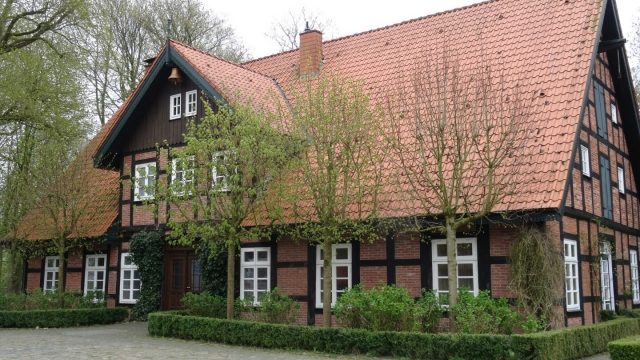
The Varrel Estate in Stuhr, An der Graft 3, dates back to the 14th century. The current buildings were constructed between the 18th and 20th centuries. The estate, located on the Varreler Bäke waterway, is now an event and cultural center for the town. The ensemble is a protected monument.
History+
Henry the Lion of Bavaria and Saxony concluded a treaty with the Archbishop Balduin I of Bremen in 1171 for the settlement of Stuhr. In their service was the landed knight Friedrich von Mackenstedt, who was allowed to sell the Bruch between Brinkum, Mackenstedt and Huchting according to Hollerrecht. According to a document from 1289, Archbishop Giselbert of Bremen permitted the Heiligenrode monastery to establish "new clearings in the ... desolate places Stelle and Verlebrinc (Varrel)". In 1381, Count Otto IV (Oldenburg-Delmenhorst), who was a vassal of the Archbishopric of Bremen, granted permission for the founding of the Varrel monastery estate. The estate was managed by monastery farmers. In 1581, as part of the secularization, Count Anton I of Oldenburg took over the Varrel monastery estate, which was now managed as a comital estate by a Meier. In 1606, Count Anton had the monastery stream – today Varreler Bäke – dammed and a water mill built as a copper mill, which was sold in 1655 to the master coppersmith Berndt Pundt. Pundt was the first civilian owner of the estate. In 1976, the municipality of Stuhr bought the estate from the widow Dora Meyer. The Förderverein Gut Varrel from 1980, with currently (2022) around 580 members, renovates, builds and maintains the complex. It publishes the Varreler Gutspost.
Buildings+
The complex consists of:
Manor house from around 1800: single-story brick-faced half-timbered house with stone infill and a two-story gabled projection at the entrance area; oldest and often rebuilt building of the estate, renovated from 1985 Mill building: two-story brick-faced water mill from 1904 with a roof house and loading facility, used as a copper mill, soon after a fulling mill for loden cloth; previously: first mill from 1798 with a grinding and a saw mill, which burned down in 1903; today: used by TuS Varrel as …
Source: Wikipedia · Licence: CC BY-SA 4.0 · Image: Jörg Heldt
This description is a machine translation of an excerpt from the linked Wikipedia article. The source text was written by its authors, the translation is by Mobile History; like the original it is licensed under CC BY-SA 4.0.
Location: 53.0318, 8.7064