ManorCoppenbrügge - Marienau

Voldagsen Manor
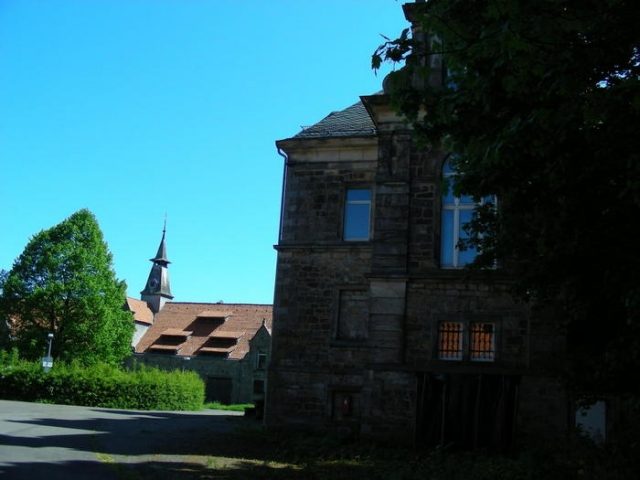
Voldagsen Manor

To be privately owned

The Voldagsen Manor is an agricultural building complex with a Neo-Renaissance style manor house and an extensive park. It is located in the Marienau district of the municipality of Coppenbrügge (Hameln-Pyrmont district) in southern Lower Saxony. A enfeoffment of the estate by the Counts of Spiegelberg was first documented around 1350. During its feudal history, the Voldagsen Manor was owned by the noble family Münchhausen for over 200 years until 1878. From 1945 to 1955, it housed the Erwin-Bauer-Institut, a research facility of the former Kaiser Wilhelm Society, now the Max Planck Society. From 1956 to 1996, the manor house was home to a training center of the Federal Association for Self-Protection. Today, the Voldagsen Manor is once again in private ownership. The entire ensemble with manor house, farm buildings, lake, and park is a protected monument.

Voldagsen is located in the eastern Weserbergland of Southern Lower Saxony, in the middle of the valley between the Osterwald ridge and the northern end of the Ith. The manor itself is situated at an altitude of 131 m above sea level, 18 km east of Hameln and 20 km south of Springe and Bad Münder am Deister. The Aue, a river about 9 km long, flows over part of the property, supplying the lake belonging to the park and emptying into the Saale near Benstorf-Quanthof.

South of Voldagsen, not far away, is Federal Highway 1, which leads west via Coppenbrügge to Hameln and east via Elze to Hildesheim. Voldagsen has its own train station, which belongs to the Elze-Löhne railway line and the Weser-Bahn. This means Voldagsen can be reached hourly by train from both Hannover and Hildesheim. Currently, this section of the line is operated by NordWestBahn. Voldagsen is part of the Ith-Schleife, a cycling path newly inaugurated in 2012. The Kansteinweg, an approximately 83 km long hiking trail from Hannover to Alfeld, also passes by the Voldagsen Manor.

The place name Voldagsen goes back to a man named "Volktag" who was enfeoffed with the estates. A suffix -hausen, in the shortened form -sen, is appended as the base word. This comes from the Old Norse word hus, which denotes a fixed dwelling built with a house. In the Middle Ages, Voldagsen also had the spellings Voldaghausen and Voldagessen. Designations with F instead of V, such as Foldagusheim, Foldaghusen, and Foldagsen, are also verifiable.

In its history, the Voldagsen Manor belonged to various feudal lords and was inherited multiple times. Voldagsen first belonged to the County of Spiegelberg, which was established in 1281 under Count Moritz I of Spiegelberg with the main town Coppenbrügge and the ancestral seat at Coppenbrügge Castle. When the last male descendant, Count Philipp of Spiegelberg and Pyrmont, fell in the Battle of Saint-Quentin in 1557, the county was inherited in the female line, subject to the sovereignty of the Duchy of Brunswick and the associated Principality of Calenberg, by a collateral line of the House of Lippe. When Count Simon of Lippe died in 1583, the inheritance passed to the Counts of Gleichen. With the death of Count Hans Johann Ludwig of Gleichen-Tonna in 1631, this comital family also died out in the male line, and the Spiegelberg fiefs passed to Nassau-Diez. From 1702, Nassau-Diez belonged to the House of Orange, the still-reigning royal house of the Netherlands. It was not until 1819 that they sold the Spiegelberg County to the Kingdom of Hanover, which was annexed by Prussia in 1866 as the Province of Hanover.

Bock von Nordholz (1350–1628)

The first documented feudal tenants of Voldagsen were the Bock von Oldendorf, a collateral line of the Bock von Wülfingen. The Bock von Oldendorf were castle men in the service of the noble lords of Homburg at their ancestral seat, the Homburg near Stadtoldendorf. Through many years of loyal service to various feudal lords, the Bock von Oldendorf were able to further expand their feudal possessions in the region. Around 1285, they built their own ancestral seat, Nordholz Castle, south of Marienau on the slope of the Ith. From 1286, they were mentioned as Bock von Nordholz in a document of the Homburgers.

Around 1350, they appear as feudal tenants of Voldagsen in a document of the Counts of Spiegelberg. At that time, Voldagsen still consisted of two separate Meierhöfe (farmsteads), which were subsequently expanded into Sattelhöfe (larger farmsteads with feudal rights). During the Hildesheim Diocesan Feud, Nordholz Castle was destroyed in 1521 and had to be evacuated. The Bock von Nordholz then chose Voldagsen as their new ancestral seat. During this period, the Oberhaus (the present manor house) was converted into a moated castle.

Until 1628, the Bock von Nordholz were able to hold the Voldagsen fief as their ancestral seat and their possessions in the region. These extended from Lauenstein to Lechstedt east of Hildesheim. Even today, the family crest of the Bock von Nordholz can be seen on one of the farm buildings on the inner courtyard side. With the death of Christoph Dietrich Bock von Nordholz in 1628, the lineage ended in the male line.

Takeover by the von Münchhausen (1628–1878)

The Bock von Nordholz and the noble family Münchhausen had been connected since 1517. From 1517 to 1521, they were joint pledgees of Aerzen Castle. When it became apparent that the last two male family members of the Bock von Nordholz would probably have no more male descendants, Hilmar the Younger von Münchhausen acquired a claim to the Voldagsen fief from the Counts of Gleichen and Spiegelberg for 2000 Thalers as early as Easter 1613.

Christoph Dietrich Bock von Nordholz had two sisters who lived on the Voldagsen estate. With a letter dated June 21, 1619, he had secured a life annuity for his sisters from the Duke Friedrich Ulrich of Brunswick, then the supreme feudal lord of Voldagsen. This meant they had the right to continue living there, even if the fief passed to a new owner. In addition, there were disputes over jurisdiction in the re-allocation of the fief and debts that Christoph Dietrich Bock von Nordholz had left to his sisters. This led to the Münchhausen family being awarded the Voldagsen Manor only in 1655 after a lengthy legal dispute through a settlement.

In an inheritance settlement with his brothers, Johann von Münchhausen (* June 24, 1629 in Rinteln; † December 8, 1714 in Germsee) received Voldagsen and moved into the estate in 1657. He rebuilt the manor, which had lain fallow since 1628 and was in very poor condition. The coat of arms stones of Johann von Münchhausen and his first wife Wilhelmine Osterheld von der Wense are dated to 1665 and mark the completion of the reconstruction of the estate.

Johann von Münchhausen had a chapel built next to the manor house, which was completed in 1661. Johann von Münchhausen had a total of 10 children from three marriages. In the vault beneath the chapel, his sons Johann († 1661), Börries Wilhelm († May 14, 1697) and Johann Friedrich († October 9, 1722), his daughter Albertina († March 10, 1697), as well as his first wife Wilhelmine Osterheld von der Wense († July 10, 1676) were buried between 1661 and 1722. The exact location of the chapel can no longer be determined today.

Several generations later, Otto Friedrich Julius von Münchhausen (* April 28, 1754 in Schwöbber; † April 2, 1828 in Schwöbber) began to convert the Voldagsen estate into its present form. The construction work was completed by his son August Friedrich Gottlob Freiherr von Münchhausen (* May 21, 1798 in Schwöbber; † March 3, 1861 in Schwöbber) in November 1838. He also built the present manor house. Two commemorative plaques, embedded in the outer wall of the farm buildings, still commemorate the start of construction and its completion.

Staats Friedrich Burghard von Münchhausen (* June 16, 1840 in Voldagsen; † March 21, 1907 in Hilkenreden near Aerzen) achieved the allodification of the manor through a recess in 1873. Gut Voldagsen thus became the property of the von Münchhausen family. In 1875, he sold part of the lands to the Hannover-Altenbekener Eisenbahn-Gesellschaft, which established the Voldagsen train stop there. In 1877, Staats von Münchhausen built the Neu Friedrichs Hütte steam brickworks directly on the railway tracks in the present-day area of Bertramstraße in Marienau. At this time, the Voldagsen Manor also included a quarry south of Marienau, where dolomite stones were processed. In 1878, over 100 workers were engaged in the processing. Staats von Münchhausen had received an award for the quality of these stones at the Hanover Provincial Exhibition in 1878. The platforms of Northeim station and Hannover main station had been built from them. Both stations were destroyed in air raids during World War II in 1945 and 1943 respectively, so nothing remains of them today.

Despite the family's extensive possessions, Staats von Münchhausen had to declare bankruptcy in 1878, and Gut Voldagsen came under forced administration. In 1880, the estate was compulsorily auctioned to the annuitant Fritz Koenig from Bonn.

Reconstruction of the Manor by Fritz and Alfred Koenig (1880–1914)

From 1882, Fritz Koenig had large parts of the buildings on the estate extended and newly constructed. To obtain building materials, he had already had the steam brickworks, newly built by Staats von Münchhausen in 1877, and some barns demolished in 1881. The eastern farm buildings, consisting of barns, the administrator's house, and the servants' quarters, were completely rebuilt. A clock tower was placed on top of the barn buildings. A major change concerned the manor house, which was extended by a complete second floor and a new terrace on the back facing the Herrenwiese (gentlemen's meadow). All buildings were equipped with a lightning rod system, which still exists today. Dolomite stones from the estate's own quarry were used for the exterior cladding of the alterations and new constructions. The Münchhausen family had also used these for the construction of the manor house and the farm buildings, thus maintaining a uniform architectural character.

Fritz Koenig had already transferred the administration of Gut Voldagsen to his son Alfred Koenig early on, who oversaw the operation of the farm and the renovation work. In April 1894, he had completely ceded ownership of Gut Voldagsen to his son. In 1891, Alfred Koenig commissioned the then internationally renowned landscape architect Rudolph Jürgens to redesign the garden. Jürgens had previously redesigned the garden of his brother Leopold Koenig's villa in Bonn (today's Villa Hammerschmidt) from 1888, which he sold to Rudolf Hammerschmidt in 1889. Rudolph Jürgens completely redesigned the manor park in Voldagsen. A lot of earth was excavated to expand the lake to its current size. A weir was built to regulate the water level of the lake. The course of the moats still corresponds to Jürgens' designs today.

Max Planck Institute for Plant Breeding Research (1945–1955)

From 1945, the manor house, the forester's lodge, and part of the lands belonging to the Voldagsen estate were leased by the Kaiser Wilhelm Society. The Institute for Plant Breeding Research, founded in Müncheberg by Erwin Baur in 1929, moved here. Under the direction of Wilhelm Rudorf, breeding experiments were carried out in Voldagsen on various cultivated plants, such as potatoes, berries, tree fruits, vegetables, and fodder plants. In 1948, the Kaiser Wilhelm Society was dissolved, and the individual institutes were incorporated into the newly founded Max Planck Society. Under the new name Max Planck Institute for Plant Breeding Research, the work in Voldagsen continued. Many new varieties of useful plants emerged from this period. Breeding material with improved breeding characteristics was also passed on to private plant breeders. However, since the climatic conditions in Voldagsen were not optimal for breeding research and the space available for sowings was no longer sufficient after 10 years, the institute was moved to Cologne in 1955.

Federal Association for Self-Protection (1955–1996)

In 1955, the Federal Air Protection Association (BLSV) leased the estate for 10 years to establish the Lower Saxony State School there. Gut Voldagsen was thus one of a total of five state schools in the old Federal Republic and began operations in 1956. Training rooms were housed in the manor house. Practice courses were conducted in the manor park and on the rest of the grounds. The aim of the association, renamed the Federal Association for Self-Protection (BVS) in 1961, was to provide comprehensive information to the public about civil and disaster protection. In particular, courses on assistance in household, traffic, and industrial accidents were conducted. Even before the lease expired, the Federal Association for Self-Protection bought the entire property in 1963. The BVS used the Voldagsen Manor for training courses until 1996. In 1997, the BVS was dissolved. Today, its tasks are carried out by the Federal Office for Civil Protection and Disaster Assistance.

Current Use

The manor is now privately owned by the Schäffer family from Hanover. After extensive renovation and remodeling, a farm café was opened in 2012 in part of the eastern farm buildings, which can also be rented for celebrations.

Miscellaneous+
  • The storyteller Hieronymus Carl Friedrich von Münchhausen, famous as the "Lying Baron," is a great-grandson of Johann von Münchhausen, the first Münchhausen to move into the Voldagsen Manor in 1657.
  • On the Herrenwiese of the manor, there is a rare polyhedral sundial. It is a 26-sided polyhedron. The sundial was made around the year 1700. Who commissioned it and who made it can no longer be traced. In 1971, the clock was extensively restored and realigned in cooperation with the Astronomical Institute of the then TU Hannover. During the calculation and alignment of the newly created gnomons, it was determined that the clock displays the local solar time of Voldagsen, meaning it was specifically made for the estate.

Take Mobile History with you

You are reading this text for free. Premium adds what matters on the road: descriptions read aloud, sites found through your camera, whole regions taken offline.

  • Every description, including the ~17,700 Premium sites
  • Audio guide: have descriptions read to you on location
  • AR finder: see sites through your camera, with distance and bearing
  • Unlimited saved sites

14 days free, then from €2.99 a month. Cancel anytime.

Source: Wikipedia · Licence: CC BY-SA 4.0 · Image: www.wehrbauten.de/thread.php?threadid=623

This description draws on the facts documented in the linked Wikipedia article; Wikipedia content is licensed under CC BY-SA 4.0. Wording and editing: Mobile History.

Location: 52.1035, 9.5870