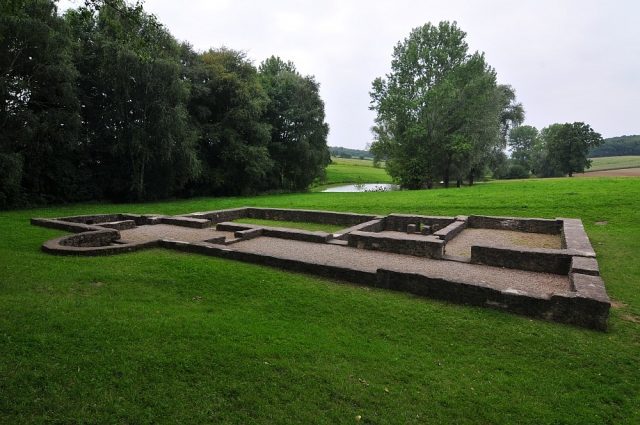
The Roman Bath can be visited
Roman Bath ICINIACVM (Iciniacum)

250 meters west of the Theilenhofen fort, separated from the southwest corner of the temporary camp only by a modern road, lie the now restored wall stumps of the military bathhouse (Balineum) next to a fish pond. It was assumed that the unusually large distance to the garrison resulted from the local water conditions. Of the two excavated construction phases of the thermal bath, the last one was preserved. It is assumed that the first bathhouse at this site can be attributed to the wood-earth period of the Iciniacum fort around 100 AD. With the entire settlement and defensive system, the thermal bath was probably destroyed around 260 AD with the fall of the Limes.
The thermal bath, first described as a "sweat bath" in 1820, later fell out of sight again. However, its approximate location next to a pond at the upper end of the Echerbach valley was still mentioned as "Bad" (bath) in the overview plan of the fort by the Imperial Limes Commission. In the 20th century, the site became a wild landfill, which was only remediated during the land consolidation. During the subsequent construction of ponds for water retention, the "rediscovery" of the subsequently restored and partially reconstructed fort bath took place, which has since become a popular visitor destination.
The visible remains today, measuring 16.5 x 28.5 m, are built in the style of Roman row baths. Seven rooms can be identified. The thermal bath, whose floor was equipped with attractive Solnhofen limestone slabs, was entered from the north side. There was a corridor there, which also served as a changing room (Apodyterium). In 1970, a votive stone to the goddess Fortuna was found here.
Fortun(ae)
Aug(ustae)
sacrum
coh(ors) III Br(acaraugustanorum)
cui prae(e)st
Vetelli(us)
v(otum) s(olvit) l(ibens) l(aetus) m(erito)
Translation:
To the sacred Fortuna Augusta, the 3rd Cohort of Braga, commanded by Vetellius, gladly, joyfully, and deservedly fulfilled its vow.
Perhaps also from the bathhouse was a relief discovered in 1820 "on the Weil" depicting a river god. This stone, once located in the district and city museum of Ansbach, is now lost.
The partially well-preserved supports of the hypocaust heating system made of stone and bricks, which were still in good condition at the time of their discovery, were removed before the renovation to protect them from weather and vandalism. They were reassembled in the Burgmuseum Grünwald, a branch of the Archaeological State Collection in Munich, and document the functioning of a Roman heating system in a partial reconstruction.
Take Mobile History with you
You are reading this text for free. Premium adds what matters on the road: descriptions read aloud, sites found through your camera, whole regions taken offline.
- Every description, including the ~17,700 Premium sites
- Audio guide: have descriptions read to you on location
- AR finder: see sites through your camera, with distance and bearing
- Unlimited saved sites
14 days free, then from €2.99 a month. Cancel anytime.
Source: Wikipedia · Licence: CC BY-SA 4.0
This description draws on the facts documented in the linked Wikipedia article; Wikipedia content is licensed under CC BY-SA 4.0. Wording and editing: Mobile History.
Location: 49.0884, 10.8430