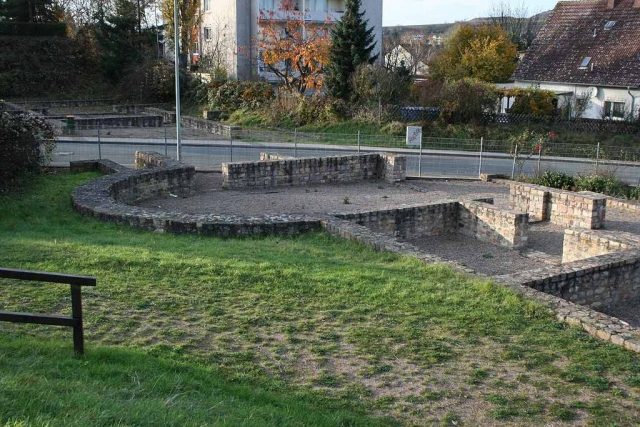
The remains of the roman Villa can be visited
Roman Villa Bad Kreuznach

The Römerhalle Museum in Bad Kreuznach, Rhineland-Palatinate, displays finds from a Roman palace villa from the late 2nd century AD, as well as other Roman-era finds from the Bad Kreuznach district. Among them are two extensively preserved mosaic floors, which are considered among the most significant finds north of the Alps, as well as numerous stone monuments.
The museum is located at Hüffelsheimer Str. 11 in the Rittergut Bangert, next to the Schlossparkmuseum and the Museum for Puppet Theater Culture. It can be reached by bus line 203 towards Agnesienberg (Schlossparkmuseum stop). The building is equipped with a ramp for strollers and disabled persons, as well as a disabled toilet.
Roman Palace Villa+
The core of the on-site exhibition consists of the archaeologically proven remains of a palace villa, which, in its size, furnishings, and building type, far exceeds the usual form of rural settlement, known as a Villa Rustica. The complex first attracted research interest with the discovery of the Gladiator Mosaic in 1893. In the 1950s, a road was built straight through the complex. After the discovery of another mosaic, the Oceanus Mosaic, further excavations took place in the unbuilt area between 1975 and 1980, funded by the German Research Foundation.
The excavations revealed a four-winged building arranged around an open courtyard (peristyle villa). It occupied an area of 70 × 80 m and was built on a north-sloping hillside in the second half of the 2nd century AD, after the demolition of a previous building. In the southern wing of the building, there was a central reception hall with an apse and a fountain, where the Oceanus Mosaic was also found. On the northern facade of the building, there was a porticus and cryptoporticus, further colonnades leading to the inner courtyard. More than 50 rooms were identified on the ground floor alone, but the building was multi-storied due to its hillside location. Outbuildings of the complex are little explored due to modern overbuilding. The owner likely belonged to the elite of the Roman province, but further details are unknown.
The villa was destroyed in the 3rd century between 260 and 275 AD. At the beginning of the 4th century, a late antique fortress was built on the north side, but it was abandoned at the latest with the construction of the Valentinianic fort of Bad Kreuznach.
A model in the museum shows the palace villa in its high imperial period construction state. Finds from the complex can be viewed on the gallery. In addition to luxurious furnishings such as glass windows and fragments of wall paintings, these also include everyday objects of the inhabitants, glass, cooking, and finer tableware (Terra Sigillata), as well as various metal objects.
Outside the museum building, the reconstructed foundations of the palace villa can be viewed, including the central apse. Various display boards explain the location within the former villa.
Mosaic Finds+
The most significant part of the exhibition are the two mosaics, which are no longer in their original location but are centrally located in the museum building, protected from the weather.
The 58 m² Gladiator Mosaic was found as early as 1893 and soon became one of the sights of the spa town. The extensively preserved mosaic shows various fights from the Roman amphitheater in 13 panels: gladiatorial combats, fights against animals, and animals fighting each other. A staircase leads down to the cellar, where the function of a Roman underfloor heating system (hypocaust) is explained.
In 1966, a second mosaic was discovered, the 68 m² Oceanus Mosaic. It comes from the central apse of the villa and depicts, in addition to the sea god, ship and harbor scenes, Mediterranean architecture, and many sea creatures originating from the Mediterranean Sea. Remains of an inscription mentioning consuls probably date the mosaic to 234 AD. Centrally located within it is a marble-clad water basin, reconstructed based on excavation findings. Oceanus himself is located in the semicircular apse, which is interpreted as a triclinium.
Stone Monuments+
On the ground floor, in addition to the mosaics, Roman stone monuments from the district and city of Bad Kreuznach are displayed. These include Jupiter Giant Columns, votive stones, and dedicatory inscriptions – some of which are
spolia, which were walled into the foundations of the late antique fort. The late antique period is evidenced by stone sarcophagi, which are probably also attributable to the late antique fort of Bad Kreuznach.
Soldier Gravestones from Bingerbrück
A special group among the stone monuments in the exhibition are the gravestones from Bingerbrück. They come from soldiers from Bingen, who, as was customary among the Romans, were buried north of the Nahe, along the main roads. These are gravestones of auxiliary troops, some of whom came from distant Roman provinces, such as Tiberius Iulius Abdes Pantera from Sidon.
Take Mobile History with you
You are reading this text for free. Premium adds what matters on the road: descriptions read aloud, sites found through your camera, whole regions taken offline.
- Every description, including the ~17,700 Premium sites
- Audio guide: have descriptions read to you on location
- AR finder: see sites through your camera, with distance and bearing
- Unlimited saved sites
14 days free, then from €2.99 a month. Cancel anytime.
Source: Wikipedia · Licence: CC BY-SA 4.0 · Image: http://de.wikipedia.org/wiki/Datei:Roemerhalle_Kreuznach_Aussenanlage.jpg
This description draws on the facts documented in the linked Wikipedia article; Wikipedia content is licensed under CC BY-SA 4.0. Wording and editing: Mobile History.
Location: 49.8451, 7.8461