The roman town can be visited
Ancient BuildingLendorf
Roman City Teurnia (Tiburnia)
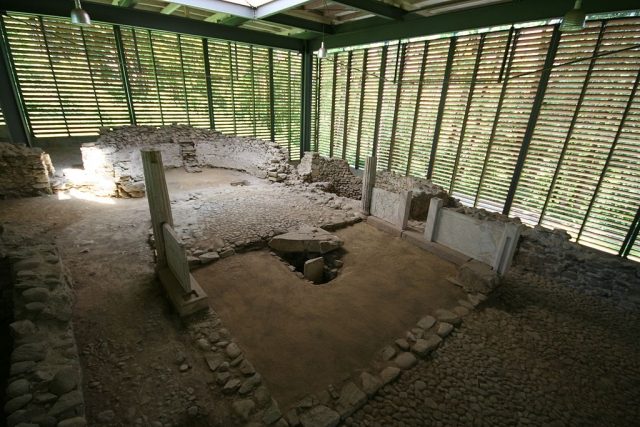
The Roman city of Teurnia, also known as Tiburnia, was once a center in Upper Carinthia. Its remains can be visited today.
History+
Already around 1100 BC, the Holzer Berg was settled, but around 50 AD, the Roman city of Teurnia emerged here. It developed into one of the largest cities in the Noric Empire with up to 30,000 inhabitants and included a forum, a market basilica, a Capitolium temple, thermal baths, residential terraces, and a temple for the Celtic god Grannus. In late antiquity, the population declined, the residential terraces were abandoned, and the slopes were used as cemeteries. At the same time, a fortification wall was erected. By the 4th century, the inhabitants were already Christians, and Teurnia served as an episcopal see until its decline around 610. From the Vita Severini, it is known that Bishop Paulinus of Teurnia acted as Metropolitan of Noricum Mediterraneum in the 6th century. The city and diocese were last mentioned in 591.
Source: Wikipedia · Licence: CC BY-SA 4.0 · Image: http://commons.wikimedia.org/wiki/File:Reste_der_Bischofskirche_in_Teurnia.JPG
This description draws on the facts documented in the linked Wikipedia article; Wikipedia content is licensed under CC BY-SA 4.0. Wording and editing: Mobile History.
Location: 46.8233, 13.4437