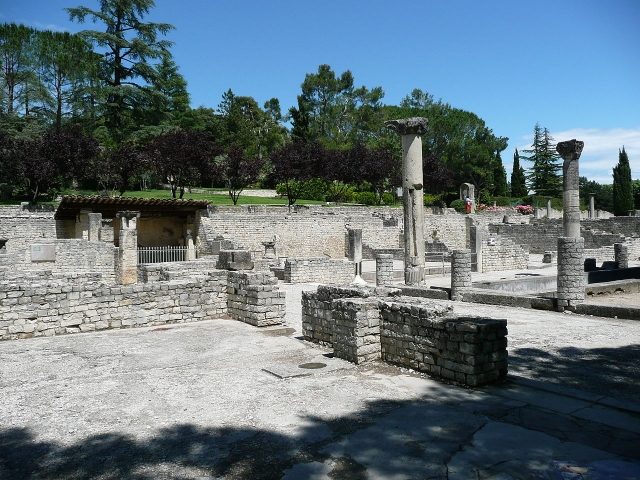
The remains of the roman town can be visited
Roman City Vasio Vocontiorum

The region was inhabited by Celto-Ligures, who also introduced bronze. Over centuries, the Celtic inhabitants of Vaison, the Vocontii people, alternated their residence between the two banks of the Ouvèze. Their first oppidum was a fortress on the hilltop, which served as their regional capital. After the Roman conquest in the 2nd century BC, the Celtic inhabitants settled alongside the invaders in the fertile plains beyond the Ouvèze.
The Romans upgraded the city of their treaty and alliance partners, which was then equipped with villas, a theatre, baths, an aqueduct, and a bridge, and grew to approximately 10,000 inhabitants. Vasio belonged to the Roman province of Gallia Narbonensis. The Praetorian Prefect Sextus Afranius Burrus came from it, and – according to a hypothesis that cannot be unambiguously verified – also the historian Cornelius Tacitus.
The city was severely damaged during the Frankish invasion. In the 12th century, Count Raymond VI of Toulouse erected a medieval castle in place of the Celtic fortress, whose security attracted residents to the Haute Ville. In the 14th century, Vaison came into the possession of the Comtat Venaissin, papal property, to which it belonged until the French Revolution.
Roman Excavations
Vaison-la-Romaine is the largest French archaeological excavation site. The archaeological remains that can be visited today date from the 1st and 2nd centuries AD.
Based on the size of the public buildings, as far as they could be excavated, it can be concluded that the city covered an area of approximately 60 to 70 hectares in Roman times. The amphitheatre was carved into the northern slope of the Puymin hill and offered space for about 5,000 to 6,000 spectators.
In the east of Vaison, a temple was built during the Augustan era. Large gardens with columns surround it. This was a public place for religious ceremonies. Remains of various thermal baths can be visited in different locations in the area, including to the east of the paved street (Villasse), on the south bank of the Ouvèze, the more famous baths to the north from the mid-first century covering 2,000 m². The oldest baths occupy an area of 2,300 m² and are located in the Maison du Buste d'Argent, a house named after the silver bust of the builder found within. The villa featured mosaic floors and two gardens with water basins. The neighbouring Maison du Dauphin was also equipped with gardens and basins. The heart of the Roman city – forum and basilica – is covered by the modern city and is therefore not excavated. But at least a fifth of the Roman city – 13 hectares – has been uncovered and can be accessed from Place Abbé Sautel.
The 17 m wide Roman bridge over the Ouvèze is one of the most important bridges in the province of Narbonne and one of the very rare ancient bridges still in use today. It played a strategic role as the only crossing of the Ouvèze. In the time of the Counts of Toulouse, it was used as a toll bridge, protected by a fortified gate to the upper town. In the 15th century, it was used as a control and guard post.
In the archaeological museum on the other side of the Puymin hill – the most visited of its kind in the region with 60,000 to 65,000 admissions – a variety of objects and inscriptions discovered during the excavations can be admired, and daily life in Roman times in a provincial town can be better understood. These include the model of the amphitheatre and the Maison du Dauphin, but also everyday objects, frescoes, and exquisite mosaics found in the Villa du Paon, which give an impression of the superb taste of interior decoration of that era.
Take Mobile History with you
You are reading this text for free. Premium adds what matters on the road: descriptions read aloud, sites found through your camera, whole regions taken offline.
- Every description, including the ~17,700 Premium sites
- Audio guide: have descriptions read to you on location
- AR finder: see sites through your camera, with distance and bearing
- Unlimited saved sites
14 days free, then from €2.99 a month. Cancel anytime.
Source: Wikipedia · Licence: CC BY-SA 4.0 · Image: http://de.wikipedia.org/wiki/Datei:Maison_a_l%27apollon_laure.jpg
This description draws on the facts documented in the linked Wikipedia article; Wikipedia content is licensed under CC BY-SA 4.0. Wording and editing: Mobile History.
Location: 44.2419, 5.0719