Ancient BuildingBollendorf

Roman Villa Bollendorf
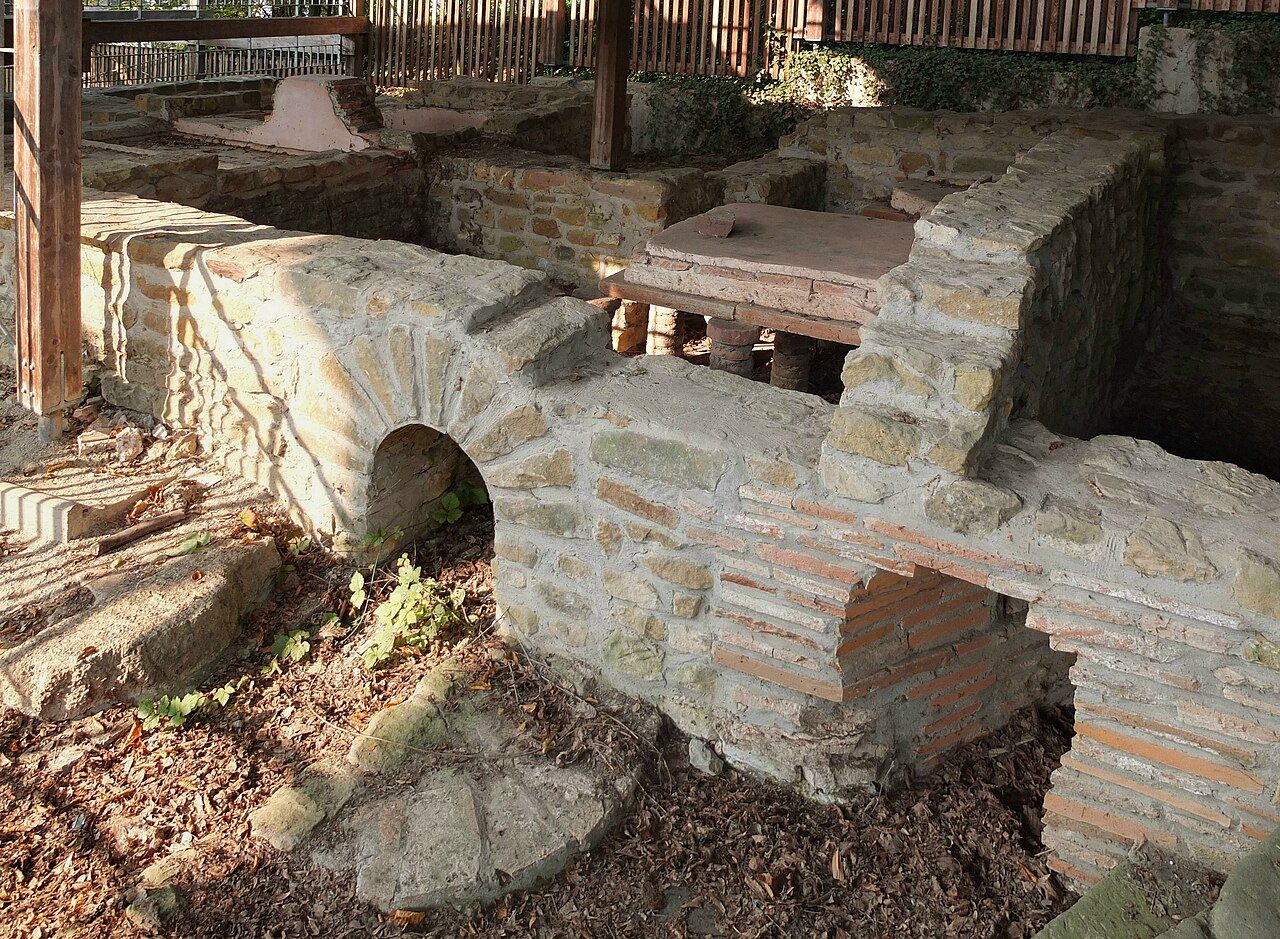
Roman Villa Bollendorf

The remains of the roman Villa can be visited


The Villa rustica (Roman country estate) was one of several Roman-era structures in and near Bollendorf (Rhineland-Palatinate).

The complex is located above the present-day Bollendorf Castle. It was built in the second century AD and used until the fifth century; during this time, some alterations were made. Apparently, the villa was not reoccupied after a fire. The complex consists of the foundations of a main house measuring 27 × 23 meters. This included an atrium, which was 17 meters long and 11 meters wide and was later roofed over and used as additional living space. The house featured two risalits on the valley side, between which was a colonnade with a central grand staircase. The house and veranda had cellars. Utility rooms were located on the mountain side of the house; furthermore, in the northern corner at the back of the house, there was a room that could be heated by the hypocaust of the bathing facility later installed on the western narrow side. Between this room and the western risalit were the apodyterium, frigidarium, tepidarium, and caldarium; the firing possibility was in the main hall. The extension on the north side with the utility rooms and an exit to the east was also added later. To the west and north, the villa was equipped with a sandstone eaves gutter. The water was collected in an underground seepage basin.

Further Roman sites in the vicinity+

In Bollendorf, besides the Villa rustica, there was also a Diana monument, a boatman's grave, a mausoleum, which, however, fell victim to a flood, as well as a loading point for ship traffic on the Sura.

Excavations and protective measures+

Already Johann Dahlem, who served as pastor in Bollendorf from 1829 to 1857, recovered numerous artifacts from Roman times. Bollendorf was one of the first places where Roman country houses were excavated. Villae rusticae corresponding to the type of building excavated in Bollendorf from 1907 onwards are therefore referred to as Bollendorf type. The excavations were initiated by the Provincial Museum Trier and the Roman-Germanic Commission of the Archaeological Institute in Frankfurt and carried out by the scientists Kropatscheck and Ebertz. In 1925, the bathing facility was roofed over and the area fenced. Since Bollendorf was located in the area of the Westwall and the town was shelled by American troops in 1944/45, numerous destructions were recorded during the Second World War. The roofing of the bathhouse also fell victim to the fighting and was replaced in the 1990s. Later, the protective structure was supplemented by an entrance building, where visitors can learn about the complex and the Gallo-Roman history of the area.

Take Mobile History with you

You are reading this text for free. Premium adds what matters on the road: descriptions read aloud, sites found through your camera, whole regions taken offline.

  • Every description, including the ~17,700 Premium sites
  • Audio guide: have descriptions read to you on location
  • AR finder: see sites through your camera, with distance and bearing
  • Unlimited saved sites

14 days free, then from €2.99 a month. Cancel anytime.

Source: Wikipedia · Licence: CC BY-SA 4.0 · Image: Palauenc05 / CC BY-SA 4.0 via Wikimedia Commons

This description draws on the facts documented in the linked Wikipedia article; Wikipedia content is licensed under CC BY-SA 4.0. Wording and editing: Mobile History.

Location: 49.8511, 6.3685