The remains of the roman Villa can be visited
Ancient BuildingLauffen am Neckar
Roman Villa Lauffen
This article or section has been entered on the quality assurance page of the Roman Limes project due to content deficiencies. This is done to bring the quality of articles in the subject areas of Limes research/Provincial Roman Archaeology/Roman Military History to an acceptable level. Please help to eliminate the deficiencies of this article and participate in the discussion!
The Villa rustica near Lauffen am Neckar was a Roman estate that, in its final expansion phase, comprised four buildings on an area of 94 × 90 m. The oldest structures are estimated to date back to 150 AD. Most likely, the villa was abandoned around 260 AD during the Limes Fall. The sophisticated water supply was fed by a spring, still active today, located 100 meters above.
The remains of the estate are located in the Brunnenäcker district. They can be reached via the road from Ilsfeld to Lauffen; a signposted parking lot is located about 300 m above the complex. The Villa rustica is about 2 km from the center of Lauffen; the path through the vineyards is not permitted for general vehicle traffic.
The Villa rustica was located on a rock terrace above the Neckar riverbank, which is now surrounded by vineyards and orchards and still offers a view of the Neckar valley.
Complex+
The older residential building was built directly on the edge of this terrace. It contained a storage cellar carved into the rock and a heated living room, but apparently no longer met the demands of its inhabitants, so another residential building was constructed further up the slope.
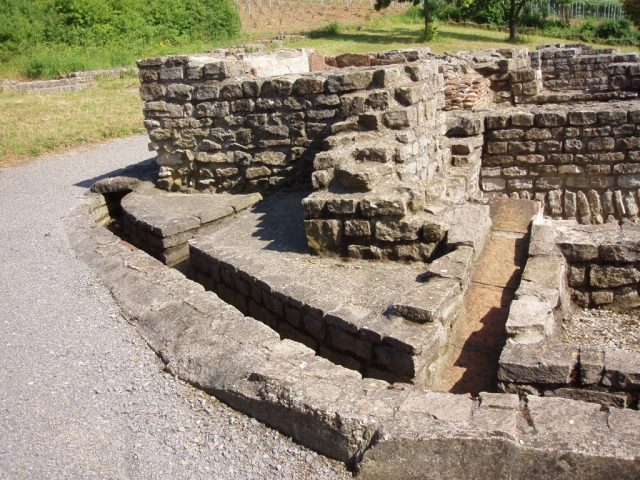
This younger residential building offered, among other things, a large living hall situated transversely to the slope, as well as a bathing facility on the mountain side, whose remains are well pr …
Source: Wikipedia · Licence: CC BY-SA 4.0 · Image: https://commons.wikimedia.org/wiki/File:LauffenAbfl%C3%BCsse.jpg?uselang=en
This description draws on the facts documented in the linked Wikipedia article; Wikipedia content is licensed under CC BY-SA 4.0. Wording and editing: Mobile History.
Location: 49.0667, 9.1778