The remains of the roman Villa can be visited
Ancient BuildingReinheim
Roman Villa Reinheim
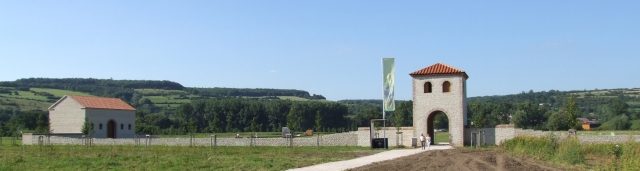
The European Archaeological Park Bliesbruck-Reinheim (French: Parc Archéologique Européen de Bliesbruck-Reinheim) in the Saarland municipality of Gersheim, district of Reinheim, and in the French municipality of Bliesbruck in the Moselle department, is a cross-border project that combines excavations and reconstructions of both Celtic and Roman finds with exhibition and training rooms. It was established in 1989 from archaeological investigations carried out on both sides of the German-French border. Together with excavation findings from the Mesolithic, Bronze Age, and the period of the Germanic migrations, the Iron Age Celtic and Roman, as well as early medieval finds and findings, show a settlement continuity of over 10,000 years in the Blies valley.
The Roman Villa in Reinheim was already the subject of initial excavations in the early 19th century, but has only been systematically excavated and researched since 1987. It is a very large farm complex, whose walled courtyard area was 300 meters long and 135 meters wide, and whose main building in the north was almost 80 by 62 meters. A part of the building in the northern area of the west wing is interpreted as the estate's own thermal bath due to the layout of the rooms, the discovery of water channels, and fragments of tube-like bricks (tubuli) which prove the existence of underfloor heating (hypocaustum). The exact time of the establishment of the estate in the area, which was settled by the Celtic tribe of the Mediomatrici and conquered by the Romans in 50 BC, is still unclear. The estate reached its greatest extent in the first half of the 3rd century. After initial destructions in the 3rd century, a phase of reconstruction followed. The destruction by fire, which was not followed by any further reconstruction, took place in the 4th century. However, finds indicate that a sparse settlement still occurred in the west wing of the main building in the second half of the 4th century. The most famous find from the excavation is the Reinheim Rider's Mask, found in 2000 near an outbuilding. This iron mask, shaped like a human face and covered with bronze sheet, probably served as a movable visor of a Roman cavalryman's helmet. Approximately 110 of these impressive masks have been found worldwide to date.
Source: Wikipedia · Licence: CC BY-SA 4.0 · Image: https://commons.wikimedia.org/wiki/File:Rekonstruktion_des_Eingangs_zur_r%C3%B6mischen_Villa_Bliesbruck.jpg
This description draws on the facts documented in the linked Wikipedia article; Wikipedia content is licensed under CC BY-SA 4.0. Wording and editing: Mobile History.
Location: 49.1338, 7.1799