The roman village can be visited
Roman Villa Rustica

During construction work in 2002 on the new state road 2008 at the hamlet of Kohlhunden, approx. 3km south of the district town of Marktoberdorf, attentive residents pointed out wall remains and bricks. The find site is located on a moraine hill, west above the distinctive kettle hole – today's Kühstallweiher.
Thanks to the understanding cooperation with the Kempten road construction office, as well as the voluntary help of W. Keinert (Kempten) and S. Hunecke (Kempten), the 25 to 35 meter wide, already cleared route could then be carefully re-excavated by machine and investigated for several months. Under the surface removal by the excavator, seven Roman buildings emerged, three more could be detected using geomagnetic methods. On a total area of approx. 7000m² (north-south orientation), the foundations of a Roman "Vicus" of a "Villa-Rustica" were found, as they were operated by farming families 2000 years ago. Similar Roman supply farms, which supplied Roman border troops with agricultural goods, are known in the former province of "Raetia", although their density lags far behind that of the Limes hinterland north of the Danube.
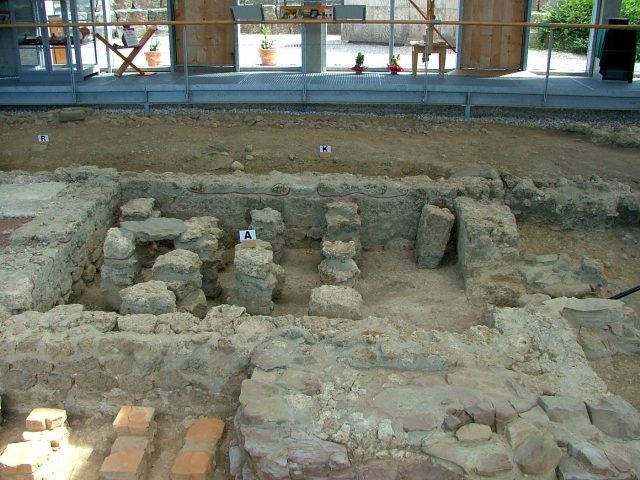
The size and furnishings of the owner's/tenant's residential house, located on the hilltop, corresponded to the usual prosperity. Approximately 40 meters west of the main house was the small family bath, which, as a standard of ancient hygiene and an obligatory part of rural living culture, was not missing from any estate. The large, multi-period building (Fig. plan), whose foundation remains (approx. 9 x 13 meters) were secured by a protective structure (today's museum), possessed all the functional rooms and facilities of those thermal baths that the Romans knew from the provincial cities. Individual rooms, finds of painted wall plaster, and lime screed floors are still clearly recognizable, as is the heating technology used. In addition to fragments of a glass window, an ancient mill game was also found for the entertainment of bathers.
Of a total of eight outbuildings grouped around the main house, four could be examined in more detail in the area of the road alignment. Not far at the foot of the moraine hill, a stone well was also found. From the mud at the bottom of the well, some partly processed wooden objects could be recovered, particularly noteworthy is the juniper handle of a woven basket. Judging by the finds, the farm was probably built only in the middle of the second century and abandoned again after three or four generations in the middle of the 3rd century. Traces of destruction could not be found, but from the last years of the settlement comes a remarkable sacrificial depot with a rich ensemble of Terra Sigillata vessels with consecration inscriptions, from the Upper Germanic manufacturing center Tabernae-Rheinzabern on the Rhine. The scratched inscriptions on the belly of some spherical cups name sacrificers and deities. Due to their abbreviations, they are not easy to decipher, HIIRC(uli). V(otum) s(uspectum) SVIIROS LIACI (filius) SOL(vit) – "Dedicated to Hercules. Sueros, son of Liacus, has fulfilled his vow". It is assumed that the attached consecration inscriptions come from a main sanctuary in "Tibur-Tivoli" as "Hercules Victor – the patron deity for house and home.
Furthermore, what is probably the oldest recorded place name "Cenabio" is found. It is assumed that this is an intentionally "buried" legacy as part of a communal cult meal, a private sacrificial ceremony. Connected with the ceremony was also the blood sacrifice of a sheep or goat and a pig; remains of burnt spare ribs and a roast lamb or goat were found in a grinding bowl. In addition to these finds, other small objects were also recovered that could be assigned to sacred acts. Writing tools, a tinned bronze inkwell, an iron spatula (for smoothing writing tablets), and a penknife (without a reed pen). Such ritual gifts in their ancient form were the communication of humans with the gods, a communal cult meal "convivum" where the "present" gods were entertained with wine and incense as an expression of hospitality. After their use, these gifts were no longer usable and were buried in a pit.
According to archaeologists, the finds in Kohlhunden represent the largest known Roman Villa-Rustica complex in the entire Allgäu region. The finds themselves have unique religious-historical significance, as they bear witness to a limited period of the 3rd century, a time of upheaval – the Migration Period. Invading Germanic tribes, especially Alamanni and Juthungi, who increasingly crossed the Limes border and traversed the Roman province of RAETIA, as well as advancing over the Alps into the Po Valley, plundered many of the villages in this geological area. Within 2-3 generations, many inhabitants of these estates lost their lives, the economy collapsed, and warlike conflicts shook the Roman Empire. All the more relevant in this turbulent time were the silent and hopeful prayers of the population to the gods, including "Hercules, the strong helper in need" in this difficult time.
Take Mobile History with you
You are reading this text for free. Premium adds what matters on the road: descriptions read aloud, sites found through your camera, whole regions taken offline.
- Every description, including the ~17,700 Premium sites
- Audio guide: have descriptions read to you on location
- AR finder: see sites through your camera, with distance and bearing
- Unlimited saved sites
14 days free, then from €2.99 a month. Cancel anytime.
Source: Wikipedia · Licence: CC BY-SA 4.0
This description draws on the facts documented in the linked Wikipedia article; Wikipedia content is licensed under CC BY-SA 4.0. Wording and editing: Mobile History.
Location: 47.7510, 10.6283