Ancient BuildingNiedereschach-Fischbach

Roman Villa Rustica Fischbach
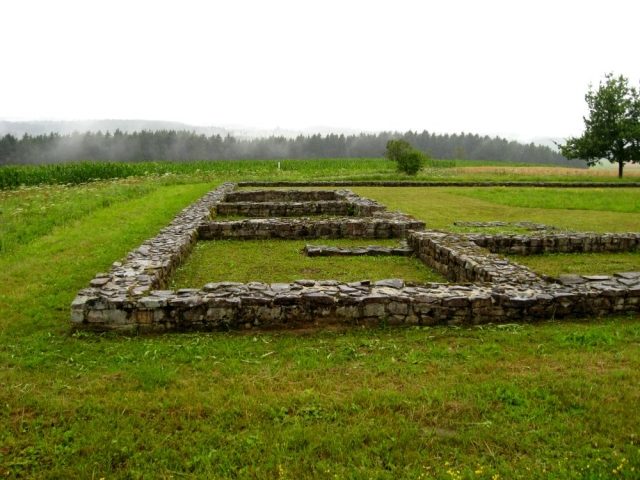
Roman Villa Rustica Fischbach

The Villa Rustica can be visited

Already in 1883, excavations in the area of the Villa von Fischbach uncovered large piles of stones and brick fragments, cornice stones, a larger piece of a scale column, and bricks with a legionary stamp of LEG XI CPF from nearby Rottweil (ARAE FLAVIAE). In 1897, head forester Roth from Villingen carried out more precise investigations in the area of the baths. He discovered the findings that are largely present today, albeit in a significantly better preserved state. After the excavations, the site lay unprotected in the forest for almost 90 years, repeatedly visited by amateur archaeologists or treasure hunters. Nature also took its toll, with tree roots bursting the masonry. Roth also touched upon the buildings on the hill and the indeterminate building on the slope, but did not investigate them further. Due to the strong natural erosion of the exposed upper buildings in conjunction with continuous intensive agricultural use, a significant loss of substance was particularly to be feared there. Thus, in 1985, the State Office for Monument Preservation, Freiburg branch, in cooperation with the municipality of Niedereschach and the employment office, decided to excavate the remains of the buildings on the hill under the local direction of an LDA employee. Already during the first soundings, it became clear that the state of preservation was very critical. In some places, the surface had already been eroded down to the natural soil, but there were also some undisturbed niches. In the immediate vicinity of the buildings, enough architectural fragments were found to allow a partial reconstruction of the furnishings. However, old reports also indicated that stone material had been removed from this site for a long time, which was now unfortunately emphatically confirmed.

The precise assignment of individual buildings to specific construction phases is more difficult. Roth already suspected a military origin based on the legionary stamps. The new finds of bricks with legionary stamps, the unusual location on a ridge, and some small finds such as a sword scabbard fitting or a spearhead would also support this. It is certain that from the last quarter of the 1st century until the presumed end of the villa in the 1st quarter of the 3rd century, many additions and alterations took place, which are not always easy to trace.

After the excavations on the hill, the LDA Stuttgart then decided to excavate and investigate the baths once again. The goal was a subsequent conservation and restoration, after the upper buildings had already been conserved by the municipality. For this purpose, the LDA hired an unemployed archaeologist on a temporary ABM basis, who led the work and also carried out the processing. Unfortunately, many examples demonstrate that a scientifically exact execution does not necessarily have to be didactically useful. Site plans and reconstruction proposals on information boards on site should be designed in such a way that a less experienced observer, e.g., students, can assign them to the object. If walls are too high to allow views, they directly invite climbing. Older people, who are very often among the visitors, however, are at a disadvantage. Unproven suggestive designations such as "manor house" for an object only partially excavated cannot diminish the significance of the enormous complex above with certainly not "servant-like" furnishings. And so there are still some examples.

The owner of the villa was LUCIUS MARIUS VICTOR.

Text on the votive stone for the goddess Fortuna:

DE(ae) FO/RTUN/AE L. M(a)R(ius) VI(cto)R

Take Mobile History with you

You are reading this text for free. Premium adds what matters on the road: descriptions read aloud, sites found through your camera, whole regions taken offline.

  • Every description, including the ~17,700 Premium sites
  • Audio guide: have descriptions read to you on location
  • AR finder: see sites through your camera, with distance and bearing
  • Unlimited saved sites

14 days free, then from €2.99 a month. Cancel anytime.

Source: Wikipedia · Licence: CC BY-SA 4.0

This description draws on the facts documented in the linked Wikipedia article; Wikipedia content is licensed under CC BY-SA 4.0. Wording and editing: Mobile History.

Location: 48.1447, 8.5163