The remains of the roman Aqueduct can be visited
Ancient BuildingVers-Pont-du-Gard
Roman aqueduct of Nîmes
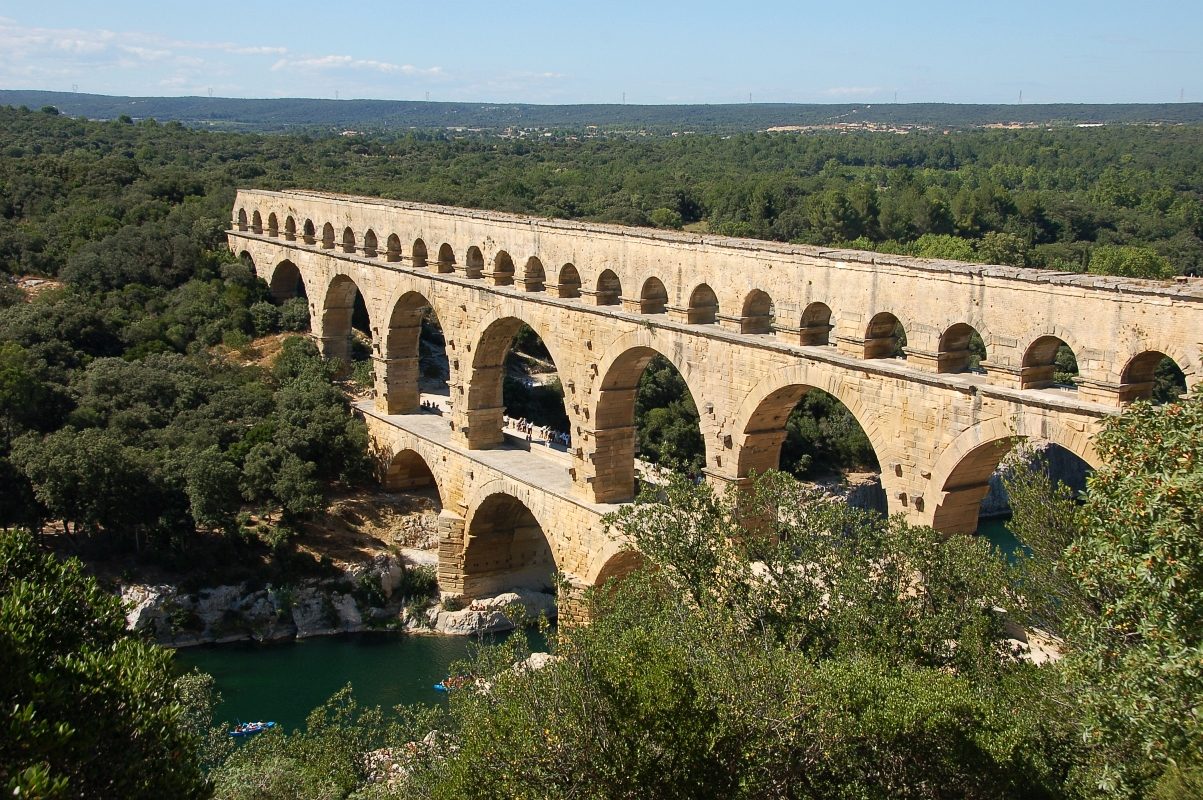
The Roman Aqueduct to Nîmes once supplied water to the Roman city of Nemausus. This structure, located in the Occitanie region of France, is an example of the technical capabilities of the Romans.
History+
The almost 50-kilometer-long aqueduct was built to transport water from the springs near Uzès to Nîmes. While earlier dating placed its construction around 19 BC, recent excavations suggest its origin in the mid-1st century AD. A central element of the aqueduct is the bridge over the Gardon River valley. After its completion, the aqueduct supplied the city of Nemausus, which then had about 20,000 inhabitants, with approximately 20,000 cubic meters of water daily. About two-thirds of the pipeline ran underground and had to be carved into the rock. The entire system had an average gradient of only 24 cm per kilometer, a precision whose calculation methods remain a mystery to this day.
Source: Wikipedia · Licence: CC BY-SA 4.0 · Image: Mimova(Mimova (talk)) / Public domain via Wikimedia Commons
This description draws on the facts documented in the linked Wikipedia article; Wikipedia content is licensed under CC BY-SA 4.0. Wording and editing: Mobile History.
Location: 43.9486, 4.5307