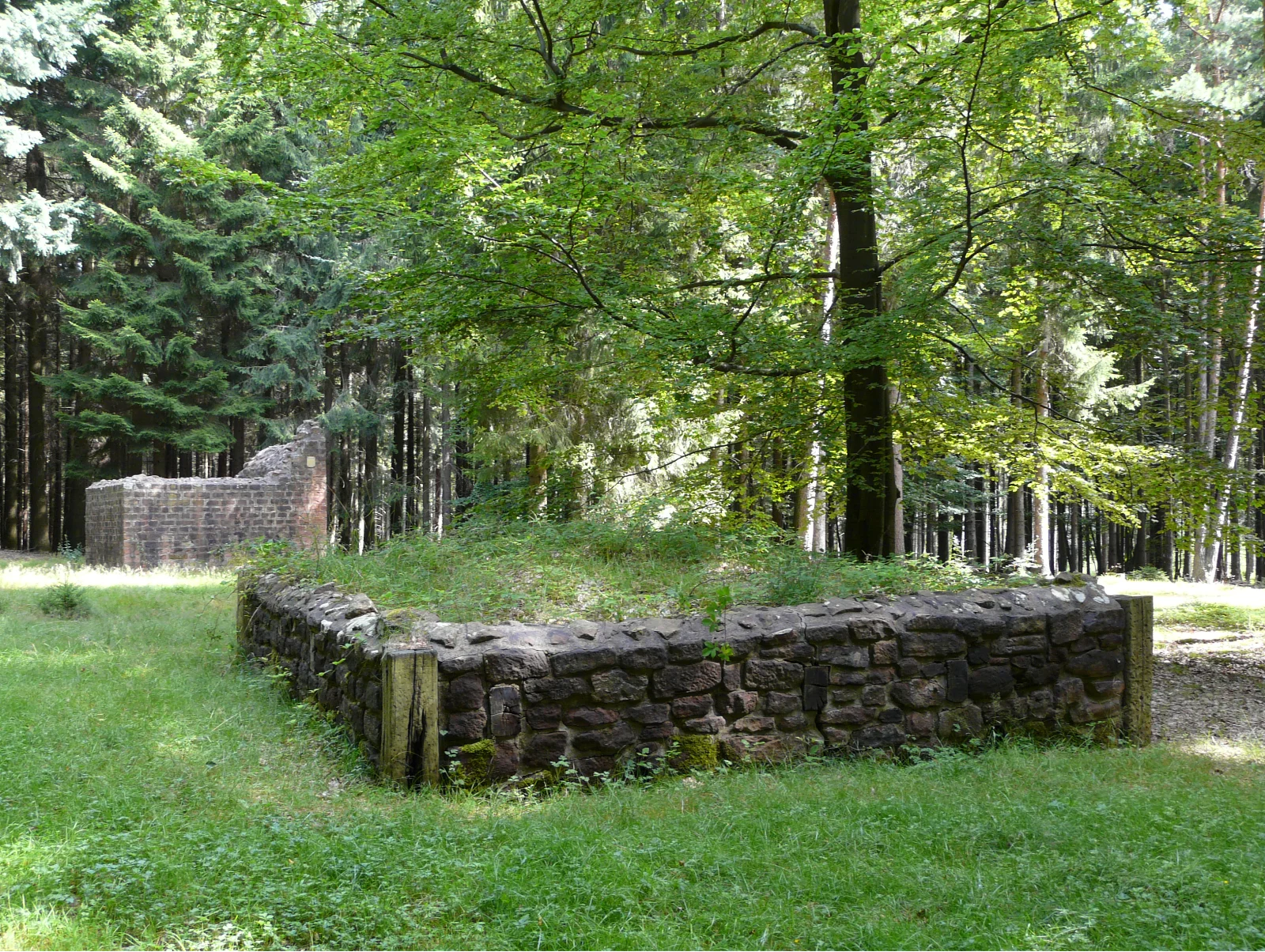
The remains of the roman Watchtower can be visited
Ancient BuildingHesselbach
Roman Limes Watchtower (WP 10/30)
The Upper Germanic-Rhaetian Limes, with a length of 550 km from Eining near Regensburg to Rheinbrohl on the Rhine, is the largest archaeological monument in Germany and has been recognized by UNESCO as a World Heritage Site. Limes (Latin: border path/wall) refers to the border fortifications of the Roman Empire, which were erected towards the end of the 1st century AD.
This border was monitored by more than 900 towers, which were built in timber construction during the initial phase, starting around 80 AD. Stone towers followed, which were plastered from 150 AD onwards. Excavations have shown that the white plaster often had cracked joints, which were painted in terracotta. This created the impression of beautiful ashlar masonry.
Preserved and reconstructed tower site of a stone and a wooden tower, along with a reconstructed Limes palisade. The stone tower was investigated by Friedrich Kofler during the excavations of the Hesselbach fort, and the wooden tower by Anthes in 1895.
The stone tower had a square floor plan with a side length of 4.80 m. The wooden tower mound, clearly visible in the terrain, bore a dry-stone foundation, also with a square floor plan, whose side length was 5.25 m and whose wall thickness was 65 cm. Inside, the tower foundation was divided into two unequally sized rooms by another 90 cm thick dry-stone wall. In addition, the western wall in the larger, southern room had been reinforced to a width of 1.20 m. The tower was surrounded by a circular ditch 20 m in diameter.
Source: Wikipedia · Licence: CC BY-SA 4.0 · Image: Von Hartmann Linge - Eigenes Werk (Originaltext: eigene Aufnahme), CC BY 1.0, https://commons.wikimedia.org/w/index.php?curid=12203730
This description draws on the facts documented in the linked Wikipedia article; Wikipedia content is licensed under CC BY-SA 4.0. Wording and editing: Mobile History.
Location: 49.5943, 9.0844