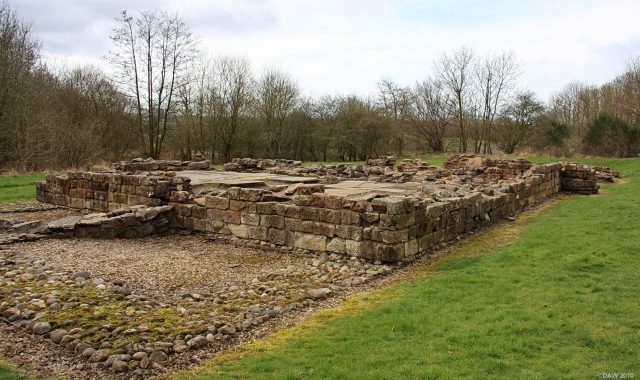
The remains of the roman Bath house can be visited
Roman Bath house Bothwellhaugh

Bothwellhaugh Roman Fort, known as Clotagenium ("Clyde-mouth") to the Romans is the remains of a Roman legionary fort in North Lanarkshire near Glasgow.
It was built as part of the western side of the Antonine Wall built around 142 CE. A comparable eastern site would be Inveresk Roman Fort. The forts defenses consisted of a turf and clay rampart 23+1⁄2 feet (7.2 m) thick, supported on thick sandstone foundation slabs, part of which was preserved to a height of around 5 ft (1.5 m). A 33 ft (10 m) wide berm separated the fort wall and the first of two ditches, each measuring about 15 ft (4.6 m) wide and 4 ft (1.2 m) deep, and spaced 7 ft (2.1 m) apart. It was built in a rhomboid pattern and was large enough to house both troops and cavalry. A number of artifacts were taken from the excavations on the site, such as a carved drain cover, to the Hunterian Museum at Glasgow University and are now on show there.
Near the fort are the well preserved remains of a Roman Bath house and a medieval copy of an original Roman Bridge over the South Calder Water. The distance from the thermae (baths) to the fort suggests there are other, as yet undiscovered structures.
Take Mobile History with you
You are reading this text for free. Premium adds what matters on the road: descriptions read aloud, sites found through your camera, whole regions taken offline.
- Every description, including the ~17,700 Premium sites
- Audio guide: have descriptions read to you on location
- AR finder: see sites through your camera, with distance and bearing
- Unlimited saved sites
14 days free, then from €2.99 a month. Cancel anytime.
Source: Wikipedia · Licence: CC BY-SA 4.0
This description draws on the facts documented in the linked Wikipedia article; Wikipedia content is licensed under CC BY-SA 4.0. Wording and editing: Mobile History.
Location: 55.7975, -4.0280