Ancient BuildingWaldgirmes

Roman Forum Waldgirmes
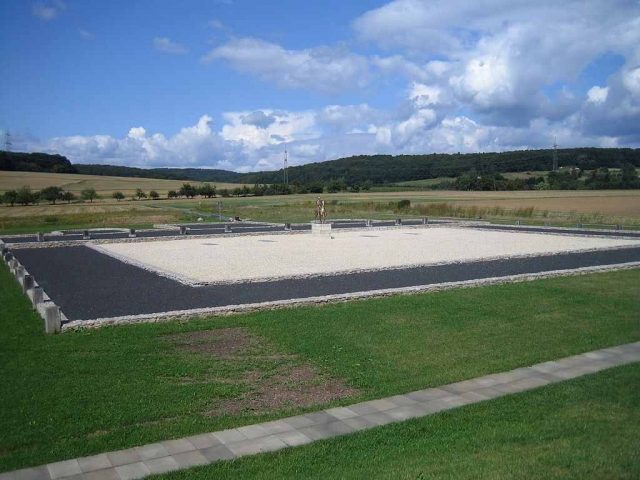
Roman Forum Waldgirmes

The roman Forum can be visited

Waldgirmes is a district of the municipality of Lahnau in the Central Hessian Lahn-Dill-Kreis. The population is slightly more than 3,300. Its first mention was around 771 in the Lorsch Codex, meaning Waldgirmes has a history spanning over 1200 years. Traces of much earlier settlement are already found in the Forum, a planned Roman city foundation in Germania Magna, which was, however, abandoned after only a few years. Among the traces of Roman construction from the time of Emperor Augustus, parts of a gilded bronze equestrian statue of the emperor were found.

From the vicinity of Waldgirmes, finds from the Linear Pottery culture (4600–3800 BC) and the Corded Ware culture (around 2500 BC) are known. Furthermore, a Celtic burial ground from around 300 BC is also known.

Near Waldgirmes, a Roman city in its founding phase was located, which was probably abandoned after the Battle of the Teutoburg Forest. The official name of the Roman settlement is not known. (See also the main article Roman Forum Lahnau-Waldgirmes)

Waldgirmes was first documented on June 17, 771, in the Codex Laureshamensis. In the 8th, 9th, and 10th centuries, Waldgirmes belonged to the County on the middle Lahn; a certain Heimo is attested as the first count in the 8th century.

In 1104, Waldgirmes, along with the western half of the County of Gleiberg, fell to Count Otto von Gleiberg. After his marriage to the heiress of the County of Solms, he henceforth called himself Otto von Solms and united his previous possessions with the County of Solms. In the division of the county in 1255 between the brothers Heinrich and Marquard, Waldgirmes fell to Marquard, who named himself Count of Solms-Königsberg after his new ancestral seat. In 1310, a road was built south of Waldgirmes from Wetzlar via Niedergirmes through Naunheim to the Dorlar Lahn crossing, intended to connect the monasteries of Altenberg and Dorlar. In 1350, the last representative of the Solms-Königsberg line sold his possessions to Landgrave Heinrich II of Hesse, known as "the Iron." However, this contract was only approved by Emperor Ferdinand II in 1629/1631. In the meantime, the inhabitants were obliged to pay tithes to two lords.

Before 1585, a division of the "Rodheimer Mark" took place, to which Waldgirmes also belonged. This also affected a communal forest on the Königsstuhl, which was called Spitzenberg, Hämüskopf, or Himberg. This resulted in a dispute between the villages of Heuchelheim, Kinzenbach, Atzbach, Dorlar, and Waldgirmes, which lasted until the conclusion of a division agreement on August 11, 1773.

During the Thirty Years' War, Protestant Waldgirmes, like its neighboring towns, was severely affected. Among other things, Waldgirmes was plundered by Swedish troops at the end of the war, and the church was set on fire.

Since 1816, Waldgirmes belonged to the Gießen district. In 1866, Waldgirmes became Prussian after the Prussian-German War and was incorporated into the Biedenkopf district in 1867, after which it belonged to the Wetzlar district until the formation of the Lahnstadt.

In 1977, Waldgirmes became a district of the large city "Lahn." After its dissolution, the three districts of the former Lahntal municipal district, namely Waldgirmes, Dorlar, and Atzbach, were merged into the municipality of Lahnau on August 1, 1979.

Education+

In the district is the Waldgirmes primary school for primary school students from the Waldgirmes and Dorlar districts. Training and courses of the Lahn-Dill-Kreis Adult Education Center in Wetzlar also take place in the primary school building.

Museum+

Waldgirmes has a local history museum with 470 m² of exhibition space in the buildings and a courtyard area of 400 m². 3,700 exhibits are displayed there. The neoclassical main building of the local history museum was built in 1840/1841 as a schoolhouse with a teacher's residence. The museum also includes two barns. The museum was founded on the initiative of Hedwig Schmidt (* December 8, 1914; † May 25, 1980) in 1971. In 1977, the museum initially received the premises of the former teacher's residence. It is supported by an association, also founded by Hedwig Schmidt in 1977, with currently 230 members. The association also publishes yearbooks.

Take Mobile History with you

You are reading this text for free. Premium adds what matters on the road: descriptions read aloud, sites found through your camera, whole regions taken offline.

  • Every description, including the ~17,700 Premium sites
  • Audio guide: have descriptions read to you on location
  • AR finder: see sites through your camera, with distance and bearing
  • Unlimited saved sites

14 days free, then from €2.99 a month. Cancel anytime.

Source: Wikipedia · Licence: CC BY-SA 4.0

This description draws on the facts documented in the linked Wikipedia article; Wikipedia content is licensed under CC BY-SA 4.0. Wording and editing: Mobile History.

Location: 50.5887, 8.5413