Ancient BuildingBuchen-Hettingen

Roman Castle Hönehaus
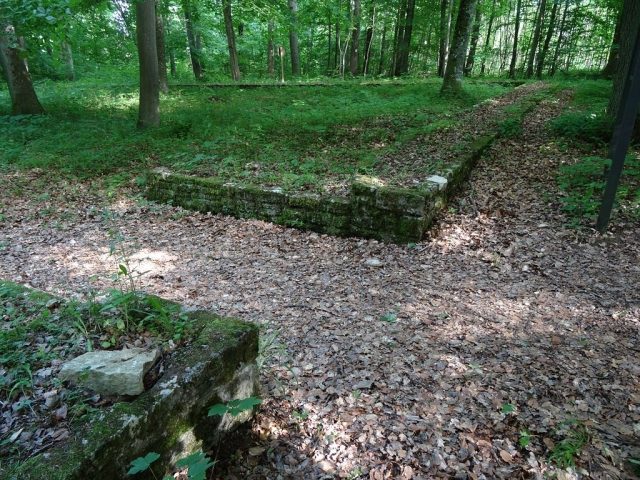
Roman Castle Hönehaus

The remains of the roman Castle can be visited


The small fort of Hönehaus, also known as the small fort of Rehberg, is a former Roman military camp on the so-called "Vorderer Limes" (Front Limes) of the Upper Germanic-Rhaetian Limes. The site, which is part of the UNESCO World Heritage, is located on the "Rehberg" in the "Großer Wald" (Great Forest) near Hettingen, Buchen municipality in the Neckar-Odenwald district. The foundations, which were still perfectly preserved when discovered, have been conserved and are freely accessible.

Location and Research History+

Topographically favorably situated in a hilly region traversed by deep valleys, the small fort, built on the existing Muschelkalk (shell limestone), was positioned south of a distinct Limes bend. The palisade was 78 m away from here. From the flat spur of the "Rehberg", soldiers had an excellent view into free Germania to the southeast, as well as to the watchtowers to the north and south. The elevation on the territory belonging to the Roman province of Germania superior sloped significantly to the west into the "Rehgrund". Only 350 m to the northwest lay the not much older, probably only briefly or not at all occupied small fort "An der Altheimer Straße". At the aforementioned Limes bend begins a roughly 80 km long straight section of the "Vorderer Limes" up to the watchtower near the hamlet of Haghof, which belongs to the municipality of Alfdorf.

In 1892, excavations were first carried out at this site by the Imperial Limes Commission (RLK) under the section commissioner Wilhelm Conrady (1829 to 1903). In 1968 and 1969, the walls in the "Großer Wald" were re-excavated and, after investigations, bricked up to a uniform height. Since then, the small complex has been considered the best preserved on its section.

Construction History+

Research suggests that the nearby small fort "An der Altheimer Straße" was a predecessor site, which was abandoned after the construction of the topographically more favorable small fort of Hönehaus, measuring approximately 39.5 x 46 meters (= 0.2 hectares). Another consideration is to interpret the camp as a well-located main survey point for the long straight Limes section beginning there. With fire signals, the approximately 75 km south-lying Wp 9/116 near the small fort of Ebnisee could be reached from the nearby Limes watchtower.

The 1 to 1.1 meter wide and in 1892 still five to six layers high preserved enclosing wall of the fortification, equipped with round corners, had single-lane entrances with re-entrant, not very high-quality executed cheeks on the west and east sides. Similar findings were also made at the small fort of Haselburg. In the area of the eastern entrance, at the end of the cheeks, 40 x 40 centimeter post holes were found. They probably supported a roof or were used for closing the gate. The east gate was 2.40 to 2.50 meters wide, the west gate 2.60 to 2.70 meters wide. Masonry thresholds were missing.

During the new investigations in 1968/1969, it was determined that the tongue walls of the gates, projecting into the interior of the fort, were added in a separate construction process, possibly even during a later construction phase. The construction techniques also differed from those of the defensive wall.

The troop quarters inside, of which no traces were found, were probably built of wood. This is suggested by pieces of red-fired wattle and daub. The daub was fired when the barracks burned down. Capstones of the former battlements, which were placed on the circumvallation built from local limestone slabs, were also found. The fort had neither a rampart nor a surrounding ditch. Only in the area directly behind the circumvallation was a blackish, 30 to 40 centimeter thick and four to five meter wide layer with tool remains, shards, everyday objects, and animal bones visible. A well was not located.

According to the available finds, especially late Rheinzabern Terra Sigillata and pottery with heart-shaped profiles, the small, not very carefully constructed fortification existed only for a short period in the 3rd century until at the latest the final fall of the Limes in 259/260. The coin material ranged from the reign of Emperor Caracalla (211–217) to Gordian III (238–244). In total, four denarii from four different imperial reigns were discovered in 1892.

Finds and Whereabouts+

During the conservation in October 1967, a small votive shrine made of gray variegated sandstone was recovered by forest workers not far from the northern interior of the fort. Alongside it, Sigillata remains, amphora fragments, and shards of other vessels came to light. The dedication on the votive shrine reads Bonis Casibus Quintinius l(ibertus) Lecto/r ex v(oto). A freedman named Quintinius l. Lector had dedicated this stone to the gods of "good fortune".

Many finds from the small fort, including weapons, are now exhibited in the Buchen District Museum.

Take Mobile History with you

You are reading this text for free. Premium adds what matters on the road: descriptions read aloud, sites found through your camera, whole regions taken offline.

  • Every description, including the ~17,700 Premium sites
  • Audio guide: have descriptions read to you on location
  • AR finder: see sites through your camera, with distance and bearing
  • Unlimited saved sites

14 days free, then from €2.99 a month. Cancel anytime.

Source: Wikipedia · Licence: CC BY-SA 4.0 · Image: http://de.wikipedia.org/wiki/Datei:HoenehausEingangW.jpg

This description draws on the facts documented in the linked Wikipedia article; Wikipedia content is licensed under CC BY-SA 4.0. Wording and editing: Mobile History.

Location: 49.5429, 9.3875