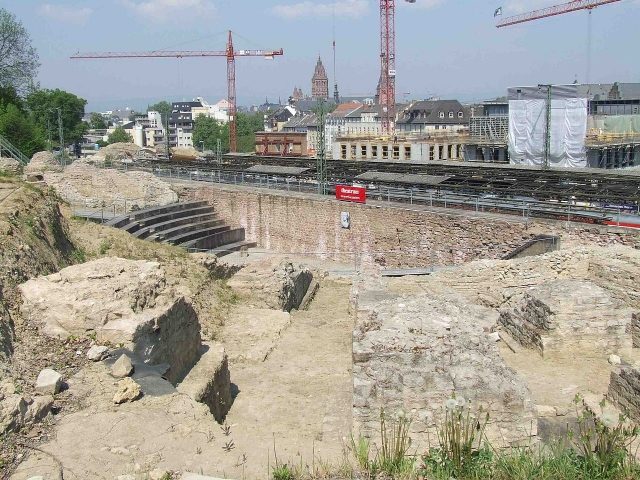
The remains of the roman Arena can be visited
Roman Theater Mogontiacum

The Roman Theatre in the Rhineland-Palatinate state capital Mainz (Latin: Mogontiacum) was only uncovered in recent years. It is located in direct proximity to the Mainz Römische Theater train station and, with a diameter of 116 m and a stage width of 42 m, was once the largest Roman stage theatre north of the Alps. The theatre offered space for approximately 10,000 visitors.
Roman Mainz owed its importance primarily to its convenient location at the confluence of the Main and Rhine rivers. From here, the nearby border of the Roman Empire, the Limes, could be very well defended, and from here, campaigns against the Germanic tribes could be organized. For this reason, a two-legion camp was founded here around 13/12 BC, which existed until after 350 AD.
Over time, a civilian settlement (Latin: Vicus) with urban character also developed around this camp, which from around 80 AD became the capital (Latin: caput provinciae) of the newly established province of Germania superior. In this city, probably in close connection with the solemn funeral games in honour of Drusus, a Roman theatre was also erected. At the Drusus memorial (see also Drususstein), only 340 m away, the military parades (decursio militum) in honour of Drusus, already mentioned in 19 AD, are likely to have been held. The Roman stage theatre would accordingly have been used for the civilian commemorative ceremonies (supplicatio) of the representatives of the 60 Gallic territorial authorities (Galliarum civitates) in honour of Drusus. Sueton already mentions a theatre in Mogontiacum in 39 AD. It is probable that there was a wooden predecessor building before the stone-built theatre, which is currently being excavated.
As the largest stage theatre north of the Alps, the theatre offered space for about 10,000 visitors. The width of the auditorium was 116 m, and that of the stage was 42 m. With the rebuilding of the city wall in the middle of the 4th century, for which stone material from the theatre is also likely to have been used, the theatre lay outside the protected area and theatre operations ceased. Reusable stone material, such as the stone blocks of the spectator stands, was gradually removed.
The massively built vaults of the theatre survived for several more centuries. From the 6th century onwards, they were used as catacombs for burials from the surrounding monasteries (especially probably St. Nikomedes, a monastery that no longer exists today). Corresponding burials were found during the excavations of recent years.
In the 11th century, the Roman stage theatre is mentioned for the last time. Gozwin writes in his "Passio sancti Albani Martyris Moguntini": "Hoc etiam astruunt adhuc superstites theatri ruinae, quod Romano more ad ludos circenses et theatrica spectacula constructum est."
During the construction of the Citadel of Mainz in the middle of the 17th century, the area was completely levelled. The last visible remains of the masonry disappeared and the Roman stage theatre fell into oblivion.
Rediscovery and Excavation+
It was only during the construction of the railway in 1884 that foundations of the stage house were found, which were measured but then demolished to lay the tracks and platforms of the Südbahnhof. However, the wall remains were not associated with the long-sought theatre. When wall remains were found again during sewer work in 1914, the art historian Ernst Neeb recognized them as remnants of a Roman stage theatre. A test excavation in 1916 confirmed his assumption, but due to the hardship of the First World War, no major excavations could be carried out. The wall remains were covered again and almost completely forgotten.
In 1998, after several years of planning, several pillar remains were made visible again in a first test trench. Since 1999, extensive excavations of the structure have been underway, made possible by donations and sponsorship, and also supported by volunteers from the Mainz population.
The theatre and its surroundings, including the adjacent Südbahnhof and the Citadel, are to be further upgraded in the near future. Initial music and theatre events in the ruins were successful and are to be continued. There are also ongoing considerations to expand the excavation area by a new traffic route to the Citadel or to reconstruct parts of the theatre.
Amphitheatre+
Mogontiacum almost certainly also had an amphitheatre. This has not yet been clearly localized; however, historical traditions and indications from excavations point to the Zahlbachtal near the no longer existing Dalheim monastery as the location. In the records of the Mainz monk Siegehard around 1100, there is talk of the ruins of a theatre in the Zahlbachtal, which is said to have been built for gladiatorial and circus games.
In the Old History of Mainz by Father Joseph Fuchs (multi-volume, published from 1771), Fuchs localized the Mainz amphitheatre at a different location, between today's city centre and the Hechtsheimer Berg. There, he said, was a large semicircle on whose ground remains of strong pillars had been found. So far, however, archaeological evidence is lacking in both cases. The existence of an amphitheatre can only be inferred indirectly through circumstantial evidence such as the dedication of gladiators.
Take Mobile History with you
You are reading this text for free. Premium adds what matters on the road: descriptions read aloud, sites found through your camera, whole regions taken offline.
- Every description, including the ~17,700 Premium sites
- Audio guide: have descriptions read to you on location
- AR finder: see sites through your camera, with distance and bearing
- Unlimited saved sites
14 days free, then from €2.99 a month. Cancel anytime.
Source: Wikipedia · Licence: CC BY-SA 4.0 · Image: http://commons.wikimedia.org/wiki/File:Roemisches-Theater-Mainz.jpg
This description draws on the facts documented in the linked Wikipedia article; Wikipedia content is licensed under CC BY-SA 4.0. Wording and editing: Mobile History.
Location: 49.9931, 8.2780