Ancient BuildingDalkingen

Roman Gate Dalkingen
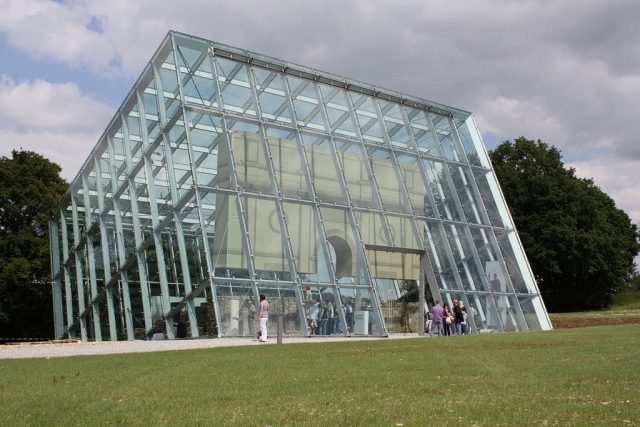
Roman Gate Dalkingen

The roman Gate can be visited

The Limes Gate Dalkingen is a unique Roman triumphal monument on the Upper Germanic-Rhaetian Limes and is one of its most impressive ruins. Since 2005, the ancient border crossing, which was expanded into a triumphal arch under Emperor Caracalla, has been part of the UNESCO World Heritage Site along with the entire Roman Limes fortifications in Germany. It is also part of the open-air museum on the Rhaetian Limes, established in 1972, which also includes the nearby Buch fort and its civilian settlement. The gate, designated a cultural monument in 2006, is now located between the villages of Schwabsberg and Dalkingen in the Ostalbkreis district, Baden-Württemberg.

In antiquity, the gate must have been visible from afar, as it was built in an exposed position on a hilltop. North of this former border crossing, the field and hiking trail from Schwabsberg to Dalkingen now passes, following the course of the Limes. The actual show facade of the gatehouse was on the south side. From there came travelers who wanted to leave the territory of the Roman Empire to enter the free, unoccupied part of Germania (Magna Germania). For many of them, the Buch fort, located about two kilometers southwest with its civilian settlement (Vicus), was certainly the last stop before or the first after the border. As the rich and often valuable finds there show, the inhabitants of Buch likely achieved considerable prosperity through border trade.

Knowledge of an ancient site has been preserved in Dalkingen for a very long time, as indicated by the field name "Mäuerlesbüsche" (little wall bushes). Evidently, the remains of the gate were visible for a long time. Investigations in this area are documented as early as 1873. In 1885, excavations took place at the Limes Gate Dalkingen under the regional conservator Eduard Paulus the Younger and the former chief of staff of the Württemberg army, Eduard von Kallée, without, however, being able to ascertain the function and significance of the structure. Therefore, Oscar Paret described the building as a Roman field watch in 1934. It was not until the land consolidation in the autumn of 1973 and early summer of 1974 that a comprehensive investigation was again carried out by the State Monuments Office of Baden-Württemberg under the direction of Dieter Planck. With the help of modern working methods, the site, still visible as a two-meter-high rubble mound, could then be clearly interpreted as a Limes gate that had been rebuilt multiple times, with attached rooms for a border guard.

In 1975, the restored site was opened to the public as part of the European Architectural Heritage Year. Since the Limes Gate Dalkingen is the only structure on the Upper Germanic-Rhaetian Limes that was expanded into a monument with a triumphal arch-like facade and whose final design is apparently to be seen in the context of a datable visit by Emperor Caracalla, it gained a special significance among the ancient remains in the immediate Roman border area very early on. According to a preserved written source, the Acta Fratrum Arvalium, the emperor crossed the Rhaetian border on August 11, 213, in the fight against the Germanic tribes. In research both at home and abroad, the location of this border crossing has been repeatedly linked to the Limes Gate.

When an extensive general renovation was completed in 2000, the gate was again handed over to the public in the presence of Dieter Planck. In January 2003, the School and Culture Committee of the Ostalbkreis district approved the preservation of the site under a protective structure. In 2005, along with the entire Upper Germanic-Rhaetian Limes, it was elevated to World Heritage status, and in 2006, the Stuttgart Regional Council declared the Limes Gate a specially protected cultural monument.

The costs for a protective structure amounting to 1,470,000 Euros, which isolates the Limes Gate from its landscape-historical context, were shared by the Baden-Württemberg State Foundation, the State Office for Monument Preservation, the Baden-Württemberg Monument Foundation, and the School and Culture Committee of the Ostalbkreis district. The 16-meter-high glass-steel construction encloses the ancient building fabric over an area of 23 x 21 meters. The construction work carried out in the summer of 2010 not only protects the ancient building fabric but also reduces the previously necessary renovation costs. The height of the protective structure, which can be entered during specified opening hours and dominates the previously isolated site with its distinctive architectural design, results from the presumed height of the former Limes Gate. Its possible ancient appearance is hinted at inside the structure with printed fabric panels, which hang in original size over the preserved stone stumps of the gate.

Construction History+

In total, archaeologists were able to identify five successive construction phases on the unusually well-preserved building remains, with the various expansion periods of the Rhaetian Wall also becoming clear. The guard for the gatehouse, or the troops who manned the watchtowers at the same location, were certainly provided by the nearby Buch fort.

Phase 1

Between 130 and 135 AD, under Emperor Hadrian, a simple wattle fence with freestanding posts was erected. This fence was located in the area of the gate about two to five meters deeper in free Germania than the later built Rhaetian Wall. Less than two meters in front of the fence, an additional wooden watchtower, about 5.5 x 5.5 meters in size, was built, for which Planck was able to identify a deep post trench. The already destroyed northern half of the tower could no longer be recorded.

Phase 2

In 1969 and 1976, split oak trunks were recovered at the southern edge of Schwabsberg in the area of the Jagst lowlands, which had been swampy since antiquity, as parts of the wooden Limes palisade. As dendrochronological investigations by Ernst Hollstein on four samples showed, the second expansion of the border fortification took place no later than 161/169 AD. Planck named the early sixties of the 2nd century as the time. Dietwulf Baatz, based on the Schwabsberg findings, set the time as "around 165". Identical statements were provided by wood from the Rotenbachtal near Schwäbisch Gmünd, which there, on the border with the province of Germania superior, refers to a construction probably erected in 164 AD (see Kleinkastell Kleindeinbach).

The uncovered post pits in the area of the Limes Gate complement this finding. The fence was removed; about three meters further north, a densely packed wooden palisade of oak trunks was built, for which a narrow trench was dug. At regular intervals, the excavators found semicircular bulges on the inside of the trench. These originate from a reinforcement on the back side, created with the palisade. First, a wooden Limes Gate was built at this location, probably somewhat delayed to the construction of the palisade, as in the lowest filling of its post holes, which were unusually deep at up to 1.1 meters, a well-preserved sestertius from the reign of Emperor Antoninus Pius (138 to 161 AD) was found alongside some shards. The coin had been minted in Rome between 140 and 144 AD. The pottery, especially the Terra Sigillata, also confirms the creation of the first Limes Gate before 150 AD. The 13.3 x 14.5 meter large, symmetrically arranged wooden building with a largely rectangular floor plan was founded in post holes up to 1.1 meters deep. The wooden structure already had a passage leading from south to north. To the left and right of the central passage, three rooms were identifiable in the west and four in the east. Here one can imagine a guardroom, living quarters, and the administrative area for border traffic. As 1.1 meter deep post trenches suggest, the wooden Limes tower had probably been embedded in the new structure and remained in use. Research has noted certain similarities between the Limes Gate and the small North English milecastles on Hadrian's Wall. There, too, there were controlled passages into the unoccupied part of the island.

It is assumed that a road leading from the Aalen fort via the Buch fort into free Germania was the reason for the construction of the Limes Gate. Planck called this road a main connection to the Aalen military site. While the course of this military and trade route can be delimited in the area of the former Roman imperial territory, its traces in the unoccupied part of Germania are no longer detectable.

Phase 3

Some years later, probably when the wooden tower had become dilapidated, a 5 x 4.8 meter stone tower was erected about seven meters behind the Limes palisade on the eastern flank of the Limes Gate, which Planck found in a well-preserved condition. The associated palisade has not yet been identified.

Phase 4a

The construction of the Limes wall in stone was undertaken during the reign of Emperor Septimius Severus (193 to 211 AD), as indicated, among other things, by dendrochronologically examined timbers from the substructure of the wall near Dambach fort. They had been felled in the winter of 206/207 AD. No later than under Caracalla (212 to 217 AD), when the Rhaetian Limes wall was already completed, the stone tower was demolished and the rectangular, stone Limes Gate, measuring 12.6 x 9.3 meters, was erected, directly adjoining the Rhaetian Wall. In the center of the north side of the structure, on the ground in the direction of the Limes wall, researchers could identify the imprint of a massive threshold stone, clearly indicating its function as a passage.

Phase 4b

Certainly still in the early 3rd century, probably in connection with Emperor Caracalla's stay at the Limes in 213, the south facade of the Limes Gate was completely removed again. In its place, a richly structured, up to 3.4 meter wide ornate facade was built, which also had a significantly deeper foundation than the other parts of the building. The eastern and western surfaces of the facade were clad with tufa. The south side of the carefully crafted facade has two projecting rectangular pilasters on each side of the single-lane, approximately 2.1 meter wide passage, between which, in a recessed frame, elaborate reticulated masonry (opus reticulatum) made of calcareous sinter stones has been inserted. The triumphal arch-like character of the superimposed layered masonry is clearly reinforced by these details. Many striking small finds also speak for the special nature of the complex. Particularly noteworthy here are about 50 bronze fragments of a larger-than-life armored statue of excellent quality, which were found on the south front of the former archway. The sword pommel of the statue, adorned with an eagle's head, and other stylistic elements also point to the early 3rd century. According to investigations by Andreas Alföldi, research assumes that it must have been an imperial statue.

The erection of the ornate facade is linked to a campaign by Caracalla against Germanic tribes in 213, especially since the most important fort on the Rhaetian Limes, the Aalen fort with its 1000-man garrison, the Ala II Flavia, was located only a few kilometers southwest of the Limes Gate and had a direct road connection to it. The Alamanni could be considered a possible opponent of Rome in this context. In addition to the fragments of the bronze statue, eight bronze fibulae in bow, swastika, band, and S-shapes from the late 2nd and early 3rd centuries were also recovered. Furthermore, a fragment of a mask helmet is also worth mentioning. Other finds include seven spearheads, projectile bolts, and various tools that came from the ground. These include hammers, an iron awl, a spoon drill, a scraper for woodworking, an axe, fragments of at least two iron cast spoons, and a cast pan. In addition, a large number of pottery shards could be cataloged, with late Terra Sigillata from Rheinzabern (Tabernae) being completely absent. Also noteworthy is the almost life-size head of a bearded man with a laurel wreath made of sandstone, which also comes from the gate. Here, too, an imperial portrait is likely to be assumed.

Demise

As the findings at the gatehouse, which was most likely also inhabited by the guard, show, the complex burned down and was not rebuilt thereafter. In the past, the end of Dalkingen was associated with the Alamannic invasions of 233/234. A denarius is considered the last coin at the Limes Gate. It dates from the reign of Emperor Severus Alexander (222 to 235 AD) and was minted between 231 and 235 AD. However, since there is no evidence of an Alamannic attack between 233 and 234 in the nearby Vicus (camp village) of the Buch fort, the Germanic raid could also have taken place in the early summer of 254 AD. At that time, the Buch village was destroyed in a fire catastrophe. To what extent the Rhaetian border line in the Dalkingen area remained intact until the final fall of the Limes in 259/260 is still unknown.

Coin Finds+

During the excavations from 1973 to 1974, 15 coins were recovered, which are now kept in the Landesmuseum Württemberg and the Limesmuseum Aalen. The series begins with two Hadrianic mintings followed by two coins of Antoninus Pius. Another find, coin no. 7, a sestertius of Marcus Aurelius, does not originate from that investigation.

Take Mobile History with you

You are reading this text for free. Premium adds what matters on the road: descriptions read aloud, sites found through your camera, whole regions taken offline.

  • Every description, including the ~17,700 Premium sites
  • Audio guide: have descriptions read to you on location
  • AR finder: see sites through your camera, with distance and bearing
  • Unlimited saved sites

14 days free, then from €2.99 a month. Cancel anytime.

Source: Wikipedia · Licence: CC BY-SA 4.0 · Image: http://de.wikipedia.org/w/index.php?title=Datei:Dalkinger_Tor_neu_1.jpg&filetimestamp=20100730155655&

This description draws on the facts documented in the linked Wikipedia article; Wikipedia content is licensed under CC BY-SA 4.0. Wording and editing: Mobile History.

Location: 48.9269, 10.1556