Local Authorities
Rosenauer Castle

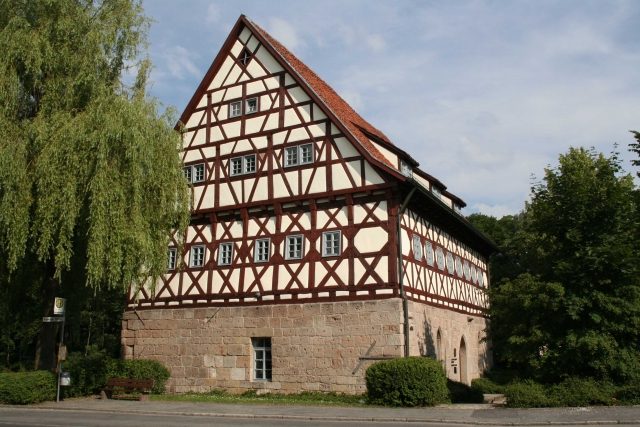
Rosenau Castle, located in Coburg between Rosenauer Straße and Hahnweg on the Rittersteich, was first mentioned as a castle in 1397, and in 1426 as the house of the mint master. In 1434, the Lords of Rosenau probably initiated the new construction of the moated castle. After thorough demolition, use as a fish, wash, and storage house, and gradual decay until the 20th century, it is now exemplarily restored and counts among the jewels of historic architecture in Coburg.
Original Construction
The mint masters Knight Heinz and Günter von Rosenawe, whose noble predicate had been temporarily revoked until 1433 due to improper conduct, built Rosenau Castle as a moated castle in 1434, not far from the outer fortifications of the city of Coburg, after Rosenau Castle in Oeslau. At that time, the brothers were granted the right to mint Coburg coins. Their ancestor, the mint master Friedrich von Ouwe, already documented in 1394, certainly also came from this knightly family, which held this office in Bamberg as early as 1250.
The Hahnfluss, then still called Hainfluss, fed the Rittersteich, which completely surrounded the castle. The western side of the pond, facing the Hahnmühle, was spanned by a stone bridge with two small corner towers, the castle-side end of which was formed by a wooden drawbridge. The actual, rectangular main building, the Palas, was bordered by two Gothic stepped gables and provided with two corner towers on the bridge side, through which one could reach the upper floor. The four-story mighty sandstone structure was adorned with oriels on the gable sides and a projection extending into the Rittersteich.
Reconstruction and Decay
Martin von Rosenau sold the property in 1556 as the last owner from the knightly family to Christoph von Hessberg, and in 1611 Duke Johann Casimir acquired the indebted property. In 1671, it was demolished down to the lower floor. On the remains of the Palas, a story and a mighty gable roof in beautiful decorative half-timbering were added. Subsequently, the ducal brewery was housed in the building. The court fisherman lived on the upper floor. In 1700 and 1773, the former castle is called the princely fish house. The bridge was demolished in 1842 and the pond was filled in, except for a small part that still exists today.
At the beginning of the 19th century, drastic alterations were made again. The windows on the upper floor and in the roof gable were enlarged without regard to the existing beam structure of the rare Franconian K in the half-timbering, and the half-timbering was plastered. From then on, the building served as the washhouse of the ducal family and was also popularly known as such.
Current Use+
After the Second World War, the building served for a time as a storage facility for sets, furniture, and props for the State Theater, until it was cleared out and left to decay. At the end of the 1970s, the Free State of Bavaria, owner since 1919, had the castle on the Rittersteich fundamentally renovated, its Franconian half-timbering exposed and restored. For several years, the Coburg construction management of the State Building Authority Bamberg has had its offices in the building.
Take Mobile History with you
You are reading this text for free. Premium adds what matters on the road: descriptions read aloud, sites found through your camera, whole regions taken offline.
- Every description, including the ~17,700 Premium sites
- Audio guide: have descriptions read to you on location
- AR finder: see sites through your camera, with distance and bearing
- Unlimited saved sites
14 days free, then from €2.99 a month. Cancel anytime.
Source: Wikipedia · Licence: CC BY-SA 4.0
This description draws on the facts documented in the linked Wikipedia article; Wikipedia content is licensed under CC BY-SA 4.0. Wording and editing: Mobile History.
Location: 50.2639, 10.9672