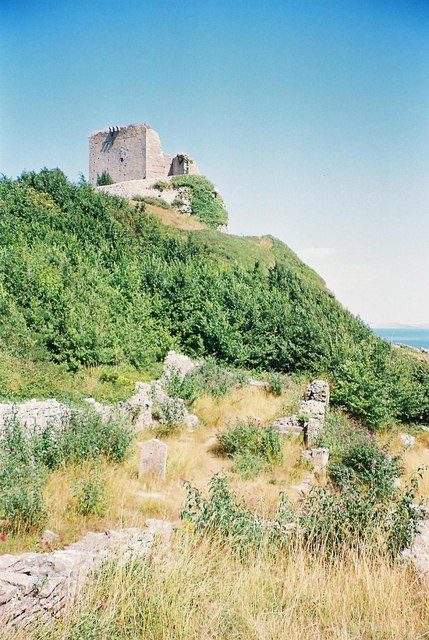
The remains of the Castle can be visited
Rufus Castle

Rufus Castle, also known as Bow and Arrow Castle, is a ruined castle overlooking Church Ope Cove on Portland, England. The castle is a Grade I listed building, dating from the late 15th century, on the site of an earlier building - making it Portland's oldest castle. Remains include parts of the keep, outer bailey, sections of wall with gun ports and a 19th-century round-arched bridge across Church Ope Road.
Rufus Castle was reportedly built for William II and that the structure still standing in ruins today was the keep of a larger castle. Although very little remains of the original castle, the possible exception is the arch that spans over the path from Church Ope Road. However, the archway has been rumoured to be of Tudor origin from when the castle was partly rebuilt. In 1142, Robert, Earl of Gloucester, had captured the castle from King Stephen on behalf of Empress Maud. It had additional fortifications added in 1238 by Richard de Clare who owned it at that time. Around 1256, Aylmer de Lusignan obtained a licence to crenellate the 'insulam de Portand' and Robert, Earl of Gloucester, was granted a similar licence just 14 months later. It is generally presumed that Rufus castle is the site of any work that may have resulted from these licences and any remains that may date from the period exist only at foundation level, or have been lost to cliff erosion. It was rebuilt in the 15th century, and much of what remains today dates from this time. In 1989, the castle's seaward arch collapsed.
In an article in the Free Portland News issue of May 2010, it was reported that the remaining ruins of the castle might be a folly built by John Penn, who owned the nearby Pennsylvania Castle, sometime in the early 1800s and therefore nothing like the castle seen in the late 1700s.
Castle design+
The castle, constructed in the form of a pentagon, has 7-foot-thick walls pierced by numerous loop-holes meant to allow archers to fire at attackers. This gave the castle an alternative name; "Bow and Arrow" Castle. It is built with Portland stone.
Rufus Castle features walls of roughly squared rubble and no roof. The walls to the north and west stand to their full height and retain at the top a number of shaped corbels for a machicolated parapet, but part of the south-east wall, which is thinner, has broken away. To the south-west is a gateway with four-centred, arched head; to the north is a 19th century gateway with a round-arched head approached by a bridge of the same date. In the south-east wall is a chamfered stone jamb of a doorway which has been closed up. In the north and west walls, at first-floor level, are five embrasures, splayed internally under segmental rear arches, with circular gunports. Outside the south gateway are the remains of stone footings and there are said to have been further buildings to the east, where the cliff has fallen away. The pentagonal tower of Bow and Arrow Castle overlooking Church Ope Cove has late Medieval gunholes, but rests uncomfortably on an earlier foundation to the north and stepped plinth to the west which may have been a 12th century keep.
Ownership+
Rufus Castle has been owned by Mark Watson since the mid-1990s, a writer and broadcaster on royalty and genealogy. He has written books on royalty such as Royal Families Worldwide.
In the Sunday Mirror issue from 10 August 1997, an interview/article based on Watson was written by Caroline Sutton. In the article, which had the headline "Hello darling... I'm king of the £1 castle.", Watson revealed plans to turn the castle into a tourist attraction, with the article writing "Home is a council house, he drives a shaky old car and his income amounts to shirt buttons. But Mark Watson has just snapped up his very own clifftop castle... for £1. Now Mark, wife Caroline and their four children can't wait to show the castle off to the royals who often pop in to their terraced house for tea - honestly. Mark, 33, believes that battered Rufus Castle - built on the Dorset coast by William The Conqueror's son - can be transformed into a national treasure. He has already set his plans into motion and predicts that restoration will cost at least £250,000. He said: "People may think it's a mad scheme, but I'm sure it will work. I want to set up a fund and restore it as a local bit of heritage and a tourist attraction." Warning bells might have sounded to anyone but Mark when the last owners felt the castle was such a liability that they were willing to let it go for a quid. At least Mark's home in Kinson, Bournemouth, provides a roof over their heads and three bedrooms. The castle has no roof and not even four walls. But Mark's colourful outlook and big plans convinced the former owners he was the right man to take it on. He's had a succession of jobs since leaving school at 16 and now concentrates on tracing family trees."
Take Mobile History with you
You are reading this text for free. Premium adds what matters on the road: descriptions read aloud, sites found through your camera, whole regions taken offline.
- Every description, including the ~17,700 Premium sites
- Audio guide: have descriptions read to you on location
- AR finder: see sites through your camera, with distance and bearing
- Unlimited saved sites
14 days free, then from €2.99 a month. Cancel anytime.
Source: Wikipedia · Licence: CC BY-SA 4.0 · Image: Chris Downer / CC BY-SA 2.0 via Wikimedia Commons
This description draws on the facts documented in the linked Wikipedia article; Wikipedia content is licensed under CC BY-SA 4.0. Wording and editing: Mobile History.
Location: 50.5395, -2.4283