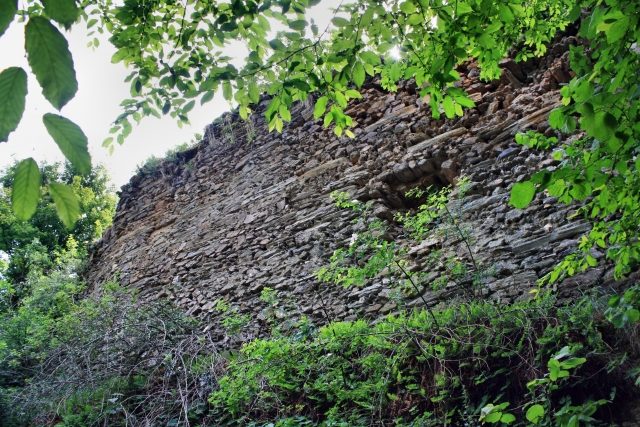
RuinAdolfseck

Adolfseck Castle (Ruin)

Adolfseck Castle (Ruin)

The remains of the Castle can be visited

Adolfseck Castle is a ruined spur castle on the southern edge of the Bad Schwalbach district of Adolfseck, on an inselberg of the Aar river. It is located in the Rheingau-Taunus-Kreis in Hesse.

In a feudal letter from the Archbishop of Mainz, Gerlach von Nassau, dated February 18, 1356, it is mentioned that Count Adolf I of Nassau-Wiesbaden-Idstein was in the process of building Adolfseck Castle and that he would receive it as a fief from the Archbishop. Eleven years later, Adolfseck was granted town rights. After Adolf's death in 1370, the property passed to his son Count Walram IV, who handed the castle over to his brother Johann in 1386. When the latter became Archbishop of Mainz in 1397, it returned to Adolf II, his nephew and son of Adolf of Nassau-Wiesbaden-Idstein.

The Nassau castle served not only to secure the Bäderstraße (Spa Road) but also as protection against the County of Katzenelnbogen, which owned Hohenstein Castle a few kilometers to the north.

After the extinction of the Nassau-Idstein line in 1605, a legal dispute arose over the castle, which was decided in favor of Kurmainz in 1612. However, the defeated heir, Count of Nassau-Weilburg, retained control. During the Thirty Years' War, the castle was probably besieged by the Adolfseck redoubt located to the north. Already in 1612 it was in poor condition, but it was temporarily reoccupied in 1653. By 1679, only a "collapsed pile of stones" remained.

The main castle, oval in plan, was probably of Romanesque origin and is located on a mountain spur. To the west, south, and east, there was originally a loop of the Aar river dammed up to form a lake. Access was through a gate tower in the town fortifications of the valley settlement, which was connected by a straight path to the gate tower of the outer bailey. East of the outer bailey, a path running parallel to the Aar breakthrough ditch led south to the gate tower of the core castle. This oval main castle was approximately 55 m by 40 m in size and consisted of a polygonal curtain wall. A 6-8 m wide zwinger was added in the mid-14th century, which merged into the neck ditch in the north.

Only minor remains of walls and a well are preserved from the castle; the oval main castle is only recognizable in its ground plan. The entire complex is a protected monument.

Take Mobile History with you

You are reading this text for free. Premium adds what matters on the road: descriptions read aloud, sites found through your camera, whole regions taken offline.

  • Every description, including the ~17,700 Premium sites
  • Audio guide: have descriptions read to you on location
  • AR finder: see sites through your camera, with distance and bearing
  • Unlimited saved sites

14 days free, then from €2.99 a month. Cancel anytime.

Source: Wikipedia · Licence: CC BY-SA 4.0

This description draws on the facts documented in the linked Wikipedia article; Wikipedia content is licensed under CC BY-SA 4.0. Wording and editing: Mobile History.

Location: 50.1589, 8.0799