The remains of the Castle can be visited
Alt-Regensberg Castle (Ruin) (Regensdorf)
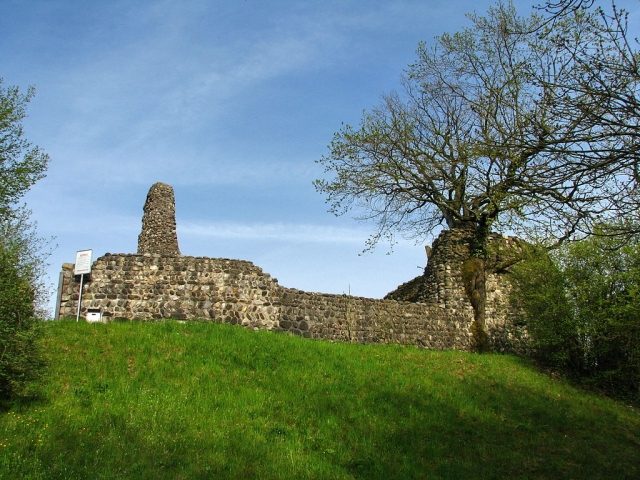
The castle dates back to the high nobleman Lütold von Affoltern and was probably built as the ancestral seat of the Lords of Regensberg around 1040. The original origin of the Regensbergers is not precisely known. It is presumed that they were settled in the Mâcon region. The Regensberg family was very powerful, and their possessions were widely scattered. Among other things, the Regensbergers were the founders of the monasteries of Fahr and Rüti and the towns of Regensberg and Glanzenberg.
Around the year 1050, the Regensbergers became responsible for the ecclesiastical needs of the population and built the St. Niklaus Chapel as a parish church in Oberregensdorf, by far the oldest building in the municipality of Regensdorf and at the same time one of the oldest ecclesiastical buildings in the Canton of Zurich.
Lütold I, the son of Lütold von Affoltern, began to call himself after Alt-Regensberg Castle and died in 1088 in battle against the abbot of St. Gallen Monastery.
Lütold IV had finally expanded his position of power to such an extent that he could call himself Count of Regensberg from the early 13th century. At this time, he owned estates and rights in large parts of the Zurichgau, in Thurgau, Klettgau, and far into Aargau.
The old ancestral castle was now significantly expanded with a stone curtain wall, a cistern, and new economic buildings. The tower of Alt-Regensberg Castle was also newly constructed with carefully hewn bossed ashlar blocks.
Decline of the Regensbergers
After the death of Lütold V (around 1250), his two sons, Lütold VI and Ulrich von Regensberg, divided the inheritance. Ulrich received the castle town of Neu-Regensberg as well as possessions in the area of Glanzenberg, Fahr, and Weiningen. Ulrich henceforth resided in Neu-Regensberg, his brother Lütold VI in Alt-Regensberg. Now began a long series of sales and pledges, without which the family apparently could not maintain their lifestyle. The Regensberg Feud of 1267/68, which is only fragmentarily documented, falls into the two decades after the division of inheritance between Ulrich and Lütold VI, ending with the economic decline of the Regensbergers and the sale of their possessions to Habsburg feudal lords.
The last secular representative, Lütold IX, probably inhabited the ancestral castle of Alt-Regensberg. In 1321, Lütold IX issued a document for the last time at Alt-Regensberg. He died about ten years later as the last male representative of the family. The shift of the Habsburg center of power to Austria is reflected in the repeated pledges of Regensberg.
When the Regensbergers died out in the male line with Lütold IX around 1331, the castle passed into the possession of the Lords of Landenberg-Greifensee in 1350 through inheritance. In 1444, the last representative of the Landenbergers handed over the castle to the Confederates during the Old Zurich War. They probably did not spare it. When the complex was bought in 1458 by the wealthy Zurich merchant and textile dealer Rudolf Mötteli, he completely renovated it, but left the building fabric as it was. Due to a dispute with the city of Zurich, Mötteli was dispossessed by the Zurich authorities as early as 1468.
Zurich saw no use for the complex, neither militarily nor for administrative purposes. Therefore, it gradually fell into disrepair and was used as a quarry. In 1705, the people of Regensdorf obtained building material for the new church from the old castle, and in 1775, the bridge of Adlikon was built from its stones. During the Helvetic Republic, the ruin passed from the city into the possession of the Canton of Zurich. Its slopes, however, remained private and served as vineyards. Their owners considered demolishing the curtain wall because falling stones bothered them. A protection order saved the ruin, and at the beginning of the 20th century, the Altburg was preserved in its current form.
Take Mobile History with you
You are reading this text for free. Premium adds what matters on the road: descriptions read aloud, sites found through your camera, whole regions taken offline.
- Every description, including the ~17,700 Premium sites
- Audio guide: have descriptions read to you on location
- AR finder: see sites through your camera, with distance and bearing
- Unlimited saved sites
14 days free, then from €2.99 a month. Cancel anytime.
Source: Wikipedia · Licence: CC BY-SA 4.0
This description draws on the facts documented in the linked Wikipedia article; Wikipedia content is licensed under CC BY-SA 4.0. Wording and editing: Mobile History.
Location: 47.4285, 8.4820