CastleFlims

Belmont Castle (Ruin) (Flims)
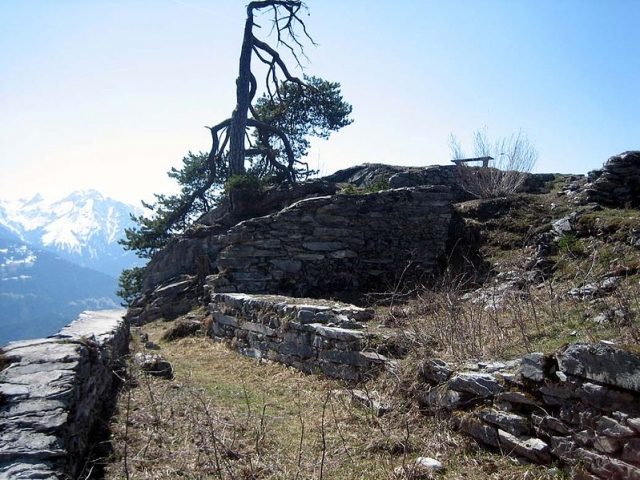
Belmont Castle (Ruin) (Flims)

The remains of the Castle can be visited

The ruins of Belmont Castle are located northeast of Flims in the Swiss canton of Graubünden, with a line of sight to Crap Sogn Parcazi Castle.

Location+

The complex is situated in the forest between Flims-Fidaz and Alp Bargis on a rock approximately 50 m high, high above the road from Trin to Flims. From the castle, both nearby Hohentrins and Hochjuvalt and Ortenstein in Domleschg were visible. The castle rock is easily accessible on foot in half an hour from a parking lot. The final ascent is via a steep path on the north side, with steps partly carved into the rock.

Complex+

In 1930, according to Erwin Poeschel, only minor wall remnants of the entire complex were visible. Between 1932 and 1936, the floor plan was excavated and the wall remnants secured.

Access leads via a brick ramp to a plateau with dimensions of approximately 70 by 30 meters. An irregularly shaped curtain wall surrounds it, against which the three main parts of the complex leaned. In the west, there was likely a gatehouse, perhaps with stables. The central building complex, of which wall remnants are still visible, consisted of a structure approximately 10 by 8 m with a door on each of the narrow sides and probably served as living quarters.

The buildings in the east consist of various parts, erected in several phases and no longer individually recognizable. Remains of wall paintings were found in the southeastern room. The superstructures were probably largely made of wood.

In the center of the complex is a large circular filter cistern. The low wall around it served as the foundation for a covered structure.

On the part of the complex located approximately 10 m higher, a narrow rock ridge about 30 m long and 10 m wide, no traces of a building are recognizable, but it cannot be ruled out that a tower once stood there, possibly made of wood.

The oldest datable archaeological finds, including a spur, date from the turn of the 10th to the 11th century. It is presumed that the oldest parts of the Belmont complex date from that period. Although the complex was demonstrably inhabited until the 14th century, it was not significantly rebuilt after the mid-12th century. This suggests that the owners had moved their main residence to other castles.

Belmont was the ancestral seat of the family of the same name, who belonged to the small circle of noble free lords of the Vorderrhein valley and owned estates in Flims, Vals, and Lugnez. The name Belmont is the Latin/Romance version of the common name Schönenberg. The von Belmont family first appears in documents as witnesses in the Gamertingen treaties of January 22, 1139, where a Lutefridus de Belmont is mentioned. With these treaties, the Bishop of Chur sealed the purchase of various estates in the Upper Engadine from the Counts of Gamertingen.

The Barons of Belmont were related to the Barons of Vaz, and possibly also to the Tarasp family. They provided canons to the Diocese of Chur and, with Konrad III von Belmont, a bishop from 1273–1282. The oldest named Rhaetian student at the University of Bologna was a Heinrich von Belmont. The family died out in 1371 with Ulrich Walter von Belmont. Through his sister Adelheid, married first to Heinrich von Rhäzüns, a part of the considerable inheritance passed to her daughter Elisabeth von Rhäzüns, wife of Caspar von Sax-Misox.

Belmont Castle is first mentioned in documents in 1380 on the occasion of an exchange of properties between Elisabeth von Rhäzüns and her cousin Brun von Rhäzüns. Elisabeth reserved ...the hill (Bühel) and the castle site at Belmunt and the court at Flyms... as well as all serfs, ...who formerly belonged to the same castle at Belmunt... However, the castle was probably already abandoned at that time.

There are no indications of violent destruction, for example during the Belmont Feud of 1352, or traces of fire. It is conceivable that an earthquake in 1356 or 1358 accelerated the castle's decay. In 1461, the complex is mentioned again: In an arbitration award concerning the border between Flims and Trin, it states ...behind the castle site Belmunt.

Take Mobile History with you

You are reading this text for free. Premium adds what matters on the road: descriptions read aloud, sites found through your camera, whole regions taken offline.

  • Every description, including the ~17,700 Premium sites
  • Audio guide: have descriptions read to you on location
  • AR finder: see sites through your camera, with distance and bearing
  • Unlimited saved sites

14 days free, then from €2.99 a month. Cancel anytime.

Source: Wikipedia · Licence: CC BY-SA 4.0

This description draws on the facts documented in the linked Wikipedia article; Wikipedia content is licensed under CC BY-SA 4.0. Wording and editing: Mobile History.

Location: 46.8456, 9.3342