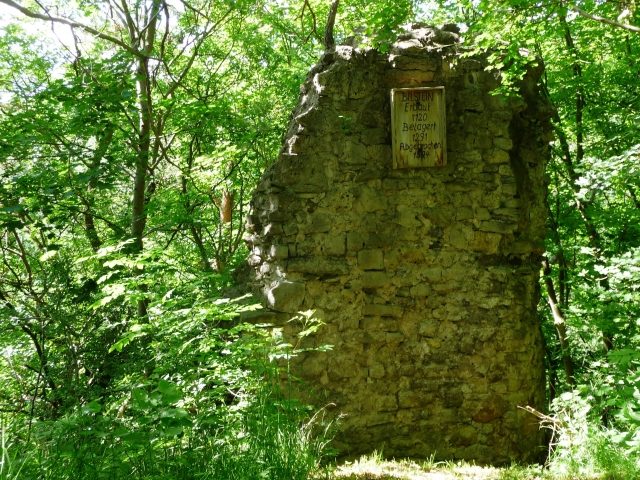
The remains of the Castle can be visited
Bilstein Castle (Ruin) (Albungen)

Bilstein Castle is a lost castle near Eschwege, in North Hesse (Germany).
The complex, of which minor wall remains and traces of a cellar and well are preserved, was the seat of an influential Thuringian noble family, who called themselves Counts of Bilstein from about 1140/1145.
The ruin of the hilltop castle is located on the high Bilstein, which has been a nature reserve since 1960 with hornbeam and oak forest, and on the south slope oak and wild service tree forest. It lies west of the village of Albungen, a northwestern district of Eschwege. The Bilstein rises about 100 m above the valley of the Berka stream, not far from its confluence with the Werra. Its rocks drop almost vertically towards the Berka. The Berka valley at this point is very narrow and steep-sided and is therefore called Höllental (Hell Valley).
Bilstein Castle was built by the Counts of Bilstein, probably on the remains of an earlier existing but then destroyed complex. The ancestors of the family are documented at least since Wigger I in the second half of the 10th century. After renewed destruction around 1100, the castle was rebuilt by Count Rugger II (Rüdiger II) in 1120 with a footprint of 40 x 25 m, and from about 1140/'45, Rugger and his descendants then called themselves "von Bilstein". This name was later also used in historiography for the ancestors up to Wigger I.
Around 1283, the castle was mentioned as being in the possession of Heinrich von Treffurt, who also called himself Heinrich von Bilstein. Landgrave Albrecht of Thuringia, who accused the Bilsteins of highway robbery and breach of the peace, besieged and conquered the castle in 1291; it was probably significantly damaged in the process. Ten years later, in 1301, the last Count of Bilstein, Otto II, sold the castle – as well as all his feudal and allodial possessions – to Landgrave Heinrich I of Hesse. Otto died impoverished in 1306.
The castle was subsequently administered by Hessian castellans or temporarily pledged to various noble families; for example, from 1350 to 1372 to the Lords of Treffurt. Until the 16th century, the Lords of Hundelshausen and those of Eschwege, among others, are documented as officials at the castle.
In the 16th century, the castle fell into disrepair. Although it was repaired once more from 1559 to 1562, it was then demolished in 1594.
Viewpoint+
From a viewing platform on the former castle grounds, one can see west along the Berka valley to the Meißner and east over the Werra valley to Fürstenstein Castle.
Take Mobile History with you
You are reading this text for free. Premium adds what matters on the road: descriptions read aloud, sites found through your camera, whole regions taken offline.
- Every description, including the ~17,700 Premium sites
- Audio guide: have descriptions read to you on location
- AR finder: see sites through your camera, with distance and bearing
- Unlimited saved sites
14 days free, then from €2.99 a month. Cancel anytime.
Source: Wikipedia · Licence: CC BY-SA 4.0
This description draws on the facts documented in the linked Wikipedia article; Wikipedia content is licensed under CC BY-SA 4.0. Wording and editing: Mobile History.
Location: 51.2273, 9.9647