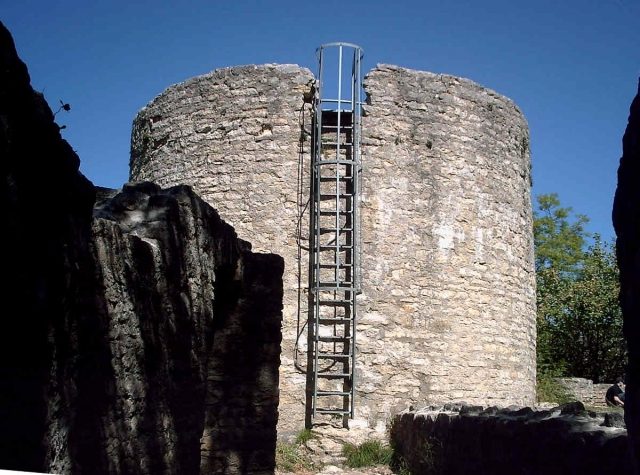
The remains of the Castle can be visited
Bischofstein Castle (Ruin)

The Bischofstein ruin is a medieval castle ruin in the Ergolztal valley in the Swiss canton of Basel-Landschaft.
North of Sissach (on the municipal border between Sissach and Böckten), the Bischofstein ruin is located in close proximity (100 meters north) to the Itkon ruin on the ridge of the Chienberg. The ruin is easily accessible from Sissach or Sissacherfluh via hiking and footpaths.
Bischofstein Castle was built along a vertical rock face, which forms a natural protection for the fortress in the northwest. The other sides were separated from the surrounding terrain by a deep trench system.
Two construction phases can be distinguished:
- The original castle: The curtain wall follows the irregular course of the rock head. While it is quite weakly constructed above the rock face, it reaches a thickness of over one and a half meters above the moat. The original access was from the northeast from the moat via a ramp (remains of the gate system can still be seen on the inside of the curtain wall). The gate was (as is common in this region) designed as a strong door. The complex was and is dominated by a round keep with a wall thickness of 2 meters 30 and a clear width of only about 3 meters.
- Extension: A protected filter cistern and a new, outer gate system with a Zwinger (outer bailey) were added to the west and south of the complex. During this expansion phase, an inner gate was broken through in the original southern curtain wall (passage from the Zwinger to the castle courtyard) and the old gate was walled up.
The Lords of Eptingen apparently enjoyed a rather comfortable lifestyle for the time: the many well-preserved stove tiles found (glazed and unglazed versions) indicate several ovens, and the windows were partly glazed (panes set with lead rods). The many iron parts, an almost complete brass pan, and even a bronze lock also indicate considerable prosperity.
During the construction of the fortress, not only fresh material from the neck ditches was used, but it can be assumed that the immediately adjacent Itkon ruin - which was already in decay at the time - was also exploited as a building material supplier.
After the extinction of the Itkon family, the Lords of Eptingen took over or inherited their property in the Chienberg area and built Bischofstein Castle around 1250. As was often customary at the time, the castle was handed over to a sovereign (in this case, the Bishop of Basel) to ensure better protection and received back as a fief (first evidence: 1311 Ulrich von Bischofstein): Here, the name of the fortress was even chosen accordingly to make this transfer and the resulting protection visible.
Bischofstein Castle appears to have been damaged in the 1356 Basel earthquake. Older reports speak of a repair and use of the castle until the 15th century, but this assumption seems, according to Meyer, to result from a misdating of the finds: glass finds were dated too young by the excavators in 1937/38. Thus, it can be assumed that the Eptinger did not prioritize this fortress in the repair work and let it fall into disrepair.
In the middle of the 15th century, the Eptinger sold Bischofstein to the Basel ministeriales, the Lords of Rhein, and already on November 15, 1464, they sold Bischofstein to Wernher Truchsess von Rheinfelden and Peter Offenburg von Basel. Shortly thereafter, the Truchsessen von Rheinfelden gave up their possession, and the Offenburger remained the sole owners for about 100 years. On January 24, 1560, the ruin with the associated estates and rights (the ruin itself was probably no longer interesting, but the estates and rights very much so) passed to the city of Basel, which assigned it to the Farnsburg office for administration.
Unfortunately, treasure hunting was repeatedly carried out at Bischofstein, destroying archaeologically interesting finds. A first excavation motivated by historical interest was carried out in 1914/16 and uncovered the first wall sections and part of the keep. The resulting surge of interest led in 1926 - thanks to financial support from the Sissach citizens' community - to a continuation of the excavation work. In 1937/38, the ruin was then completely excavated and restoratively preserved: This work also integrated the previously made finds.
Take Mobile History with you
You are reading this text for free. Premium adds what matters on the road: descriptions read aloud, sites found through your camera, whole regions taken offline.
- Every description, including the ~17,700 Premium sites
- Audio guide: have descriptions read to you on location
- AR finder: see sites through your camera, with distance and bearing
- Unlimited saved sites
14 days free, then from €2.99 a month. Cancel anytime.
Source: Wikipedia · Licence: CC BY-SA 4.0
This description draws on the facts documented in the linked Wikipedia article; Wikipedia content is licensed under CC BY-SA 4.0. Wording and editing: Mobile History.
Location: 47.4746, 7.8270