To be privately owned
Borghausen Castle (Ruin)

Borghausen Castle is a castle ruin in the area of the city of Attendorn in the Olpe district in North Rhine-Westphalia. The hilltop castle is located about one kilometer northwest of Peperburg on the Breiten Hagen, a 60-meter-high rock massif of the Attendorn-Elsper double syncline, which slopes steeply down to the Lenne and Repe valleys.
The Borghausen manor originated when Bernhard Vogt von Elspe took up residence at Borghausen farm around 1540, which had fallen to him in the inheritance division with his brothers in 1539.
The beginnings of the castle are obscure. It is certain that its history was always closely linked to that of Haus Bamenohl: Already in the mid-15th century, Heidenreich von Plettenberg, whose wife Angela von Heggen had brought a share of Bamenohl into the marriage, united the two estates of Bamenohl and Borghausen in his hand. However, the assertion that the castle is identical with Babenohl Castle cannot be substantiated by sources.
On May 20, 1609, the Borghausen farm was pledged by Wilhelm von Neuhoff and his wife Ursula von Hatzfeld zu Ahausen to the spouses Dietrich and Catharina von Hatzfeld zu Schwarzenberg.
On May 9, 1622, Archbishop and Elector Ferdinand of Cologne enfeoffed Friedrich and Johann Gottfried von Fürstenberg with the offices of Bilstein and Waldenburg as well as with the Lenneamt. According to a tax assessment from 1631, Bernt Vogt still lived in the castle with a servant, a farmhand, three boys, three girls, and a cowherd girl. In 1632, the castle was stormed by Hessian-Swedish troops under Colonel von Linteloe. After the destruction of the castle, Bernhard Vogt von Elspe is said to have hidden for a long time in the so-called Küllenloch from the peasants and soldiers, where his loyal servant supplied him with food during this time.
On July 5, 1649, Johann Bernhard Vogt von Elspe zu Borghausen, son of the deceased spouses Bernhard Christoph Vogt von Elspe and Walburg née von Fürstenberg, married Mechthild Katharina von dem Broel gen. Plater. He owned Haus Borghausen, located "on a rocky spur above the left bank of the Lenne," which has been considered the main seat of the Vogts von Elspe zu Borghausen since about 1540. As a morning gift, the bride received the Plattenhof in Kirchhelden (near the church). The marriage produced a total of 9 children, of whom only the youngest was not born in Borghausen, but around 1673 in Westhemmerde. Vogt von Elspe moved with his family to Westhemmerde, where he now maintained his main residence.
July 30, 1690 – Lease agreement for 16 years of the noble house Borghausen between Konrad Wilhelm Vogt von Elspe zu Westhemmerde and Borghausen and Jobst Edmund Michael Christoph von Beckman and his wife Sybilla Elisabeth von der Heesen.
November 4, 1706 – New lease agreement Borghausen between Konrad Wilhelm Vogt von Elspe zu Westhemmerde and Borghausen and Franciscus Andreas Antonius Außel and his wife Helena Burghoff
In 1790, the Princely Orange-Nassau Chief Steward Baron Voigt von Elspe called von Voß, hereditary lord of Rodenberg, Westhemmerde, Bamenohl, Borghausen, Werl and Oeringhausen, named himself.
Borghausen remained in the possession of the Vogts von Elspe until the 18th century, though not always in direct lineage. The last to die was Gisbert Moritz on the night of March 11-12, 1800, at the age of 80, as Chief Steward Wilhelm of Orange-Nassau in The Hague. He stipulated in his will that his niece Anna Luise Gisbertine von Bodelschwingh née Vogt von Elspe be appointed universal heir. Her daughter from her second marriage, Christine Sophie Luise, married Baron Carl Wilhelm Georg von Plettenberg in 1788, whose family still owns the ruin today.
In 1987, the castle ruin, including the section wall, was entered into the list of monuments of the city of Attendorn.
Anlage+
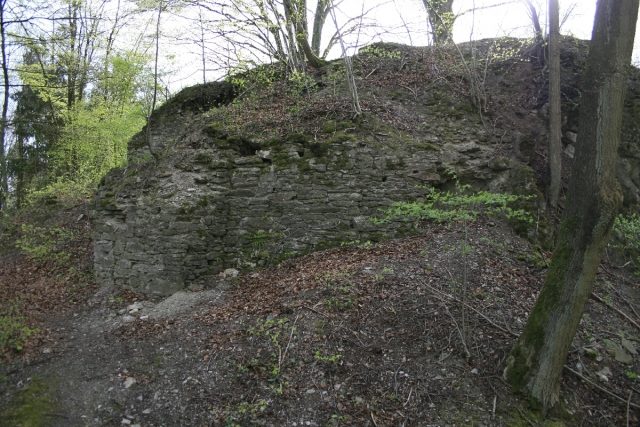
The rubble stones of the castle complex served the inhabitants of the surrounding villages as building material for the construction of their houses, so that today only the dilapidated ruins of the castle are visible. The foundations of a tower on the northern rock nose, which protrudes into the Lenne and Repe valleys, as well as some angular cellar rooms are still recognizable.
The castle was secured by a frontal section wall, which completely sealed off the Benner plateau from the mountain spur 200 meters in front of the complex. Access to the castle was probably not via the plateau but via a sunken path from the Repe valley up to the section wall and from there over the mountain spur to the castle complex. Furthermore, the wall of the Lenne preserved at the foot of the mountain massif could also have belonged to the castle complex. This wall, still up to 3 meters high, made of rubble stones along the old Lenne riverbed, has been removed up to the terrain behind it. The actual access to the castle could have been from the valley, at the point where the Repebach flows into the Lenne.
Nature has overgrown the remains of the ruin with trees and plants, so that the decay continues to progress. In the past, grave robbers have repeatedly dug for objects without the permission of the owner and the office for archaeological monument preservation. Extensive searching with metal detectors yielded no results other than nails. A clear dating of the complex is therefore difficult.
Take Mobile History with you
You are reading this text for free. Premium adds what matters on the road: descriptions read aloud, sites found through your camera, whole regions taken offline.
- Every description, including the ~17,700 Premium sites
- Audio guide: have descriptions read to you on location
- AR finder: see sites through your camera, with distance and bearing
- Unlimited saved sites
14 days free, then from €2.99 a month. Cancel anytime.
Source: Wikipedia · Licence: CC BY-SA 4.0
This description draws on the facts documented in the linked Wikipedia article; Wikipedia content is licensed under CC BY-SA 4.0. Wording and editing: Mobile History.
Location: 51.1478, 7.9961