The remains of the Castle can be visited
CastleBossonnens
Bossonnens Castle (Ruin)
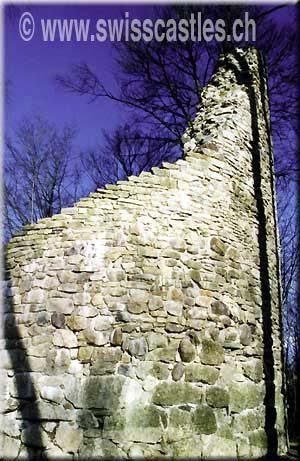
In the municipality of Bossonnens in the Vivisbach district, Canton of Fribourg, Switzerland, the Bossonnens Ruin, a former castle, is at approximately 752 meters above sea level. Its remains are now freely accessible.
History+
The origins of the Bossonnens lordship likely date back to the first millennium when the area was under the Abbey of Saint-Maurice. In the 12th century, it came into the possession of the Blonay family, who had the Bossonnens castle, with its square tower, built in the second half of the century. In the early 13th century, Rudolph I of Oron took over the lordship, and in 1221, a chapel of the Grand-St-Bernard chapter in Bossonnens was first mentioned. Under Amédée I of Oron-Bossonnens-Attalens, the lordship experienced its heyday in the late 13th century. Around 1260, he had a Savoyard-style circular watchtower built and founded a small village between this tower and the castle. However, the 14th century brought decline, division, and loss of independence. After the Oron family died out in the early 15th century, the lordship increasingly fell into disrepair. In 1513, Bossonnens fell to the Duke of Savoy. After the Reformation in 1536, Bossonnens became a Fribourg bailiwick, but in 1618, the castle was sold to a private individual and subsequently fell into ruin.
Take Mobile History with you
You are reading this text for free. Premium adds what matters on the road: descriptions read aloud, sites found through your camera, whole regions taken offline.
- Every description, including the ~17,700 Premium sites
- Audio guide: have descriptions read to you on location
- AR finder: see sites through your camera, with distance and bearing
- Unlimited saved sites
14 days free, then from €2.99 a month. Cancel anytime.
Source: swisscastles.ch
Text and/or image for this object come from the linked site and are used with the permission of its operators; the linked page remains the copyright of its authors. The legacy catalogue kept text source and image source in a single field, so which part came from there can no longer be told apart entry by entry.
Location: 46.5206, 6.8483