RuinWichmannshausen

Boyneburg Castle (Ruin) (Wichmannshausen)
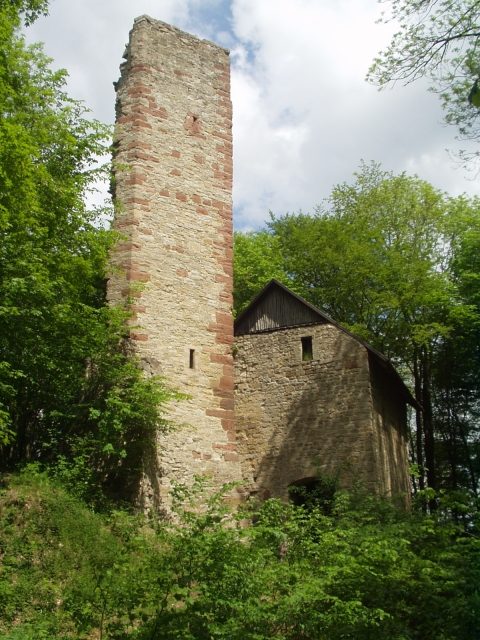
Boyneburg Castle (Ruin) (Wichmannshausen)

The remains of the Castle can be visited

The Boyneburg, also known as Bemelburch, is a castle ruin of a former hilltop castle in the urban area of Sontra in the Werra-Meißner-Kreis in Hesse (Germany). The Boyneburg ruin stands in the Ringgau about 2.5 km east-southeast of Wichmannshausen, a north-northeastern district of Sontra. It is located on the wooded Boyneburg mountain, a limestone mountain with steeply sloping sides, which rises between the flowing waters of Netra to the north, Ulfe to the southwest, and Sontra to the west. The castle encompassed about 4.5 hectares of the partly unwooded mountaintop area. In the northern part of the mountain, on the steep slope, are the remaining castle ruins.

In the valleys around the mountain, to the west are Boyneburgk Castle and the Boyneburgk Estate, and to the east of the mountain is the Harmuthshausen Estate.

Layout+

The core castle is separated from the outer bailey by a neck ditch. It has a trapezoidal ground plan, with its wider side facing the rising slope to the south. To the north, above the sloping steep side, is the narrow side of the castle complex. The outer bailey was secured by three ditches, which are still recognizable today.

Of the buildings, only two approximately 25-meter-high walls of the pentagonal keep and some foundation walls remain. The gatehouse, attached to the keep, was only rebuilt in its original location in 1952 and 1953. The masonry shows rubble stone and bossed ashlar.

The ruin is still owned by the von Boyneburg family today. Both the family and the castle appear over time in documents under the names Bumeneburc (1123), Boimeneburch (1137), Buonineburch (1156), Böbeneburc (1217), Boimiberg (1261), Bonneburg (1262), Bömeneburg (1292), Boyneborg (1392). Even today, the names Bemelburg, Bomeneburg, or Boeneburg exist in the region for the ruin and the mountain.

It is confirmed that a refuge castle existed on the Boyneburg mountain, Netra and Ulfe, in prehistoric and early historical times.

In the 11th century, the mountain came into the possession of the Counts of Northeim, who presumably built the first fortifications from tree trunks. It is assumed that the name of the castle and the mountain is derived from this. The castle was first mentioned in a document in 1107 as "Bemelburch" in a charter by Emperor Henry V, who had the castle destroyed due to raids by the castle men. Nevertheless, Count Siegfried III of Northeim, son of Otto of Northeim, received the castle again from the emperor as an imperial fief and rebuilt it. After his death in 1108, Count Siegfried IV of Northeim took over the castle; from 1123 onwards, he also called himself "Commes de Boumeneburc". He died in 1144, as the last male descendant of the Northeim family, and the castle reverted to the emperor as an expired fief.

Between 1150 and 1160, Abbot Markward of Fulda took over the dilapidated castle and had it repaired. He wanted to protect the monastery's possessions in the region from the castle. Emperor Frederick I (Barbarossa) was at the castle for the first time in 1156, and it was referred to as an imperial castle. Barbarossa held a court day at the castle in 1166 and an imperial diet in 1188, and in 1188 he endowed income for the priestly position at the castle chapel. In 1189, Emperor Frederick I Barbarossa set off from the Boyneburg for the Third Crusade, during which he died in 1190.

Since the castle was located between the important imperial estates in the Harz and in the Wetterau, it was of political importance to the empire. It was occupied by imperial ministerial castle men, who at least since 1138 named themselves after the castle. This family split into three branches in the 13th century.

After the end of the Thuringian-Hessian War of Succession in 1264, Landgrave Henry I of Hesse received eight fortified localities on the Werra from Henry of Meissen; among them was Eschwege. On May 12, 1292, Henry I was enfeoffed by King Adolf with Eschwege and the imperial castle Boyneburg as an hereditary imperial principality, thereby attaining the dignity of an imperial prince. This led to disputes for over two centuries with the former imperial ministerials at the castle, who did not recognize the feudal lordship of the Landgraves of Hesse. A settlement between the Landgraves and the von Boyneburg family was only reached in 1449, and from 1460 onwards, the von Boyneburg held the castle as a Hessian hereditary fief. By this time, however, they had already left the castle and taken up residences on their estates below the castle.

After 1571, a bailiff still lived in the castle, and in 1595 it was still in good condition, but then began to decay. During the Thirty Years' War, the castle was plundered in 1626 by troops under the command of Tilly and partially burned down by Croats in 1637. Nevertheless, it was occupied by a bailiff until 1672, before it was finally abandoned and served as a quarry for the surrounding population.

Current Use+

The castle area is a protected monument, and the castle hill is used for forestry. Due to its significance for imperial and state history, archaeological excavations have taken place several times. The Boyneburg is also a tourist attraction in the Ringgau. Every Ascension Day, the bread donation festival is celebrated at the castle.

"The Maiden of Boyneburg" (in several versions) is a legend from the Brothers Grimm's work "German Legends":

In ancient times, many years ago - when this castle was still inhabited by the Boyneburg family, three sisters lived here, bound in intimate love. Of these sisters, the youngest, who was born during a thunderstorm, once dreamed that she would lose her life in a thunderstorm.
When she reached her 18th year, a strong thunderstorm approached the Boyneburg and remained over it for three days and nights. Then the youngest maiden remembered her dream and shared it with her sisters, who decided to sacrifice themselves for their darling; The two eldest rushed to the castle gate, implored heaven's grace and protection, and were ready to die. But the thunderstorm did not recede. Then the youngest maiden recognized her fate, bravely and trusting in God, she went out in front of the castle, in a fervent prayer she commended her soul to the Most High, - then a lightning bolt flashed and she was gone - , the thunderstorm had also receded, it was appeased.
This donation is distributed in her memory.

The foundation of the donation by the maiden of Boyneburg, condemned to death, who in her will - according to some versions of the transmitted legends - is said to have stipulated "that on the day of her death the entire community should be fed and gifted".

This service may only be held by a pastor from the district of Datterode. Previously there was bread and bacon. Today only bread, which is thrown into the crowd by the current Baron.

Take Mobile History with you

You are reading this text for free. Premium adds what matters on the road: descriptions read aloud, sites found through your camera, whole regions taken offline.

  • Every description, including the ~17,700 Premium sites
  • Audio guide: have descriptions read to you on location
  • AR finder: see sites through your camera, with distance and bearing
  • Unlimited saved sites

14 days free, then from €2.99 a month. Cancel anytime.

Source: Wikipedia · Licence: CC BY-SA 4.0

This description draws on the facts documented in the linked Wikipedia article; Wikipedia content is licensed under CC BY-SA 4.0. Wording and editing: Mobile History.

Location: 51.1016, 10.0093