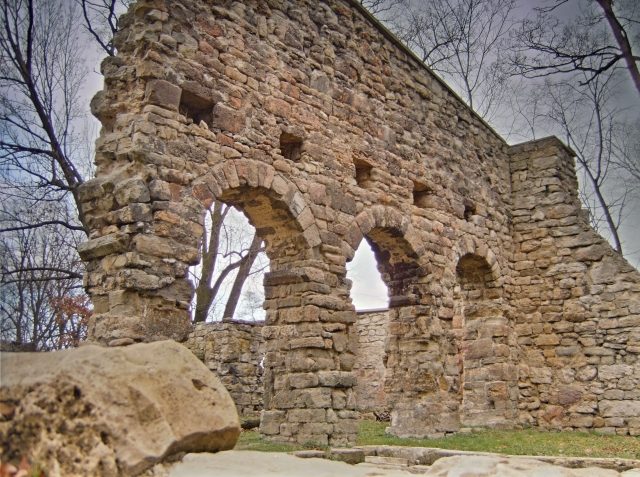
The remains of the Castle can be visited
Cyriakskirche (Ruin) (Camburg)

The Cyriaxkirche in Stöben (town of Dornburg-Camburg) is, according to some historians, the only building in Thuringia preserved from the turn of the first millennium. It is also known as St. Cyriakus, Cyriaksburg, or Cyriaksruine. The building is, considering its importance for the region, little known.
Description
The ruin of the church is located 1.5 km northwest of the small town of Camburg in the Saale-Holzland district in Thuringia.
History
Whether the church was founded in the 10th century cannot yet be definitively proven. Structural remains date back to the 11th century. The church could therefore be connected to a fortification "Stuwi". The castle district of "Stuwi" probably adjoined that of Dornburg to the north, or was part of the Dornburg castle district.
It is uncertain whether this church or the area is identical with the possessions of a countess mentioned in the year 999.
In the year 999, Thietmar of Merseburg noted in his chronicle:
:„De quorum numero quaedam cometissa nomine Cristina predii suimet, quod in Stuwi civitate habuit, magnam partem sancto tradidit Maurico in Magadaburg.“ (Among them was a countess named Christina, who conveyed a large part of her inheritance, which she had in the castle of Stöben, to Saint Maurice in Magdeburg.)
The castle mentioned in the chronicle is no longer traceable today.
From the mentioned Moritzkloster in Magdeburg, the Augustinian Canons' Monastery Neuwerk near Halle was founded.
In the year 1121, a papal confirmation document certifies the affiliation of the "Church of Stubi" to the Augustinian Canons' Monastery Neuwerk/Saale.
A female skeleton was found, which, however, is dated to a later period. It might be Adelheid, the wife of Dietmar von Selbold, from the Ludowingian house (see founding history of Lausnitz Monastery). She built a hermitage near her possessions "Rysen" (deserted village of Reißen, near Eckolstädt). It is possible that this could have been located in the immediate vicinity of the church ruin now referred to as Cyriaxkirche. At least, the castle of Stöben, which had come into the possession of Dietmar von Selbold, must have been connected with this hermitage.
The church was a parish church until 1539. Probably, similar to Rodameuschel, there was a secession of the parish "St. Laurentii" from the parish "mons St. Cyriaci" in the 14th or 15th century.
The church was abandoned after 1539, as the Reformation led to the merging of the parishes "St. Laurentii", "mons St. Cyriaki" and "mons St. Petri". Since then, it served as a quarry.
Structure
The church uses an Ottonian architectural style and is one of the few preserved buildings from this period (List of Ottonian buildings). Due to the uniqueness of the church, it is even used as a reference (Camburg type).
The hall church consists of a nave, to which a strongly recessed chancel (presbytery) and a rectangular altar room are attached. Four arches each separated two side rooms from the chancel, but only three arches from the southern arcaded row are preserved. In these, beam holes can be seen, indicating the low roof height of the side rooms.
On the southern front, a small window, a light slit tapering outwards, is originally preserved.
Two underground passages lead from the complex, which are now filled in. One can still be walked for a few meters; it is said to have originally reached the town of Camburg. Here it is said to have ended at the church square next to the rectory. The second passage allegedly led under the Saale to the village of Abtlöbnitz. These claims, based on legends, are however very unlikely due to the geological conditions.
Modern Era
The first archaeological investigation took place in 1885. At this time and later, some restorations were carried out.
The ruin of the monastery was often used as a playground by children from Camburg, which led to further damage, such as the destruction of the altar stone. Only in the 1970s was the value of this complex recognized and conservation measures attempted.
Take Mobile History with you
You are reading this text for free. Premium adds what matters on the road: descriptions read aloud, sites found through your camera, whole regions taken offline.
- Every description, including the ~17,700 Premium sites
- Audio guide: have descriptions read to you on location
- AR finder: see sites through your camera, with distance and bearing
- Unlimited saved sites
14 days free, then from €2.99 a month. Cancel anytime.
Source: Wikipedia · Licence: CC BY-SA 4.0
This description draws on the facts documented in the linked Wikipedia article; Wikipedia content is licensed under CC BY-SA 4.0. Wording and editing: Mobile History.
Location: 51.0636, 11.6947