The remains of the Castle can be visited
Dorfelden Castle (Ruin) (Niederdorfelden)
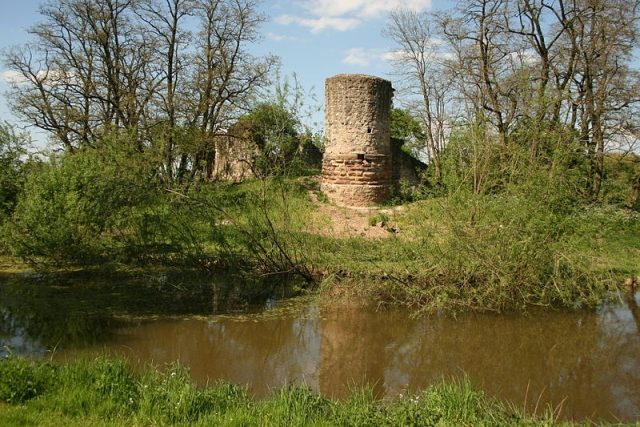
The castle ruin Dorfelden is a moated castle and is located in Niederdorfelden near Hanau in the Main-Kinzig district in Hesse.
The castle stands on an artificially raised hill, which is surrounded by the Nidder river. The river also supplies the water for the circular moat around the castle complex. The ruin is located directly north of the old village center of Niederdorfelden and can be reached via dirt roads in a short walk.
While the village of Dorfelden was first mentioned in 767 as Turinfelde, the first documented mention of the castle only dates back to 1234. The occasion was an inheritance division between Reinhard III. von Dorfelden and his brother Heinrich. The family was first mentioned in 1166 and likely succeeded the Lords of Buchen, who are previously documented for this area. They probably owned the neighboring Wachenbuchen Castle.
The successors of Reinhard III. named themselves after Hanau Castle (de Hagenowe), starting with Reinhard I. von Hanau, the progenitor of the Lords and later Counts of Hanau.
Subsequently, there were pledges and transfers of ownership, among others, to the Falkensteiners, Weinsbergers, and Rieneckers. In 1266, the Falkensteiners transferred their half of the castle to Fulda Abbey as a fief.
In 1333, Ulrich II. von Hanau enfeoffed the castle to Duke Rudolf of Saxony. Saxony's interest in this fief was that the Elector of Saxony, on his way from there to Frankfurt am Main, about a day's journey from the place of election (and later also coronation) of the German kings, needed a fortified place. This was important for a safe journey to and from Frankfurt. A parallel process is attested for Ulrich IV. von Hanau, who in 1372 sold Babenhausen Castle to the Bohemian Crown for this reason and received it back as a fief. In the German Empire, the castle belonged to the Free Court of Kaichen.
In the following centuries, Dorfelden Castle lost its importance. Its functions gradually transferred to the neighboring Junkerhof, and finally, it was only mentioned as its "accessory". It served as a quarry and increasingly fell into disrepair. Only towards the end of the 20th century were some stabilization measures taken to prevent the last remaining walls from collapsing.
Layout+
Parts of the curtain wall are still preserved in the north and northwest. Remains of buildings are visible on the inside of the north wall. Also still preserved is a round tower, which has bossed ashlar in the lower area. These probably date from the second half of the 12th century. The remains of another round tower lie at the foot of the hill on which the castle stands. The castle is completely surrounded by a circular moat, which is fed by the Nidder river.
Take Mobile History with you
You are reading this text for free. Premium adds what matters on the road: descriptions read aloud, sites found through your camera, whole regions taken offline.
- Every description, including the ~17,700 Premium sites
- Audio guide: have descriptions read to you on location
- AR finder: see sites through your camera, with distance and bearing
- Unlimited saved sites
14 days free, then from €2.99 a month. Cancel anytime.
Source: Wikipedia · Licence: CC BY-SA 4.0
This description draws on the facts documented in the linked Wikipedia article; Wikipedia content is licensed under CC BY-SA 4.0. Wording and editing: Mobile History.
Location: 50.1969, 8.8025