The remains of the Castle can be visited
CastleDornach
Dorneck Castle (Ruin) (Dornach)
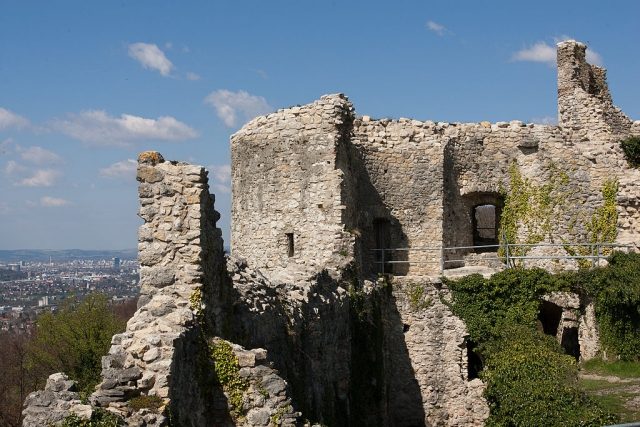
The Dorneck Ruin, a former medieval fortress, stands on a rock ridge near Dornach in the Canton of Solothurn, Switzerland.
History+
Archaeological findings suggest that Dorneck Castle existed as early as the mid-11th century, although written mentions only appear from the mid-14th century. Originally owned by the Freie von Pfeffingen, the castle passed through family ties to the Counts of Saugern and around 1200 to the Counts of Thierstein. After being damaged by the Basel earthquake in 1356, it was quickly repaired and expanded. In 1360, Dorneck went to Duke Rudolf IV of Habsburg, who immediately returned it to the Thiersteins as a fief. Later, in 1384, the fief was sold to Austria. In 1394, the Habsburgs pledged the castle to the Basel citizen Henmann von Efringen, but reserved the right of access. In 1462, the Efringers also took over half of the village of Dornach, but later ran into financial difficulties and pledged Dorneck to Konrad von Hallwil. In 1485, the city of Solothurn acquired the castle, which was already in poor condition at that time. Nevertheless, in 1499, during the Swabian War, the garrison managed to repel an attack by imperial German troops. Subsequently, extensive repair and expansion work began, transforming Dorneck into a modern fortress over 300 years. During the Thirty Years' War, it remained unharmed. In 1798, the castle was damaged by artillery fire during the French invasion and subsequently conquered. In the 19th century, it served as a quarry. In 1902, the citizens of Dornach, who owned the ruin, donated the remains to the Canton of Solothurn, which had them cleaned and preserved by 1906. Since 1970, the Solothurn monument preservation office has been caring for the complex.
On site+
The ruin is freely accessible. Visitors can explore the keep, palas, and tower from the 13th century, as well as the bailey, flanking tower, and chapel tower from 1500, the large and small bulwark, the powder tower from 1543, the curtain wall, and various other building parts.
Take Mobile History with you
You are reading this text for free. Premium adds what matters on the road: descriptions read aloud, sites found through your camera, whole regions taken offline.
- Every description, including the ~17,700 Premium sites
- Audio guide: have descriptions read to you on location
- AR finder: see sites through your camera, with distance and bearing
- Unlimited saved sites
14 days free, then from €2.99 a month. Cancel anytime.
Source: Wikipedia · Licence: CC BY-SA 4.0
This description draws on the facts documented in the linked Wikipedia article; Wikipedia content is licensed under CC BY-SA 4.0. Wording and editing: Mobile History.
Location: 47.4798, 7.6279