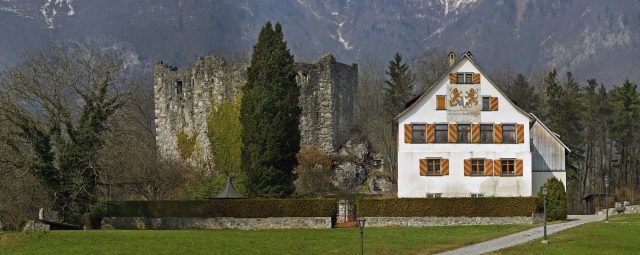
The remains of the Castle can be visited
Forstegg Castle (Ruin) (Sennwald)

The ruin of Forstegg Castle is located in the municipality of Sennwald in the Swiss canton of St. Gallen, in the district of Salez. It was built around 1200 by the Barons of Sax and gradually deteriorated into a ruin in the 19th century until 1894.
Forstegg Castle is situated on a small hill at the edge of the Schlosswald forest in the Rhine Valley at an altitude of approximately 460 m above sea level, within the debris cone of a post-glacial rockfall. The tower was built on a rock block about 10 m high.
Forstegg Castle was probably built at the same time as Hohensax Castle by Heinrich von Sax to secure his possessions in the Rhine Valley. In the division of power in 1248, the castle went to Ulrich II von Sax, who founded the Sax-Hohensax sideline. His share fragmented through inheritance, so that in the middle of the 14th century, a sideline Hohensax-Forstegg was formed around Forstegg Castle with Ulrich IV Stephan (1329–1381). Their dominion included, besides Forstegg Castle, the villages of Büsmig, Frümsen, Haag, and Salez. In 1396, Ulrich Eberhard IV also bought the village and court of Sennwald. While Hohensax and Frischenberg were conquered by the Appenzellers in 1446 during the Old Zurich War, Forstegg and its dominion remained independent, as Ulrich Eberhard IV maintained a neutral position between Zurich, the Appenzellers, and Austria.
In 1458, however, Albrecht I (1439–1463) of Sax-Forstegg came into conflict with Austria and therefore allied himself with the Swiss Confederacy. After his death, his son Ulrich VII was accepted as a citizen by the city of St. Gallen, which pledged his dominion to its citizen Lütfried Mötteli in 1466. Having come of age, he redeemed the dominion in 1481 with his spoils from the Burgundian Wars and became a citizen of Zurich with it in 1486. In gratitude for his services in the Swabian War, Ulrich VII received the dominion of Frischenberg and the court of Lienz from the Confederacy in 1499. In 1585, the castle, which had now become the center of the Barony of Sax-Forstegg, was extended by a new palas at the foot of the castle rock (later the Landvogthaus). However, the castle was hardly used by the barons and served as a prison.
In 1615, Friedrich Ludwig von Hohensax-Forstegg sold the dominion and castle to the city of Zurich, which administered it as the bailiwick of Sax-Forstegg. The fortress builder Johannes Ardüser modernized the fortifications with star forts and moats between 1622 and 1627, making Forstegg a contemporary fortress. In 1625, Zurich established a bailiwick seat in the palas. In 1798, the castle came to the Canton of Linth, and in 1803 to the Canton of St. Gallen, which sold it into private ownership in 1819. The complex subsequently deteriorated visibly, and the fortifications were removed around 1870. In 1894, the palas burned down and was demolished. In 1941, Paul Aebi bought the castle and renovated the tower ruin until 1962. The castle is still in private ownership today.
Complex+
The core of the complex was a mighty tower with a hexagonal ground plan, built on a rock block about 10 m high. The walls of the tower are 2.1 m thick. It had at least four stories from the very beginning. Little is known about the medieval complex. The palas was completely removed after the fire of 1894. The 17th-century armory (rebuilt 1790) and a barn are still well preserved today. Some remnants of the curtain walls and ramparts from the 17th century are preserved around the complex.
Take Mobile History with you
You are reading this text for free. Premium adds what matters on the road: descriptions read aloud, sites found through your camera, whole regions taken offline.
- Every description, including the ~17,700 Premium sites
- Audio guide: have descriptions read to you on location
- AR finder: see sites through your camera, with distance and bearing
- Unlimited saved sites
14 days free, then from €2.99 a month. Cancel anytime.
Source: Wikipedia · Licence: CC BY-SA 4.0
This description draws on the facts documented in the linked Wikipedia article; Wikipedia content is licensed under CC BY-SA 4.0. Wording and editing: Mobile History.
Location: 47.2458, 9.4959