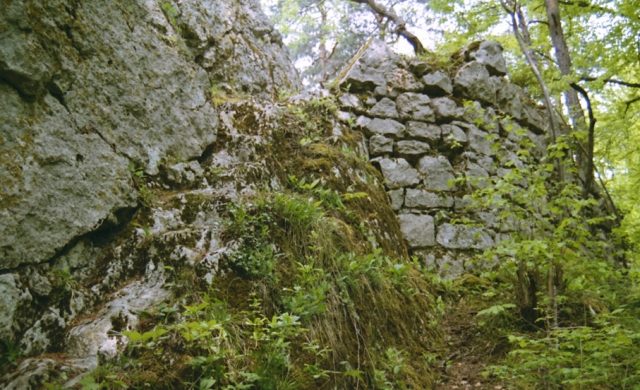
The remains of the Castle can be visited
Fürstenstein Caslte (Ruin)

The Fürstenstein ruin is located southwest of Ettingen and southeast of Hofstetten-Flüh at the entrance to the Wallental valley on a rugged rock ridge. During the Jura folding, the limestone layers in this area became practically vertical, forming in places a very narrow rock ridge where one would hardly expect a castle (see bottom picture). Access to the ruin is – with some scrambling – from the southeastern end of the rock ridge and is shown in the top picture.
Only minor wall remnants of the fortress remain, making its full extent difficult to ascertain. In 1412, an upper and a lower house were reported. The main wall remnants are found at the eastern end of the rock ridge, which is a little wider. Finds indicate that the western end of the ridge was also used in some form. The still visible masonry was constructed from roughly hewn limestone blocks. The original access led to a gatehouse on the east side at the foot of the castle and then via a steep ascent and stairs to the higher parts of the castle: a staircase carved out of the rock is visible in the upper picture. On the eastern part of the ridge, which is a little wider than the rest, probably stood the main building and a tower.
The terrain south of the castle appears to have been artificially terraced and was probably used for the erection of outbuildings. Faded holes are still visible in the southern wall of the rock ridge, which may represent traces of beam holes.
Nothing is known about the beginnings of the castle and the motivation for its construction. Nor can the current name Fürstenstein alone necessarily be interpreted to mean that the builder was the Bishop of Basel. Since the Lords of Rotberg, with the exception of the Sternenberg fortress ruin, dominated the entire area, it is more likely that Fürstenstein was founded by them: in 1302, Fürstenberg is first mentioned as an episcopal fief to the Rotbergers. During this period, castles and their associated rights were often transferred by their owners to a powerful ecclesiastical or secular lord to ensure their protection, and then transferred back by him as a fief to the original owners. In the war between King Albrecht and the Bishop of Basel, the fortress was then besieged by the Habsburgs. The siege was broken off after King Albrecht was murdered on May 1, 1308.
The castle was damaged in the Basel earthquake but quickly repaired. In 1410, the former dictatorial Basel mayor Hans Ludmann von Rotberg retreated to the protection of the fortress. To strengthen his position of power, he allied himself with Katharina von Burgund, who in turn allied herself with Basel in 1411. Due to a feud between Katharina and Heinrich zu Rhein and Rudolf von Neuenstein, Heinrich and Rudolf attacked the Fürstenstein fortress. Basel, as Katharina's ally, then destroyed Fürstenstein Castle and beheaded Heinrich zu Rhein and the entire garrison. In 1515, the ruin with its associated rights was sold to Solothurn, along with the entire lordship of the Rotbergers.
Take Mobile History with you
You are reading this text for free. Premium adds what matters on the road: descriptions read aloud, sites found through your camera, whole regions taken offline.
- Every description, including the ~17,700 Premium sites
- Audio guide: have descriptions read to you on location
- AR finder: see sites through your camera, with distance and bearing
- Unlimited saved sites
14 days free, then from €2.99 a month. Cancel anytime.
Source: Wikipedia · Licence: CC BY-SA 4.0
This description draws on the facts documented in the linked Wikipedia article; Wikipedia content is licensed under CC BY-SA 4.0. Wording and editing: Mobile History.
Location: 47.4677, 7.5307