RuinGattendorf

Gattendorf Castle (Ruin)

Gattendorf Castle (Ruin)

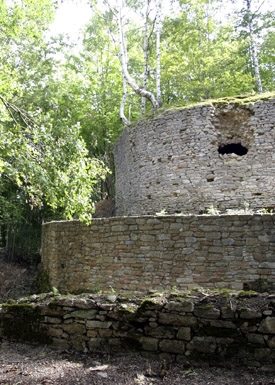
The remains of the Castle can be visited

Gattendorf Castle in Gattendorf (Upper Franconia) stands on the foundations of the former Gattendorf knight's seat, which existed until the early 16th century.

The Castle Complex+

Knight's Seat of the von Sparneck Family

The castle, a rampart complex with a defensive tower, was probably founded during the development of the land by the Counts of Vohburg. It was first mentioned in a document on March 6, 1294. In 1366, the castle, destroyed by predatory activities, was rebuilt. From 1356 to 1562, it was owned by the von Sparneck family. Two lines of the family were based in Gattendorf. An important representative was Hans von Sparneck, who negotiated with the Hussites at Hof in 1430.

Alban von Dobeneck sketched the appearance of the castle: "Gattendorf Castle rises on a considerable hill above the village, steep slopes shield the property from various sides." Based on von Dobeneck's observations of the condition at the time in 1792, an oval ground plan can be assumed. A moat, which can be crossed via a bridge, surrounds the small castle courtyard, at the end of which stands the main building. Remains of a watchtower are located in front, near the bridge directly on the steep slope.

Destruction in the Franconian War 1523

In the mid-16th century, the robber knight Hans Thomas von Absberg abducted merchants from the imperial cities in Franconia and Swabia on their trade journeys and demanded a high ransom for their release. The Lords of Sparneck supported him in his feud. Gett, a representative of this family, appeared in 1519 at Gattendorf, the castle that had long been in the possession of the Sparnecks. In 1522, an imperial servant was ambushed at the Knittlinger Steige. Gett von Sparneck is also said to have been among the troops who supported Absberg in the ambush, and so the Swabian League sent its troops in 1523 to raze a total of 23 robber nests to the ground. Five of the castles destroyed belonged to the Sparnecks alone. On July 10, 1523, Gattendorf was plundered and the remains blown up to make a return of the owners impossible.

The woodcut shows the castle from approximately the perspective of today's Baroque castle. The hill slopes steeply towards the houses on the right of the picture. The houses, some of which are also burning, belong to Schloßgattendorf. In addition to an earthen rampart, a palisade fence, and, recognizable by the wooden bridge, a moat system, the castle also includes a castle wall that encloses at least one main building and a tower in a round shape. The uppermost section of the tower is designed as a half-timbered construction. All parts of the castle are in flames. Above the entrance, the coat of arms of the von Sparneck family is emblazoned. In the foreground of the picture are the troops of the Swabian League, cavalry on the left and infantry on the right, each armed with spears, and in the middle two horse-drawn cannons. The two accompanying riders carry burning sticks to ignite the cannons.

Further Construction History

Although the complex was mentioned in the border regulation between Saxony and Brandenburg the following year, it was not completely rebuilt. The remains were provisionally repaired around 1562, but the decay could not be permanently stopped. The building was used as a warehouse, granary, and brewery. The dilapidated brewery burned down in 1895 and remained a ruin. Today, a lined moat and a larger cellar vault indicate the medieval origins of this building.

The Baroque Castle+

In 1700, the Schmidt family acquired the knight's estate from Margrave Christian Ernst and began constructing a Baroque castle in the following years. Wolf-Christoph Schmidt was a margravial tax administrator. The family resided there until 1779. The swan in the municipal coat of arms commemorates them. The castle is used as a restaurant.

Source Text: Wikipedia

Take Mobile History with you

You are reading this text for free. Premium adds what matters on the road: descriptions read aloud, sites found through your camera, whole regions taken offline.

  • Every description, including the ~17,700 Premium sites
  • Audio guide: have descriptions read to you on location
  • AR finder: see sites through your camera, with distance and bearing
  • Unlimited saved sites

14 days free, then from €2.99 a month. Cancel anytime.

Source: Wikipedia · Licence: CC BY-SA 4.0

This description draws on the facts documented in the linked Wikipedia article; Wikipedia content is licensed under CC BY-SA 4.0. Wording and editing: Mobile History.

Location: 50.3137, 12.0016