RuinGreifenstein

Greifenstein Castle (Ruin)
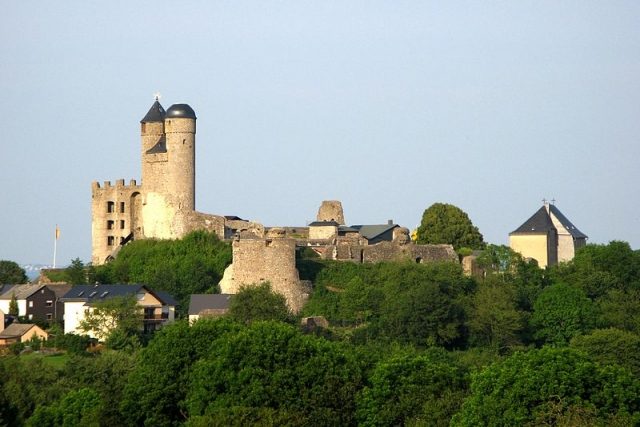
Greifenstein Castle (Ruin)

The remains of the Castle can be visited

Greifenstein Castle is located in the town of Greifenstein in the Lahn-Dill district in Central Hesse. The castle is situated on a mountain in the Dillwesterwald and offers a good view over the Dill valley. At 441 meters above sea level, it is the highest castle in the Lahn-Dill district. The castle is a widely visible landmark; signs on the A45 motorway point to it.

The hilltop castle was first mentioned in a document in 1160. In 1298, the castle was destroyed by the Counts of Nassau and Solms, as was Lichtenstein Castle, which was never rebuilt. In 1315, it came into the possession of the Counts of Nassau through a pledge from the House of Habsburg (Albrecht I had bought the castle from Kraft von Greifenstein). After falling into disrepair under various owners until 1676, it was converted into a baroque palace by Count Wilhelm Moritz von Solms-Greifenstein. After the count moved to Braunfels in 1693, the complex fell into ruin.

In 1969, the castle ruin was donated to the newly founded Greifenstein Association, which to this day takes care of the preservation of the publicly accessible complex, which includes a restaurant. Greifenstein Castle was added to the list of monuments in 1995 as a monument of national importance.

Complex+

The tour of the castle grounds leads to a prison with torture instruments, a weapons and wine cellar, living chambers, and via a spiral staircase to the double-towered keep. On the pointed roof of the Bruderturm (Brother's Tower) is a griffin as a weather vane, and in the tower is the carillon with three bells (strike tones: F#1, A1, and C2).

Worth seeing, in addition to the village and castle museum, is one of the few double chapels in Germany: the St. Katharinenkapelle (St. Catherine's Chapel) was built in 1462 as a fortified church in the Gothic style. During the Baroque renovation, the castle courtyard was filled with earth, so that the chapel is now located underground. There are frescoes and loopholes as well as casemates with vaulted ceilings and defensive chambers. The Baroque church, built over the fortified church from 1687 to 1702, contains extensive stucco decoration and can be classified as early Italian Baroque. The upper and lower churches are connected by a staircase.

Hiking trails around the castle and an herb garden make the complex a popular excursion destination.

Bell Collection+

Since 1984, the castle has housed a bell collection in the "Roßmühle" (Horse Mill) bastion (gun tower). Visitors can view over 40 bells and even try them out themselves. The technology and history of bell making are explained.

Municipal Facilities+

The registry office of the municipality of Greifenstein has maintained a wedding room in the castle since May 2005.

Take Mobile History with you

You are reading this text for free. Premium adds what matters on the road: descriptions read aloud, sites found through your camera, whole regions taken offline.

  • Every description, including the ~17,700 Premium sites
  • Audio guide: have descriptions read to you on location
  • AR finder: see sites through your camera, with distance and bearing
  • Unlimited saved sites

14 days free, then from €2.99 a month. Cancel anytime.

Source: Wikipedia · Licence: CC BY-SA 4.0

This description draws on the facts documented in the linked Wikipedia article; Wikipedia content is licensed under CC BY-SA 4.0. Wording and editing: Mobile History.

Location: 50.6206, 8.2945