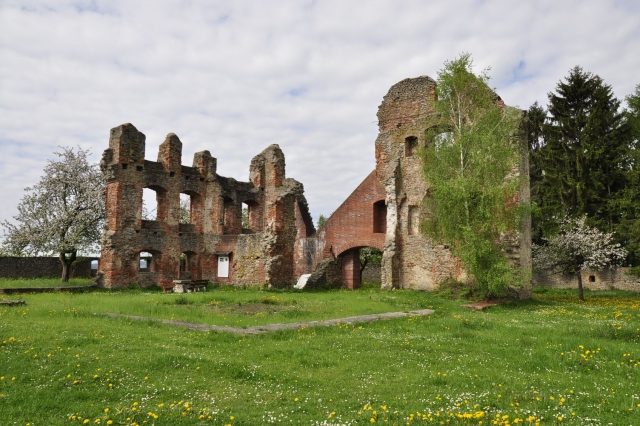
The remains of the Castle can be visited
Haibach Castle (Ruin)

The castle ruin Haibach is the ruin of a hilltop castle on the 520-meter-high "Hofberg" in the Hofberg district of the Lower Bavarian municipality of Haibach in the district of Straubing-Bogen in Bavaria.
The castle is named after the knightly family of the Haybecken, later Haibeck, who were ministerials of the Counts of Bogen.
Around 1100, a Wirnto von Haybach is mentioned in the memorial book of Oberalteich Monastery, and in 1320, Dietrich Haibeck is named in a document with the abbot of Oberalteich Monastery during the construction of Regensburg Cathedral. In 1125, Gozwin von Haybach is mentioned, in 1217 Albert von Haybach, who participated in the crusade to the Holy Land, in 1330 Dietrich Knight of Haybach, judge of Cham, administrator at the Mitterfels district court, vice-dom of the Duke of Straubing, and founder of the church in Elisabethszell. In 1348, Dietrich's sons Albrecht, Dietrich, and Hanns acquired the castle and Hofmark Wiesenfelden.
In 1494, the knightly family of the Haybecken zu Haybach and Wiesenfelden died out. Their successors were the Notthafft in 1515, later the Ossinger and the Leoprechtinger. The place was part of the Electorate of Bavaria and formed a closed Hofmark, whose seat was Haibach.
In 1633/34, the castle was destroyed by Swedish troops during the Thirty Years' War and came into the possession of the Imperial Nobles of Ossing zu Haibach in 1691, of whose family Gundacker Ossinger died as the last in 1797. From the last noble owner, the castle and the Hofmarks Haibach and Herrnfehlburg passed to the Bavarian state, which sold the property to the Haibach farmer and cattle dealer Martin Feldmayer in 1845. Thereafter, a rapid decay of the complex began.
In 1986, the "Association for the Preservation of the Castle Ruin" was founded, which renovated the castle remains until 1990, of which stately wall remains can still be seen today. In the middle of the courtyard, parts of the castle residential building from the early 18th century have been preserved. The stable building has been used as a museum since 2005.
Take Mobile History with you
You are reading this text for free. Premium adds what matters on the road: descriptions read aloud, sites found through your camera, whole regions taken offline.
- Every description, including the ~17,700 Premium sites
- Audio guide: have descriptions read to you on location
- AR finder: see sites through your camera, with distance and bearing
- Unlimited saved sites
14 days free, then from €2.99 a month. Cancel anytime.
Source: Wikipedia · Licence: CC BY-SA 4.0
This description draws on the facts documented in the linked Wikipedia article; Wikipedia content is licensed under CC BY-SA 4.0. Wording and editing: Mobile History.
Location: 49.0197, 12.7117