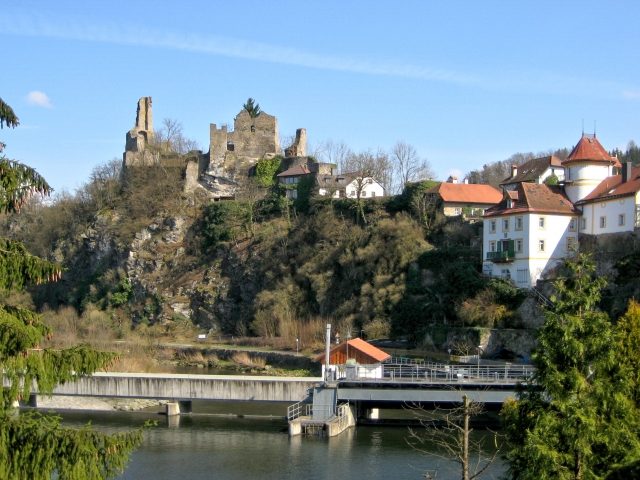
The remains of the Castle can be visited
Hals Castle (Ruin)

The castle ruin Hals is located in the Passau district of Hals. The name Hals derives from the castle's location at the "Hals", meaning the narrow loop of the Ilz river. On a narrow rocky ridge above the village lie the ruins of the once mighty spur castle.
In 1072, the Lords of Hals were first mentioned. In 1112, the castle was mentioned as property of the Palsenze of Eferding.
In 1190, the nobles of Kamm from Ortenburg gained control of the castle. The new Lords of Hals became involved in several disputes with the Counts of Bogen and the Bishops of Passau, and the Emperor even once imposed the Imperial Ban on them. In 1280, Rudolf of Habsburg granted Albert von Kamm of Hals the title of Count. The now Counts of Hals expanded their dominion to the Bohemian border. Their possessions included Osterhofen, Haidenburg, Schönberg, Aidenbach, Aiterhofen, Rathmannsdorf, and Fürstenstein. The lords also secured trade routes to Bohemia, such as the Golden Steig. Timber rafting from the Bavarian Forest and pearl fishing were important sources of income.
In 1375, after the extinction of the Kamm-Hals line, the castle came into the possession of the Upper Palatinate Count Johann von Leuchtenberg. Good personal relations with Emperor Charles IV even earned the Hals family the right to mint coins. After the death of Charles IV, Johann continued to support his son, the Bohemian King Wenceslaus. However, he ended up on the losing side in the subsequent military conflicts. The county became increasingly indebted and lost large parts of its possessions. In this situation, Johann kidnapped the Bishop of Bamberg near Hals in 1399 and extorted a ransom, which, however, did not solve the financial problems. The remaining part finally fell to the noble families of Aichperg in 1485 and later to the Degenberg family. In 1517, the dominion was bought by the Wittelsbachs.
In 1622, the castle was damaged by a fire. After 1663, the ducal castle administrators then lived in the newly built official residence in the village of Hals, and the castle was only used as a storage facility.
During the War of the Austrian Succession in 1741, the castle was dismantled to prevent the enemy from using it militarily. In 1810, the still standing walls collapsed. Since then, the structure has increasingly fallen into disrepair and served as a quarry.
The ruin is now privately owned but can be visited with a guided tour. The rare Elder Iris (Iris × sambucina) grows on the castle rock.
Approximately 750 meters northwest is the castle's outwork, Reschenstein Castle.
Take Mobile History with you
You are reading this text for free. Premium adds what matters on the road: descriptions read aloud, sites found through your camera, whole regions taken offline.
- Every description, including the ~17,700 Premium sites
- Audio guide: have descriptions read to you on location
- AR finder: see sites through your camera, with distance and bearing
- Unlimited saved sites
14 days free, then from €2.99 a month. Cancel anytime.
Source: Wikipedia · Licence: CC BY-SA 4.0
This description draws on the facts documented in the linked Wikipedia article; Wikipedia content is licensed under CC BY-SA 4.0. Wording and editing: Mobile History.
Location: 48.5914, 13.4619