RuinHaynrode

Harburg Castle (Ruin) (Haynrode)
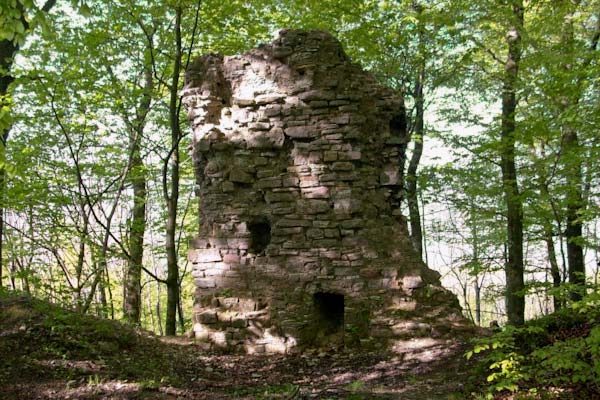
Harburg Castle (Ruin) (Haynrode)

Memorial, The remains of the Castle can be visited.

The Harburg, also called Horeburg, is a castle ruin in the area of the village of Haynrode in the district of Eichsfeld in Thuringia.

Location
The ruins of the Harburg are located approximately 1.2 km (as the crow flies) southeast of Haynrode on a now forested, conical mountain in the Bleicheröder Mountains.

History
Probably only built in 1073/74 as a fortified counter-structure to the neighboring Hasenburg, the Harburg was mentioned around 1120 as "Horeburg" without specifying the owner. It seems to have belonged to the Margrave of Stade, because among the possessions that the Archbishop of Mainz Adalbert I (1111-1137) received from Richardis of Stade, the Harburg was mentioned alongside the Gerode monastery. The small fortress remained a ministerial castle, to which initially no larger administrative area belonged, although between 1133 and 1148 some burgraves of Harburg appeared, who, however, belonging to the high nobility, only bore the title and acted as archiepiscopal officials. In 1139, it also came as a fief to the Counts of Gleichen.

As early as 1165, the Harburg, along with the Rusteberg castle ruins, was destroyed in a feud between Archbishop Konrad of Mainz and Emperor Barbarossa and soon thereafter transferred to the Landgrave of Thuringia as co-owner. After the death of Archbishop Johann of Luxembourg-Ligny in 1373, a part of the Mainz cathedral chapter elected the 20-year-old Bishop of Speyer, Adolf von Nassau, as administrator of the archdiocese. However, Pope Gregory XI, at the request of Emperor Charles IV, instead appointed Ludwig von Meißen as archbishop. Years of armed conflicts ensued, which were particularly fought in Thuringia and Eichsfeld. During these conflicts, citizens of Duderstadt and Heiligenstadt, as well as Mainz vassals, captured the Landgrave-Thuringian castles of Worbis and Harburg, which Landgrave Balthasar of Thuringia, a cousin of Ludwig, had completely seized, and handed them over to Adolf von Nassau. Since this time, Mainz maintained these possessions, but pledged them in 1381 for 200 years as the Harburg-Worbis office to Siegfried von Bültzingslöwen.

During the Peasants' War, the Harburg was captured and destroyed by rebellious peasants from the groups of Thomas Müntzer and Johannes Pfeiffer around May 5 to 8, 1525. It was not rebuilt and completely fell into disrepair. From its stones, the Bültzingslöwen built their manor houses and the church in Haynrode, as well as the official residence in Worbis, because since 1350, Harburg and Worbis formed an administrative community. In the course of the Counter-Reformation, in 1574, the Elector and Archbishop of Mainz Daniel Brendel von Homburg dissolved the pledge with the Lords of Bültzingslöwen and appointed civil servants as officials.

Construction
The castle complex has an oval footprint with an area of about 27x20 m and was protected to the east by two ramparts with moats against the plateau. Here there is also an outer bailey measuring 15x12 m. On the north side, a slightly lower terrace, which is also enclosed by a protective wall, indicates further buildings. Only the partially demolished ruin of an 8x17 m stone building in the core castle remained in considerable remnants. A depression in the terrain, still recognizable in the 1960s, was interpreted as a cistern.

Current Use
The castle site is a protected archaeological monument. The relevant area is used for forestry and is freely accessible to visitors.

Take Mobile History with you

You are reading this text for free. Premium adds what matters on the road: descriptions read aloud, sites found through your camera, whole regions taken offline.

  • Every description, including the ~17,700 Premium sites
  • Audio guide: have descriptions read to you on location
  • AR finder: see sites through your camera, with distance and bearing
  • Unlimited saved sites

14 days free, then from €2.99 a month. Cancel anytime.

Source: Wikipedia · Licence: CC BY-SA 4.0

This description draws on the facts documented in the linked Wikipedia article; Wikipedia content is licensed under CC BY-SA 4.0. Wording and editing: Mobile History.

Location: 51.4369, 10.4586