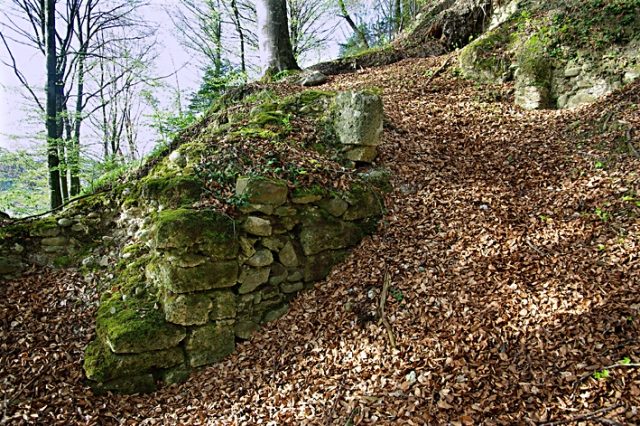
The remains of the Castle can be visited
Hasenburg Castle (Ruin) (Willisau)

The castle dates from the second half of the 13th century. Around 1350, the entrance was reinforced and a Zwinger (outer bailey) was built.
The fortress served as the residence for the noble family of Hasenburg, who had been documented in the area around Willisau since 1212. These nobles were already the lords of Willisau around 1040, but their ancestral castle (Asuel) was in the Bernese Jura (region between Delémont and Porrentruy). Hence Neu-Hasenburg (New Hasenburg). Many documents were issued at Hasenburg. The castle was first mentioned in writing in 1285 during a division of property, in which Heimo was awarded the New Hasenburg.
In the 14th century, the castle was subject to the Habsburgs. In 1386, the castle was plundered and set on fire by Austrian citizens from Sursee and Zofingen and then by the Confederates. Eight days after the Battle of Sempach, the Bernese marched against Willisau again and completely destroyed the castle.
After the extinction of the family, the castle, as well as the city, passed to the Countess of Neuchâtel-Valangin.
In 1406, the Countess and her son sold the lordship of Willisau with Hasenburg and other castle complexes to the Canton of Lucerne. The castle was never rebuilt.
In 1958 and 1959, the complex was archaeologically investigated by Hugo Schneider. On the upper platform was the main castle with the residential wing (at least 3 floors) and a castle courtyard with an entrance, located uphill. The walls consist of boulders. To the east is a well about 26 m deep. At the southwest corner of the outbuilding, researchers discovered a cistern fed by surface water. The inventory of finds includes typical castle finds, such as stove tiles, pottery, knives, arrowheads, stone basins with coats of arms, leather shoes, and other tools.
The oldest known stove tiles in the Canton of Lucerne, among others, were excavated in the ruins of Hasenburg. They date from the 14th century and bear motifs from the imagery of the nobility.
Take Mobile History with you
You are reading this text for free. Premium adds what matters on the road: descriptions read aloud, sites found through your camera, whole regions taken offline.
- Every description, including the ~17,700 Premium sites
- Audio guide: have descriptions read to you on location
- AR finder: see sites through your camera, with distance and bearing
- Unlimited saved sites
14 days free, then from €2.99 a month. Cancel anytime.
Source: Wikipedia · Licence: CC BY-SA 4.0
This description draws on the facts documented in the linked Wikipedia article; Wikipedia content is licensed under CC BY-SA 4.0. Wording and editing: Mobile History.
Location: 47.1257, 8.0034