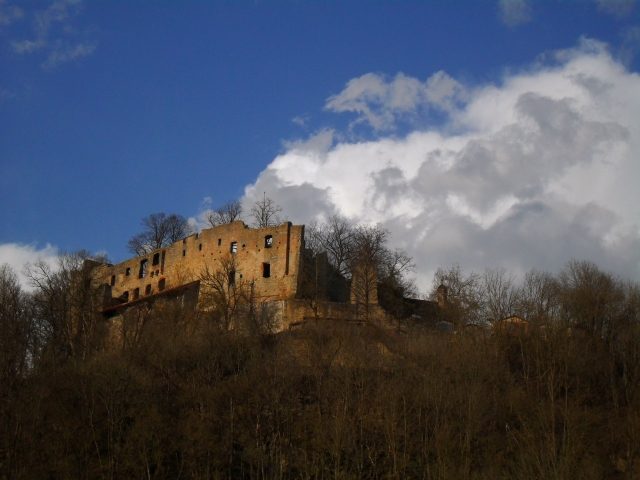
The remains of the Castle can be visited
Hilgartsberg Castle (Ruin)

The Hilgartsberg ruin is a castle ruin near Hofkirchen in the district of Passau. Where the Danube leaves the Dungau and enters the breakthrough valley between the southern foothills of the Bavarian Forest, the Hilgartsberg ruin rises behind Hofkirchen on a steep slope on the left bank.
In 1112, an Ezil (Heinrich) de Hilkerirchesberg is mentioned for the first time. The spur castle then belonged to the County of Windberg under the feudal lordship of the Bishops of Bamberg. In 1207, it was granted with other estates to Walchunus von Kamm. He bequeathed it to his nephews Alram and Albert von Hals and Bernhard von Uttendorf.
A lengthy dispute arose with the Bishops of Passau and Bamberg, who did not recognize this arrangement. In October 1226, an arbitration court finally awarded the lordship to Count Rapoto II of Ortenburg. After the death of his son Rapoto III in 1248, his daughter Elisabeth and her husband Hartmann I of Werdenberg sold the property to Duke Heinrich of Lower Bavaria in 1259.
The Dukes initially had the castle administered by caretakers. In 1309, Seifried der Puchberger was enfeoffed with it. After his death in 1326, the Ecker von Eck came into possession of the fortress. Since Peter Ecker von Eck fell out of favor with Duke Albrecht, the castle was besieged and captured by the Duke in 1357.
Albrecht equipped the castle with ramparts and a tower in 1360. Now, ducal caretakers once again administered Hilgartsberg. Towards the end of the 15th century, the Weisenberger were enfeoffed with it, and after their extinction in 1596, Rudolph Freiherr von Pollweil und Weilerthal received it. His lineage died out in 1617, and now Elector Maximilian I granted the estate with the Hofmarken Schöllnstein, Rannetsreit, Garham, Leithen, and Oberngschaid to Hanns Ernest Graf Fugger, Lord of Kirchberg and Weißenhorn.
Although the Fuggers, who exercised higher jurisdiction over the mentioned Hofmarken, never lived in the castle themselves, they significantly expanded it after the castle fire of 1626. The complex included a granary where natural tributes had to be delivered. In 1698, Count Franz Ernst Fugger acquired the castle and the Hofmark Grubhof as his own property. In the War of the Spanish Succession, Hilgartsberg was occupied by the Austrians in 1704. In the War of the Austrian Succession, it was conquered and burned down on November 11, 1742, by Austro-Hungarian troops under the command of Lieutenant Colonel Count Gorani.
The Fuggers did not rebuild the ruin. In 1821, Joseph Eligius Graf Fugger zu Glött sold the lordship to the Bavarian state. The remaining buildings initially went to an innkeeper and farmer from Garham in 1823, and later partly to a brewery owner from Vilshofen. In 1838, due to excessive maintenance costs, the owners ceded all buildings to the state free of charge.
Until 1970, the school of the former municipality of Hilgartsberg was housed here. The school building was sold to the owner of the castle restaurant. On December 18, 1995, the market town of Hofkirchen acquired the Hilgartsberg castle ruin from the Free State of Bavaria. Since then, the castle's support association maintains the complex and organizes annual castle festivals and a castle Christmas.
Description+
From the northeast, one reaches the outer bailey with the well-preserved medieval castle chapel of St. George via a ditch and through a gatehouse. The interior of the chapel dates mainly from the 16th century, the altar from the Rococo period. The altarpiece, depicting the Annunciation of the Lord, was probably created in the early 17th century.
Through a gate tower, one enters the inner bailey, and through another gate tower, into the castle courtyard. An open-air stage has been erected here. In one corner, there is a deep well, which forms the starting point of an underground passage. It leads under the walls into the outer bailey. Also noteworthy is the excellent view of the Danube valley.
Take Mobile History with you
You are reading this text for free. Premium adds what matters on the road: descriptions read aloud, sites found through your camera, whole regions taken offline.
- Every description, including the ~17,700 Premium sites
- Audio guide: have descriptions read to you on location
- AR finder: see sites through your camera, with distance and bearing
- Unlimited saved sites
14 days free, then from €2.99 a month. Cancel anytime.
Source: Wikipedia · Licence: CC BY-SA 4.0
This description draws on the facts documented in the linked Wikipedia article; Wikipedia content is licensed under CC BY-SA 4.0. Wording and editing: Mobile History.
Location: 48.6613, 13.1526