RuinBad Urach

Hohenurach Castle (Ruin)

Hohenurach Castle (Ruin)

The remains of the Castle can be visited

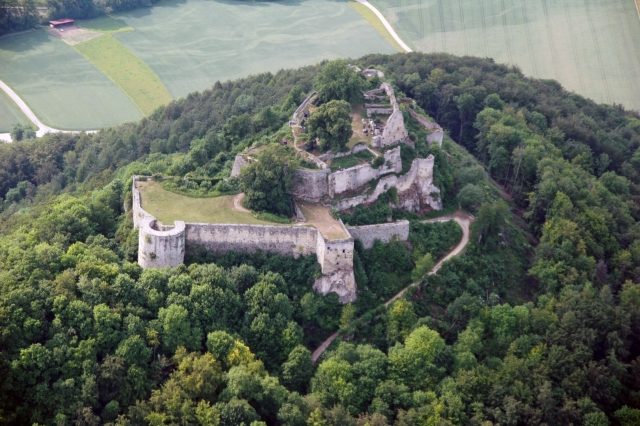
Hohenurach Castle is located approximately 40 kilometers southeast of Stuttgart in Bad Urach in the Reutlingen district of Baden-Württemberg. The ruin is a former hilltop castle about 250 meters above the Erms Valley and the town of Bad Urach. It lies at an altitude of around 700 meters above sea level and is now a popular excursion destination.

The castle was built between 1030 and 1050. The builders were the Counts of Urach. They originated from the East Franconian region near Würzburg. Count Egino IV of Urach was married to Agnes of Zähringen and inherited her family property upon the death of his brother-in-law, Duke Berthold V of Zähringen. His son Egino V then called himself Count of Urach and Lord of Freiburg Castle in Breisgau. In 1239, the castle was pledged to the Counts of Württemberg. In 1254, the Counts of Fürstenberg - the Counts of Urach had by then split into the Freiburg and Fürstenberg lines - initially sold half of the castle to Württemberg. Eleven years later, the Counts of Württemberg became sole owners. In 1428, a fundamental reconstruction and expansion of the castle took place under Count Ludwig I of Württemberg. After the division of Württemberg by the Nürtingen Treaty of January 25, 1442, Ludwig expanded Urach into the residence of his part of the country. After the reunification of Württemberg-Urach with Württemberg-Stuttgart by the Münsingen Treaty of December 14, 1482, Ludwig's son, Count Eberhard V, moved the residence of the united country back to Stuttgart. In 1490, Eberhard had his allegedly mentally ill cousin Heinrich of Württemberg arrested in Stuttgart. Heinrich then lived on Hohenurach, shielded from the outside world, with his family until his death on April 15, 1519. In 1498, his second eldest son Georg I of Württemberg-Mömpelgard was born there. Duke Ulrich was Heinrich's eldest son, Duke Friedrich I was Georg's son.

From 1540 to 1556, the castle was expanded into a fortress. During the Thirty Years' War, the fortress was surrendered to imperial troops in July 1635 after an eight-month siege. From 1641 to 1649, the castle was occupied by Bavarian troops. From 1663 to 1669, the damaged fortress was repaired and expanded with outer works.

In 1694, parts of the castle were destroyed by a lightning strike in the powder tower of the large Zwinger. In 1761, the fortress was abandoned. Part of the castle was then demolished in 1767 for the new construction of Grafeneck Castle. Subsequently, it was used as a quarry for the construction of buildings and bridges.

Description+

The complex has the shape of an acute triangle with approximate side lengths of 280 meters, 230 meters, and 110 meters.

Personalities+

Due to a polemic he had written against the Württemberg court, the philologist and poet Nicodemus Frischlin (1547-1590) was imprisoned in Hohenurach Castle. On the night of November 29-30, 1590, he died during an escape attempt. While abseiling from the fortress wall, he fell and broke his neck.

Take Mobile History with you

You are reading this text for free. Premium adds what matters on the road: descriptions read aloud, sites found through your camera, whole regions taken offline.

  • Every description, including the ~17,700 Premium sites
  • Audio guide: have descriptions read to you on location
  • AR finder: see sites through your camera, with distance and bearing
  • Unlimited saved sites

14 days free, then from €2.99 a month. Cancel anytime.

Source: Wikipedia · Licence: CC BY-SA 4.0

This description draws on the facts documented in the linked Wikipedia article; Wikipedia content is licensed under CC BY-SA 4.0. Wording and editing: Mobile History.

Location: 48.4936, 9.3782