RuinWarzenbach

Hollende Castle (Ruin) (Warzenbach)
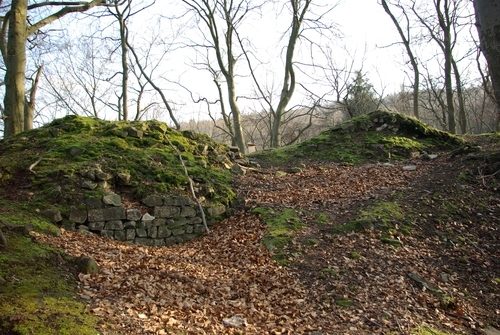
Hollende Castle (Ruin) (Warzenbach)

The remains of the Castle can be visited

Hollende Castle was a medieval castle between Warzenbach and Treisbach, districts of Wetter north of Marburg in Hesse. It was occasionally also referred to as Hohenlinden Castle.

The castle was built even before the first mention of the Gaugrafen Giso and stood on imperial property. The Gisonen were probably initially official or titular counts without allodial possessions, who, like a number of other noble freemen, were entrusted with territorial administration by the Ottonian and Salian emperors after the extinction of the Konradiner in Hesse. The Gisonen were initially particularly documented as vogts of the Wetter canonesses' convent. Their ancestral seat was on the Hollende, which was transferred to them as an imperial fief. In 1008, a first Count Giso in the Lahngau was mentioned. Giso I was also temporarily Count of Maden in the Hessengau and as such had his seat on the Obernburg in Gudensberg near Fritzlar in North Hesse.

In the summer of 1073, Giso II met his death at Hollende. He had played an inglorious role in a conspiracy against the Duke of Bavaria, Otto of Northeim, by having Otto accused of a planned murder of Emperor Henry IV by a hired false witness, Egeno of Konradsburg. Otto had subsequently been outlawed by Henry, deposed as duke, and dispossessed of his Saxon family estates. Otto did not forget, and when he rebelled against Henry for the second time in 1073, his followers invaded Hesse, conquered Hollende Castle, and killed Giso and his co-conspirator Adalbert of Schauenburg.

In 1118, during the dispute between Emperor Henry V and Archbishop Adalbert I of Mainz, Giso IV enfeoffed Hollende Castle, which had until then been imperial property, to the Archbishop and received it back from Mainz as a fief. After Giso's death in 1122, it thus finally fell to Electoral Mainz as an expired fief. From 1141-1170, the castle was held as a Mainz fief by Count Poppo I of Reichenbach († 1156) and then by his nephew Poppo II († 1170).

In 1247, after the death of Henry Raspe IV, the last Landgrave of Thuringia from the House of Ludowinger, disputes arose between Sophie of Brabant and the Mainz Archbishop Siegfried III of Eppstein over the recognition of Sophie's claims to inheritance for her underage son Henry to the landgravial possessions in Hesse. With Henry Raspe's death, many of these lands threatened to fall to Mainz. Sophie demanded these estates and had all castles besieged and destroyed whose lords refused to pay homage to her. In the following months, Hollende Castle and presumably also Weißenstein (approx. 1 km north of Wehrda) as well as Hohenfels Castle in 1247 and 1293 were razed to the ground by Sophie's troops.

Layout+

Hollende Castle had a rounded, rectangular wall 2 m thick and encompassed an area of 28 m x 22 m. Inside was a tower measuring 10 m x 7.5 m with a wall thickness of 2.5 m.

Take Mobile History with you

You are reading this text for free. Premium adds what matters on the road: descriptions read aloud, sites found through your camera, whole regions taken offline.

  • Every description, including the ~17,700 Premium sites
  • Audio guide: have descriptions read to you on location
  • AR finder: see sites through your camera, with distance and bearing
  • Unlimited saved sites

14 days free, then from €2.99 a month. Cancel anytime.

Source: Wikipedia · Licence: CC BY-SA 4.0

This description draws on the facts documented in the linked Wikipedia article; Wikipedia content is licensed under CC BY-SA 4.0. Wording and editing: Mobile History.

Location: 50.9011, 8.6155