RuinHossingen

Hossingen Castle (Ruin)

Hossingen Castle (Ruin)

The remains of the Castle can be visited

Hossingen Castle, also known as Hossenburg, is a castle ruin on a spur in the valley (local dialect short form: Burtel) 750 meters southwest (Swabian Alb road to Unterdigisheim) of the church of Hossingen, a district of Meßstetten in the Zollernalbkreis in Baden-Württemberg. The area now belongs to the municipality of Meßstetten.

Description+

The castle complex was a spur castle with a core castle and presumably a residential tower, as well as an outer bailey measuring approximately 9 by 27 meters. Behind the two castles stood the barns of the manor farm. Few wall remnants and two neck ditches remain of the complex. The barrier systems on the right side of the valley are still completely preserved, with the exception of the watchtower. The hilltop castle was built in the first half of the 12th century.

The original owners of the castle were probably the Hossen, one of whom, Albert, can be traced in Heinstetten in 1296 and 1306. Other experts see Hosse as a given name of the Heinstetten nobility. In the 14th century, the castle belonged to the County of Hohenberg. In 1345 and 1347, it was sold with Hossingen, Tieringen, and Meßstetten to Heinrich von Tierberg. The owners were the Haiterbach line of the Lords of Tierberg. In 1418, it was sold to Württemberg. On medieval construction sites, there were no transport costs for the lord of the castle. In a preserved ledger from 1560, the lords of the castle had boards from the sawmill and building materials transported free of charge to Schalksburg by their subjects in Hossingen, Oberdigisheim, Meßstetten, and other places. Even the dogs kept in Hossingen Castle did not have to be fed by their owners. Meßstetten, Hossingen, and Tieringen supplied feed oats as a substitute for the duty to feed the castle lords' dogs. In 1565, a castle path from Meßstetten was mentioned.

Garrison by conscripted Hossingen citizens

According to the muster roll from 1521, the Hossingen militia soldiers were responsible for securing the castle. Further barriers in the Meßstetten urban area are located at Bschorner Weg (military training area at Kählesbühl), Tobelsteige (towards Laufen), Rottweiler Weg (Lochenpass at the hiking car park), and Eschental (Unterdigisheim). The names of the mounted soldiers are preserved: Ulrich Eppler (armed with a long spear), Melchior Wizemann (armed with a hook gun), Martin Eppler jun. (armed with a hook gun), Martin Eppler sen. (armed with a spear), Conrad Schweitzer (armed with a spear), Jakob Schweitzer (armed with a hook gun). Further names from later lists: Baltes Fraider Vogt (armed with a halberd), Hans Wizemann (armed with a hand cannon), Jakob Fink, the watchman Kiefer (armed with a long spear), Balle Müller (armed with a hook gun), Müller Michael, Martin Gurnern (armed with a hook gun), Jörg Kiefer (armor, armed with a long spear), Claus Eppler (armor, armed with a long spear), Conrad Fink, Braisch Johannes (substitute for Nikolaus Eppler), Hauser Nikolaus (substitute for Martin Kummer). Leadership positions in the Württemberg Landwehr were held locally by Captain Walter Ruckenbrot from Balingen, Lieutenant Hans Tüffel from Tuttlingen, and Ensign Albrecht Kupferschmid from Tuttlingen. Hans Butz from Balingen worked as a barber-surgeon. After participating in the Peasants' War of 1525, Hans Wizemann and Martin Eppler, imprisoned in Balingen Tower, were forbidden to carry weapons. Only a bread knife with a broken tip was allowed. The largest castle complex in the Meßstetten urban area certainly served as a retreat for the Württemberg soldiers of the outposts. In Hossingen, Unterdigisheim, and Meßstetten, soldiers practiced on shooting ranges on Sundays. The saltpeter for gunpowder was produced by saltpeter boilers such as Johannes Ammann from Tailfingen and Johannes Schempp (salt boiler's son, local dialect short form Salvaiter) in Meßstetten.

The tax list of 1525 shows four farmsteads for Hossingen. Another farm belonged to the Holy in Meßstetten. The farmhands lived in this area in single-story Seldner houses, lined up like a town, with a courtyard gate on small allocated wasteland plots. In Oberdigisheim, it was called Armeleuteviertel in Frommern Granitz. Later, extended Seldner houses were preserved on the Eichhalde and in Talstraße. Thus, the town of Wangen mentioned in the legend could go back to the actually existing Seldner houses of seasonal workers, small craftsmen, and farmhands from the castle's manor farm.

Water supply

The castle complex was supplied with water by means of barrels from the valley. A wooden pipeline (Deichel) has not yet been found. There are several springs within a radius of 700 meters. Rainwater was collected in a cistern. In the castle kitchen, sulfurous spring water was often used for preparing legumes (peas, beans, lentils). Waters largely identical to today's Tuttlingen (Fluorine 0.61; Calcium 222; Magnesium 48.7: Sulfate 577: Bicarbonate 211), Balingen, and Haigerloch mineral waters were used in the castle kitchen from artesian springs in Oberdigisheim (hamlet Geyerbad) and Nusplingen (Wildbad, Mayenbad).

Agriculture

The lords of the castle practiced arable farming and animal husbandry. The cheese production attested and widespread around Schalksburg is related to the presumed Welsh settlement there in the 8th and 9th centuries. Lautlingen cheese enjoyed a certain fame. One third of the arable land always lay fallow and was used as pasture. In the following year, oats, barley, rye, hemp, flax, lentils, and peas were cultivated in addition to emmer and spelt. Rock flour from unburnt gypsum was used as fertilizer. In addition to rather stony arable land, there are also very fertile soils locally. Due to the altitude, cold air can only accumulate on the arable land at Michelfeld and in the valley. Good revenues were achieved from sales in Rottweil, Tuttlingen, Schaffhausen, and Zurich. The markets in Ebingen, Nusplingen, and Mühlheim were only of local importance compared to Zurich and were not capable of absorbing such large quantities, as can be seen from the Duke Eberhard II's list of tributes.

Castle Chapel

The castle chapel, like the Hossingen St. Nicholas Chapel first mentioned in 1404, belonged to the Martin's Church in Ebingen. The cemetery where the castle residents were buried was also located there. In 1275, Heinrich von Tieringen served as pastor. From 1337, one of the controversial religious documents, an indulgence letter from Avignon, has been preserved: whoever participates in the altar patronage in the Wolfgang Chapel on the neighboring Altentierberg Castle shall, according to Bishop Paulus Fluginens, receive a 40-day indulgence for their sins.

Reformation in the vicinity of the castle

As early as 1517, Pastor Dieter Rieber preached in Benzingen about the ineffective indulgence trade. Especially during the Austrian foreign rule (1519–1534), the Reformation was suppressed with brutal punishments. In 1524, the Duke of Württemberg committed to the Reformation. The Freiburg physician Johannes Murer preached locally in peasant clothing as Karsthans the priesthood of all believers. He was arrested in Balingen in 1523 and later executed. The pastor of Oberdigisheim traveled from village to village and called on the population to revolt against the government. A crowd of 1600 people gathered. In 1525, the Meßstetten chaplain German Kopp was expelled from the country. The County of Hohenberg is considered a stronghold of the Anabaptist movement. In 1527, Anabaptists were burned as arch-heretics in Rottenburg and in 1530 in Tübingen.

Below Hossingen Castle, the village of Ensisheim is also said to have been burned down because of the Anabaptists. Only the mill remained on the cycle path before Bärenthal. The Mennonites refer to this Anabaptist movement; Michael Sattler, imprisoned in Binsdorf and later executed, is considered a co-founder of this free church.

Strategic importance of Hossingen Castle

In the run-up to the Thirty Years' War, the castle and the rampart on the right side of the valley, which is still completely preserved today, were expanded into a barrier system close behind the southern border. The troops, already assigned in peacetime since 1521, had the task of securing the strategically important crossings of the Seestraße from Lake Constance via Fridingen, the Reichsstraße, local dialect in Kolbingen: free road, from Mühlheim and Tuttlingen (spelling at the time: verhütten).

In the War of the Spanish Succession, Imperial Field Marshal Duke Eberhard Ludwig, Field Marshal von Thüngen, and Prince Meinrad II of Hohenzollern-Sigmaringen decided to reinforce the defenses at Hossingen Castle with spoil from nearby iron ore mining sites and integrate them into a modern, continuous line of defense. From Lake Constance via Friedingen, the Bäratal to the Lochen, via the Lautlingen and Tannheim valleys to the Zollersteig, then via the Killertal to the Talheim Steig and further east. In April 1704, the entrenchment work was completed.

The Escort

To protect against predatory attacks and wild animals, the escort was established as a royal prerogative. In 1456, the Ebingen Vogt, on behalf of the Count of Württemberg, granted escort to the cities of Constance, Überlingen, Lindau, and Pfullendorf. To Rottweil in 1475, up to the stone bridge near the mill in Rottweil's old town. A letter from 1560 indicates that Jewish merchants used the road "hefftig und vill" (heavily and often).

The Testament of a Cologne Archbishop

On November 5, 1632, Colonel Hans Michael Rau occupied the adjacent Truchsess-Waldburg territory with Nusplingen to enforce a will by military means. On December 4, 1577, the Nusplingen Truchsess Gebhard von Waldburg was elected Archbishop of Cologne. In 1582, the Archbishop of Cologne converted to the Reformation and married Agnes von Mansfeld. According to Württemberg's legal interpretation, Nusplingen was bequeathed to the Württemberg Duke in a valid will.

The pond below the castle

The defense of Württemberg's southern border was facilitated by a pond dammed with a Klauser dam, called "Weiherle" in the local dialect. According to oral tradition, the water power was used by the water wheel of the sawmill below the castle in the Sägental.

Mining near the castle

Mining was carried out in the area. In addition to open-pit mining up to 15 meters deep, mining tunnels were also driven. Some tunnels followed clay fissures and caves. Others followed ore seams, which often occur in dry valleys. The iron ore extracted was smelted with charcoal into wrought iron and spring steel. Almost all firearms forged in Baden-Württemberg were still manufactured at the beginning of industrial rifle production in Oberndorf from high-quality steel from the Harras, Ludwigsthal, and Thiergarten smelters. Fidel Eppler worked locally as an ore supervisor. The wooden buckets holding 108 liters of bean ore were compensated with 14 Kreuzer. A particularly common trade was the freight business. In addition to horses for ore transport, others were kept in Meßstetten for trips to Switzerland. Ferdinand von Steinbeis succeeded in optimizing the blast furnace process in Ludwigsthal. The pointed props were, for example, bought in Tailfingen and installed by Lautlingen miners at the Hörnle. The pointing common in the Middle Ages prevented the props from snapping under overload. An impending failure was indicated by a growing beard at the tip. Thus, the secret passage in the orally transmitted legend is probably based on actually existing bean ore tunnels.

Battlefields near the castle

Peasants' War 1525: Right at the beginning of the year, the rebels plundered Schalksburg. The emblem of the peasants around Balingen was a black and red flag with a white cross. According to oral tradition, Hossingen Castle was damaged in the Peasants' War.

On February 15, 1632, at midnight, there were fights and looting by imperial cavalry under the chief bailiff of Gutenstein. Several Meßstetten citizens were fatally wounded. On May 20, 1634, and April 30, 1635, there were also deaths to mourn in Meßstetten. In 1633, there were battles in Mühlheim and Nusplingen. Truchsess Wilhelm Heinrich reports how on October 16, 1633, Swedish and Württemberg troops passing Hossingen Castle towards Unterdigisheim plundered, robbed, and burned down Nusplingen. Everything except two small houses in the town and one church, along with three more houses in the suburb, was reduced to ashes, a pitiful sight. After the lost Battle of Nördlingen, the Duke fled to Montbéliard. In 1635, Meßstetten was given to Count Heinrich von Schlick. Thus, Meßstetten had a new lord for 13 years. On January 29, 1641, 20,000 thalers were captured in an attack by the Hohentwielers on Balingen. Konrad Widerhold and his victorious team stopped at the Gasthaus zum Adler in Tuttlingen.

In 1643, the Bavarian Colonel Kreuz came from Tuttlingen via the Reichsstraße past the castle and wanted to spend the night in Ebingen. General Erlach put him to flight and destroyed the Ebingen city fortifications. After a surprise attack on Tuttlingen on November 24, 1643, Bavarian troops captured numerous French cannons. About 600 men secured the area around Tuttlingen with them and built palisades and ramparts. In 1645, Konrad Widerhold attacked Tuttlingen and the surrounding area. The last remaining Württemberg combat troops, stationed at Hohentwiel Fortress, had orders to destroy all palisades, city gates, and barriers. Württemberg troops reached the Ebingen suburb via Hossingen Castle. In the course of the war, the complex was completely razed.

By April 1704, palisades and ramparts near the castle were reinforced to secure Württemberg's southern border in the War of the Spanish Succession. The Bavarian-French army could not be stopped by the defense line and marched into Tuttlingen on May 11, 1704.

Legends+

"City of Wangen"

Legendary memories are known of vanished places.

A city called Wangen is said to have disappeared between Hossingen and Meßstetten. Excavated clay deposits in this area bear witness to artisanal production.

"White Rider and Castle Garden"

An old legend tells of a white rider, visible at certain times, who is on his way to his garden at Leuzenfelder Wasen. The painter Franz Karl Basler-Kopp is better known.

"The Castle Ghost"

Children who don't want to sleep at night are threatened not only with night ravens (local dialect "Nachtkrappen"), which actually fly to their sleeping places in the Krappenhalde near the smuggler's cave in the Lautlingen valley, but also with the "castle ghost Burteless". The Black Verri, a robber captain who was called away shortly after his conviction in Biberach Tower during a lightning strike, is also known as a child scare. "The Burteless is coming to get you!". Since 2012, the castle ghost has been a carved artwork in a tree stump next to the hiking trail to the main castle.

"Secret passage to the castle garden"

A secret passage is said to lead to Leuzenfelder Wasen. There is a pleasure garden there.

Scientific Excavations+

In 1916, excavations took place with castle researcher Konrad Albert Koch. The walls, up to 2 meters high, were recorded with the deviations customary at the time. To preserve the ruin, the wall remnants were completely covered with earth. Konrad Albert Koch succeeded in a complete drawn reconstruction of the complex.

From 2008, the measurements were repeated and digitized with significantly higher accuracy by a team led by castle researcher Häring. A 3D CAD simulation of the left part of the multi-part castle complex can be viewed on an information board below the castle complex.

Tourist information for a hiking trail around the castle+

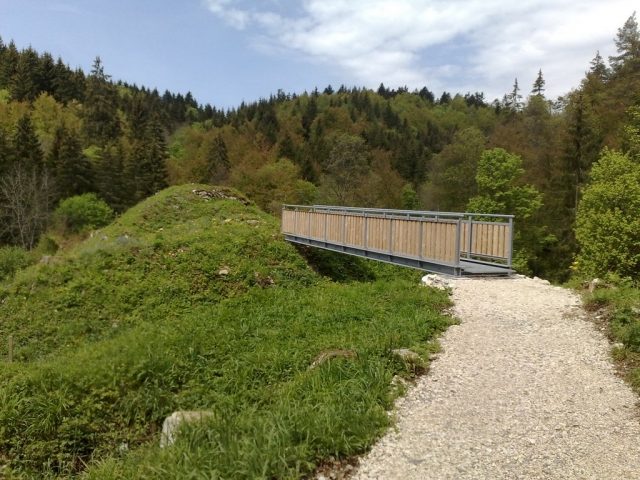
In 2011, the Swabian Alb Association, Hossingen local group, built a new drawbridge and a hiking trail to the outer bailey. After all wooden bridges on the cycle path in the Upper Danube Nature Park had to be renewed for safety reasons, a hot-dip galvanized steel bridge with weather-resistant larch wood railings was built. The design common in the Middle Ages with smooth planks and no railings is no longer permitted throughout Europe today. The bridge can be easily crossed by wheelchair users and seniors with rollators. A steep path, designed for athletic hikers, leads through another ditch to the area of the former main tower. New texts for an information board are currently being prepared by castle researcher Häring and the State Office for Monument Preservation. All hiking trails in Meßstetten are being digitized and can later be downloaded from the internet at the 18 information boards of the city of Meßstetten. UTM coordinates are located on the posts of every signpost to rescue injured hikers. From Albstadt train station, Lautlingen or Laufen stop, the castle can be hiked via the Hossinger Leiter-Heimatmuseum Hossingen. The signage of the hiking trails in Meßstetten and Nusplingen is currently being completely renewed. With new yellow signposts, the premium hiking trail to the castle will be signposted and certified in 2013. Tree trunks made of weather-resistant Douglas fir wood or hornbeams planted according to the course of the walls are intended to represent the outlines of the castle and the manor farm in the future. Farms emerged after the advent of hilltop castles as associated manor farms. It is planned to rebuild part of the castle as a shelter.

Take Mobile History with you

You are reading this text for free. Premium adds what matters on the road: descriptions read aloud, sites found through your camera, whole regions taken offline.

  • Every description, including the ~17,700 Premium sites
  • Audio guide: have descriptions read to you on location
  • AR finder: see sites through your camera, with distance and bearing
  • Unlimited saved sites

14 days free, then from €2.99 a month. Cancel anytime.

Source: Wikipedia · Licence: CC BY-SA 4.0

This description draws on the facts documented in the linked Wikipedia article; Wikipedia content is licensed under CC BY-SA 4.0. Wording and editing: Mobile History.

Location: 48.1837, 8.9206