The remains of the Castle can be visited
Innerjuvalt Castle (Ruin) (Rothenbrunnen)
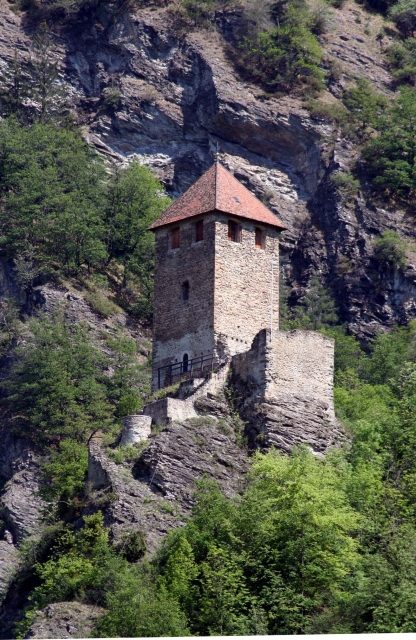
Innerjuvalt (often mistakenly referred to as Ober- or Hochjuvalt) is the younger of the two castles in the municipality of Rothenbrunnen in the Swiss canton of Graubünden. The name derives from "Jugum altum" (= high yoke).
Innerjuvalt Castle is located east above the village on a rock at the entrance to the Domleschg valley and can be reached via a steep narrow path through the forest in approximately 30 minutes.
The Innerjuvalt complex, like the neighboring Hochjuvalt Castle, is divided into a lower and an upper castle. In the lower castle, of which a wall remnant approximately 20 meters long and four meters high is still preserved, there were several residential and utility buildings.
On the upper castle, a two-story palas and a southern outbuilding were first erected by the Lords of Juvalt around 1250 on artificially leveled rock ground, then the three-story main tower with a high entrance and the southern palas were built. An outer ring enclosed a cistern and a bakery below the castle. Two helmets from the 15th century were found in the rubble of the cistern.
In a third construction phase in the late 15th century, the tower was raised by one story and provided with a defensive gallery on the east and north.
Innerjuvalt was probably built around 1250 by the Lords of Juvalt. In 1342, a court settled a dispute between the brothers Albrecht and Bertram von Juvalt at Hochjuvalt. In exchange for an annuity until his death, Bertram ceded the castle with people and goods to his brother. Hochjuvalt Castle with its associated part of the lordship was sold by Eglolf I von Juvalt to Rietberg. Johann von Rietberg, shortly before his death, gifted his castle Rietberg and Hochjuvalt to his uncles from Landenberg. They soon after sold Hochjuvalt Castle with all its rights to the Bishop of Chur for 2500 or 3500 guilders. In the second half of the 14th century, the castle appears several times in documents. According to the Domleschg Federal Letter of 1423, several nobles had to make their castles available to the confederation, including Rudolf II with the "vesty der inder Jufalt".
From the middle of the 15th century, the von Juvalt family seemed to have lived in a farm at the foot of the mountain. In 1462, the castle was sold by Elisabeth von Juvalt, née von Heidelberg, widow of Rudolf II, the last of Inderjuvalt, for 500 Rhenish gold guilders to her son-in-law Junker Pedrutt von Wannis (...the mountain castle... item house and courtyard located below the same castle Juvalt, and also the surrounding area located nearby and through which the main road passes). Around 1500, Hochjuvalt was probably abandoned, and around 1550 it was mentioned as a ruin. In recent decades, the castle has been excavated and restored by archaeologist Felix Nöthiger.
The owner of both Rothenbrunnen castles is the Domleschg Castle Association. The habitable tower with its coat of arms paintings can be rented for private events during the summer half-year. On August 1st, it is open to the public.
Take Mobile History with you
You are reading this text for free. Premium adds what matters on the road: descriptions read aloud, sites found through your camera, whole regions taken offline.
- Every description, including the ~17,700 Premium sites
- Audio guide: have descriptions read to you on location
- AR finder: see sites through your camera, with distance and bearing
- Unlimited saved sites
14 days free, then from €2.99 a month. Cancel anytime.
Source: Wikipedia · Licence: CC BY-SA 4.0
This description draws on the facts documented in the linked Wikipedia article; Wikipedia content is licensed under CC BY-SA 4.0. Wording and editing: Mobile History.
Location: 46.7683, 9.4316