MonasteryGensungen

Eppenberg Abbey (Ruin) (Gensungen)
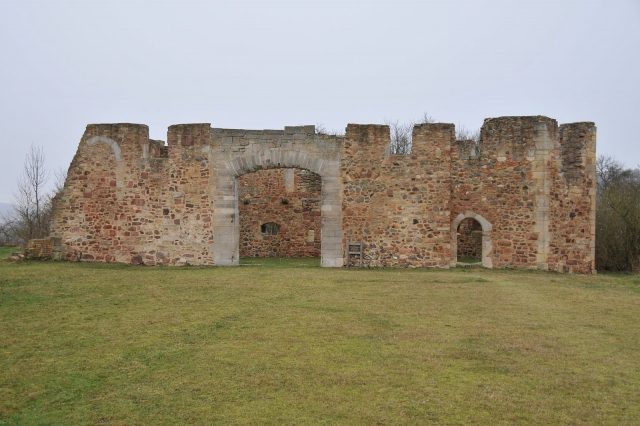
Eppenberg Abbey (Ruin) (Gensungen)

The Ruin can be visited

The Carthusian Monastery of Eppenberg is a monastery ruin near Gensungen, a district of the city of Felsberg in North Hesse, which is still called "Kartause" (Carthusian Monastery) today after the Carthusian monks who last lived in Eppenberg Monastery. The Mittelhof state domain is located nearby.

Around 1217, the nuns of the Premonstratensian monastery of Ahnaberg near Kassel received permission to build a monastery on the Eppenberg, on the slope of the Heiligenberg. On March 3, 1219, Archbishop Siegfried II of Mainz confirmed the founding of Eppenberg Monastery and took it under his protection. The number of choir nuns in Ahnaberg was set at 40, and the excess choir nuns went to Eppenberg, where they founded the new convent as a filial monastery of Ahnaberg Abbey.

However, the relationship with the mother house was obviously not always without problems. In 1223, the provost and convent of Ahnaberg emphasized their rights in Eppenberg. On February 17, 1224, Archbishop Siegfried again confirmed the prerogatives of Ahnaberg Monastery. But in 1250, the prioress of Eppenberg openly refused the prerogatives of Ahnaberg Abbey, for reasons no longer known today, and Eppenberg became an independent collegiate monastery, though like Ahnaberg, under the patronage of Spieskappel Abbey. It soon flourished, mainly through donations and the acquisition of land in the nearby villages of Altenbrunslar, Bödiger, Besse, and Gensungen. In 1269, the founding of the Premonstratensian convent of St. Georg in Homberg an der Efze originated from Provost Arnold of Eppenberg. However, the growing prosperity subsequently led to a decline in morals and discipline and finally to extravagance, mismanagement, and economic decline.

Carthusian Monastery of St. Johannis+

Landgrave Ludwig I complained bitterly about the conditions in the monastery, the dilapidated possessions and buildings, and the forgotten discipline, order, and good conduct. At his instigation, the abbey was dissolved by Papal Bull in 1438 and converted into a Carthusian monastery by monks from Erfurt, who moved in in 1440. The monastery was named "St. Johannis" and was extensively expanded and rebuilt. In 1471, Landgrave Ludwig II donated the Wimmenhof (today Mittelhof domain) and the nearby, half-ruined Heiligenberg Castle to the monastery, only stipulating that the monks should pray weekly for his salvation in the castle chapel.

Secularization+

In 1527, after the Homberg Synod of 1526, which introduced the Reformation in Hesse, the monastery was dissolved and used by Landgrave Philipp I as a hunting lodge and estate. Around 1610, Landgrave Moritz had the hunting lodge rebuilt in the style of Italian Renaissance castles. The buildings and lands were managed jointly with the nearby Mittelhof. During the Thirty Years' War, the complex was destroyed, then converted into an outwork and sheep farm of the Mittelhof state domain. In the Seven Years' War (1756-63), French troops entrenched themselves for seven weeks on the monastery hill after the lost battle of Grebenstein; two redoubts on the slope of the Heiligenberg still commemorate their camp.

Current Use+

In 1957, the main building was struck by lightning and burned down to its walls. The buildings and the monastery church increasingly fell into disrepair until the Felsberg District Beekeepers' Association took over the restoration and maintenance of the complex from 1984 onwards. A remarkable beekeeping museum was created in the former gatehouse of the monastery. Of the monastery itself, only the ruins of the monastery church remain today.

The area around the Carthusian monastery and the ruins themselves were placed under nature protection in December 1988.

Take Mobile History with you

You are reading this text for free. Premium adds what matters on the road: descriptions read aloud, sites found through your camera, whole regions taken offline.

  • Every description, including the ~17,700 Premium sites
  • Audio guide: have descriptions read to you on location
  • AR finder: see sites through your camera, with distance and bearing
  • Unlimited saved sites

14 days free, then from €2.99 a month. Cancel anytime.

Source: Wikipedia · Licence: CC BY-SA 4.0

This description draws on the facts documented in the linked Wikipedia article; Wikipedia content is licensed under CC BY-SA 4.0. Wording and editing: Mobile History.

Location: 51.1441, 9.4642