RuinBattenberg

Kellerburg Castle (Ruin) (Battenberg)
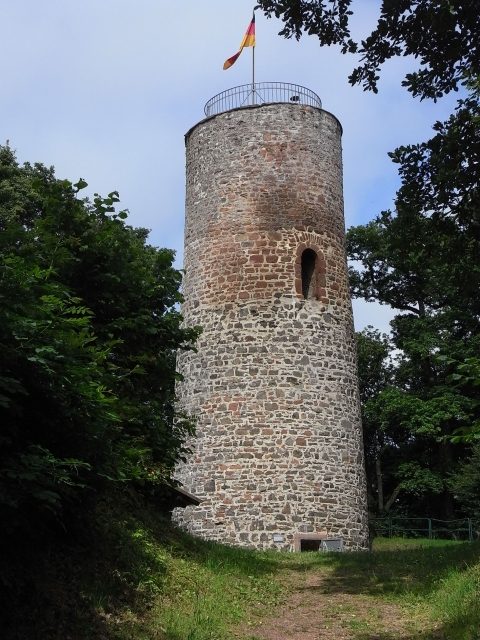
Kellerburg Castle (Ruin) (Battenberg)

The remains of the Castle can be visited

The Kellerburg is a castle ruin on the 464 m high Burgberg (castle hill) in the northern urban area of Battenberg in the district of Waldeck-Frankenberg in Hesse.

The castle was built in the early years of the 13th century by the Counts of Battenberg, probably during the reign of Count Werner I of Battenberg and Wittgenstein or his son Widekind I (Widukind), who ruled until 1238. After its completion, Widukind moved from the old count's castle on the high valley edge of Battenberg (in today's rectory) to the Kellerburg.

Due to the location of their comparatively small county in the border area between competing more powerful lordships, the Archbishopric of Mainz and the Thuringian-Hessian Landgraviate of the Ludowinger, the Battenberg counts were forced to cautiously and opportunistically maneuver between the two and lean more towards one side or the other depending on the situation to secure their own survival. Thus, Widekind I and Hermann of Battenberg, who had previously been dependent on Mainz, already in 1227 or 1228, under pressure, enfeoffed the castle (or at least one half of it) to Landgrave Heinrich Raspe and received it back from him as a fief; at the same time, they became landgravial burgmannen in Marburg. Around the same time (1228), however, initial negotiations also took place with Archbishop Siegfried II of Mainz regarding a possible sale of the castle (or its other half) to the Archbishopric. In 1234, renewed negotiations on this matter took place. A corresponding contract of April 9, 1234, according to which Widekind I committed to sell half of the castles of Battenberg and Kellerburg and the associated town of Battenberg and county "Stiffe" ("Stift") for 600 marks to Mainz, evidently did not come into force and was probably merely the result of preliminary negotiations. Widekind emphasized the consent of his brother Hermann and his son and promised to obtain the consent of Hermann's wife and daughters after Hermann's death, but the situation was not so simple, not only because the Kellerburg was a fief of the Landgrave, but also because the succession in Battenberg was linked to the condition that Siegfried I of Wittgenstein also became a Mainz vassal.

Only in July 1238, after the county had been divided between Widukind's sons into the counties of Wittgenstein and Battenberg, was this sale to Archbishop Siegfried III carried out by the brothers Widekind II and Werner III of Battenberg and their brother Siegfried I of Wittgenstein, with the Battenbergers and the Wittgensteiner each selling their half to the Archbishop. The sale had been delayed because one half of the castle belonged to Siegfried of Wittgenstein and because the Lords of Merenberg could also assert hereditary claims to the castle. Furthermore, one half of the castle had been a fief of the Landgrave since 1227/28, and the Battenbergers, with the planned sale, at least partially violated their agreements made with the Landgrave in 1228. (He had considerable leverage, not least because Konrad of Thuringia, Heinrich Raspe's brother and Ludowinger regent in their Hessian territories, had had a castle and a town built in 1233/34 on the Frankenberg, in the middle of the Battenberg county, on the border between the judicial districts of Röddenau and Geismar, to put a stop to Mainz's efforts for further territorial gain in this area.)

In 1291, Count Hermann († 1310) of Battenberg was forced by financial difficulties to sell parts of his county to the Archbishopric of Mainz: Battenberg Castle and town and the courts of Laisa, Battenfeld, and Münchhausen passed into Mainz possession. In return, Mainz returned his half of the Kellerburg to him, but reserved the right of pre-emption. In 1296, the last installment from the purchase agreement of 1291 was paid. Since the childless Hermann continued to be in financial distress and the extinction of his house was foreseeable, in 1297 – with the consent of his brother-in-law Heinrich IV of Waldeck and his wife Ida – he sold his remaining share of the Kellerburg and the lordship of Battenberg with all appurtenances for 2000 marks to Archbishop Gerhard II of Mainz. After Hermann's death in 1310, Mainz incorporated the small county and administered it as the Amt Battenberg.

Mainz needed money to finance its disputes with the Landgraves of Hesse, and already in 1303, Archbishop Gerhard II therefore pledged the Kellerburg and Battenberg Castle and town to his bailiff in Hesse and Eichsfeld, Count Otto I of Waldeck and his son Heinrich. After a dispute between Waldeck and Mainz, which culminated in the capture of Heinrich IV of Waldeck by Archbishop Peter of Aspelt, Heinrich IV returned the Kellerburg and Battenberg Castle and town, as well as Gieselwerder Castle, in 1308 against a corresponding payment.

In 1353, the Mainz cathedral provost and administrator Kuno II of Falkenstein pledged the Kellerburg and Battenberg Castle and town to the noble squires and brothers Konrad and Werner Milchling, who had actively supported him and Archbishop Heinrich III of Virneburg against Landgrave Heinrich II of Hesse. Already three years later, in 1356, Archbishop Gerlach of Nassau pledged the Kellerburg and Battenberg Castle and town to his brother, Count Johann I of Nassau-Weilburg. He sold the pledge further in 1364 to his nephew Otto II of Waldeck.

Whether and when the pledge was redeemed by Mainz is not known, but it seems not to have been the case. In 1463, the castle was abandoned as a residential complex and only used as a material store. In 1464, Archbishop Adolf II of Mainz pledged the Amt Battenberg (i.e., Kellerberg, Battenberg, Rosenthal, Melnau, and half of Wetter, along with appurtenances) and with it the Kellerburg to Landgrave Heinrich III of Upper Hesse for 30,000 guilders to raise funds to pay for the costs incurred during the Mainz Diocesan Feud of 1461/62. Heinrich, however, first had to redeem the castles of Battenberg and Kellerburg, which had already been pledged elsewhere (probably still to the Counts of Waldeck), for 22,000 guilders. Although the approximately 40 x 25 m large castle complex was still described as intact in the land register of the "Oberfürstentum" Marburg in 1577, it no longer had any actual function and fell into disrepair or was used as a quarry. The last remains of buildings, with the exception of the keep, were removed towards the end of the 19th century. The stones were used for building houses, walls, and roads in Battenberg.

Current State+

Today, only the 17-meter-high keep, restored as a viewing tower, remains of the surrounding wall and the moat can be seen on the Burgberg. The tower is open to visitors from April to September from morning until dusk. The ascent is via an internal staircase with 88 steps. From the viewing platform, there is a good panoramic view and, in good visibility conditions, a distant view as far as the Marburg Lahnberge, the Kahler Asten in the Rothaargebirge, and the Hoher Lohr in the Kellerwald.

Visitor Mine+

Since 2000, a former mine in the Burgberg has been accessible as a visitor mine. It is open from May to September on the first Sunday of each month from 2:00 PM to 5:00 PM by prior arrangement.

Take Mobile History with you

You are reading this text for free. Premium adds what matters on the road: descriptions read aloud, sites found through your camera, whole regions taken offline.

  • Every description, including the ~17,700 Premium sites
  • Audio guide: have descriptions read to you on location
  • AR finder: see sites through your camera, with distance and bearing
  • Unlimited saved sites

14 days free, then from €2.99 a month. Cancel anytime.

Source: Wikipedia · Licence: CC BY-SA 4.0

This description draws on the facts documented in the linked Wikipedia article; Wikipedia content is licensed under CC BY-SA 4.0. Wording and editing: Mobile History.

Location: 51.0159, 8.6383